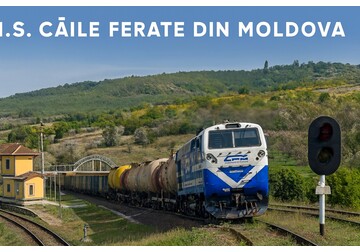
Following the reorganization of Moldova’s state-owned enterprise “Moldova Railway” (CFM), a joint-stock company “Moldova Railway – Cargo and Passenger Transportation” will be created with 100% state capital
Roman Cojuhari, Director of the Public Property Agency, noted that CFM is a difficult legacy, with huge debts and staff that are not adapted to modern realities. According to him, steps that had been postponed for decades have been taken in recent years, with the state-owned CFM beginning to pay off its debts and halting their constant growth. Roman Cojuhari emphasized that the main goal of the steps currently being taken by the government is to separate infrastructure and commercial services. In particular, the state will support the infrastructure, and a new joint-stock company created for transport services will be responsible for the transportation of goods and passengers. The state will own 100% of the capital of the new joint-stock company. The separation of infrastructure management and transport operations will allow for accurate accounting of costs and revenues from rail transport, which will enable the state to correctly assess economic efficiency. At the same time, the burden on the state budget will be reduced, resources will be more effectively directed to passenger transport, which plays a social role, and investment in services will increase. Separate management will improve service quality and reduce travel time. In the medium term, costs will be managed more efficiently, leading to stable tariffs. Roman Cojuhari emphasized that the reorganization of Moldova Railway does not mean its privatization. The state remains the owner of the railway infrastructure – tracks, stations, land, and structures – under the management of the state-owned enterprise Moldovan Railways. The joint-stock company “Moldova Railway – Cargo and Passenger Transportation” will manage trains, carriages, and passenger and freight transport. The goal of the reorganization is to create a more economically and administratively efficient structure that will contribute to the development of railway infrastructure in Moldova and improve the quality of transport services. The reorganization of Moldova Railway, as a comprehensive process, will create the conditions for the introduction of modern technologies for monitoring and maintaining the railway, which will reduce operating costs and increase the reliability of services, thereby contributing to increased revenues and attracting new market segments. The modernization of carriages and stations, improved comfort, and the introduction of modern passenger information systems can attract more users to rail transport. Given the urgency of the projects, their success largely depends on the degree of synergy between internal and external stakeholders, as well as on the speed of completion of the necessary administrative and legal steps to enable the start of restoration work as soon as possible. The reorganization of CFM can be seen as a necessity to ensure a more efficient, modern and competitive railway network. To integrate into the European railway network, CFM will cooperate with other regulatory authorities and railway operators in the region and the European Union. The reorganization of CFM is part of the commitments made to development partners (the EU, the EBRD, and the IMF). Given that CFM is a strategic operator in the country's transport infrastructure and that any delay in its reorganization could have a negative impact on passenger and freight transport, the decision to establish JSC “Moldova Railway – Cargo and Passenger Transportation” with 100% state capital will come into force on the date of its publication in Monitorul Oficial (the Official Journal of Moldova). Immediate entry into force will allow the authorities to quickly initiate reorganization measures: determining a new structure, transferring assets/personnel, amending the charter, etc. As noted by the government, in 2022–2024, the financial situation of CFM deteriorated sharply: from a net profit of 62.1 million lei in 2022, due to the regional situation, it reached an alarming loss of 322.6 million lei in 2024. This dramatic transformation highlights not only the lack of management efficiency, but also an outdated operational structure that is unable to adapt to current economic conditions. Consistently negative return on equity (ROE) and return on assets (ROA) indicate inefficient use of state resources managed by the company in its current form and a systemic inability to create added value and contribute to the competitiveness of the national economy. In 2020, the company incurred a net loss of 215.9 million lei, and in 2021, the loss temporarily decreased to 61.6 million lei, but without any measures being taken for structural recovery. In 2022, the regional geopolitical situation led to a net profit of 62.1 million lei against a backdrop of sharp growth in sales revenue to more than 1.28 billion lei. However, the lack of fundamental internal reforms led to a renewed decline, with losses of 143.9 million lei in 2023 and 322.6 million lei in 2024 – the largest loss in the last five years. At the same time, the level of debt increased significantly, parallel to a decrease in financial autonomy. This imbalance indicates chronic financial vulnerability and a dangerous dependence on state funds. The situation is exacerbated by the fact that in 2024, the cost of sales (897.9 million lei) significantly exceeded revenue (635.1 million lei), resulting in a negative gross profit of -41%, which is a clear expression of the current structure's inability to support its core activities. The situation is not limited to 2024; it was similar in previous years. Although sales revenue fluctuated significantly, from 599 million lei in 2020 to a maximum of 1.28 billion lei in 2022 and a minimum of 635 million lei in 2024, the cost of sales consistently exceeded revenue, with the exception of 2022. In 2024, the cost of sales amounted to 897.9 million lei, resulting in a gross loss of 262.7 million lei and a negative gross profit of −41%. The situation is not exceptional and has been repeated in previous years: the gross loss amounted to −86.8 million lei in 2020 and −31.7 million lei in 2021. // 04.02.2026 — InfoMarket