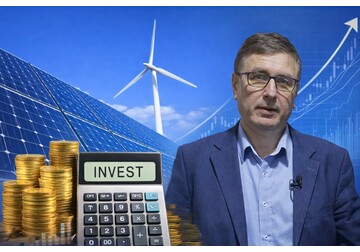
Moldova is becoming an exporter of renewable energy, and the main challenge now is energy storage - Veaceslav Ioniță
In his weekly program, the economic policy expert at IDIS Viitorul noted that Moldova has reached a turning point in the energy market following the accelerated growth in electricity production from renewable sources in recent years. “Starting from virtually zero production, the share of electricity from renewable sources in Moldova has grown to 30%. Since March 2026, Moldova has begun exporting renewable energy on a daily basis for the first time and has become an exporter,” the expert noted. According to the data presented, the volume of “green” electricity produced and sold grew from 60 million kWh in 2018 to over 1 billion kWh in 2025, and on an annualized basis, reached 1.2 billion kWh by the end of the first quarter of 2026. This figure has increased 15-fold over the past five years. Citizens who have installed solar panels for their own consumption provide another 5% of the country’s electricity consumption. As noted by Veaceslav Ioniță, for the first time, renewable electricity production in Moldova has exceeded the output of combined heat and power plants. Solar energy dominates the renewable energy mix (62%), followed by wind (32%), hydropower (5%), and biogas (1%). At the same time, the rapid growth in generation has led to a new problem: during the day, Moldova produces more electricity than it consumes, and due to a lack of storage capacity, the surplus must be exported, often at low prices. Thus, to purchase 1 kWh of electricity in the evening or morning hours, the country sometimes has to export 4–5 kWh of daytime “green” energy. In this context, as the expert emphasized, the investment focus is shifting from expanding generation capacity to developing energy storage systems. While renewable energy production capacity in Moldova stood at 41 MW in 2015, by the first quarter of 2026 it had exceeded 1,000 MW, a 25-fold increase. In 2025, four times as many photovoltaic panels were installed as in previous years, and new production capacity in a single year equaled all previous investments in this sector. According to Veaceslav Ioniță, commercial banks and authorities have already begun to make financing and construction permits for new solar parks contingent on the availability of energy storage capacity. The elimination of import duties on energy storage equipment is also under discussion, new industry standards are being developed, and the government intends to stop issuing permits for the installation of photovoltaic panels without integrated energy storage solutions. According to the expert’s estimates, installed storage capacity could grow from 15–16 MW/h in 2025 to 230 MW/h in 2026 and reach 2,000 MW/h by 2030. Veaceslav Ioniță also noted that the private sector has already invested approximately 900 million euros in the development of renewable energy, which has created an unprecedented energy surplus and transformed the structure of the electricity market. The expert believes that in the coming decades, Moldova will gradually transition to consuming electricity generated from renewable sources and improve its storage infrastructure, which will fundamentally change consumer behavior and strengthen the country’s energy security. He also noted that 35 years after gaining independence, Moldova launched an electricity exchange, which is an important step toward developing a modern and competitive energy market. // 29.05.2026 — InfoMarket