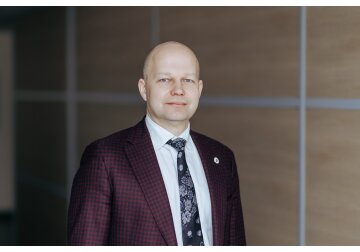
Tarmo SILD: Energbank has been profitable ever since it came under the ownership of Iute Group
Interview by InfoMarket
In early 2022, the international financial company Iute Group acquired Moldova’s Energbank. For Iute, this marked its first foray into the banking market. Over the past four years, the bank has been notable for having had 3 Chairpersons of the Executive Board approved by the regulator. In late 2025, the National Bank of Moldova (NBM) fined Energbank 3.13 million lei (which represents 0.4% of own funds calculated as of October 31, 2025) for inefficient management of risks in the IT and cybersecurity domain, and internal control systems.
The editor-in-chief of InfoMarket asked Mr. Tarmo Sild, co-owner of the Iute Group, to discuss what has happened and is happening at Energbank. But another event set the tone for the conversation: this year, the Iute Group acquired a second bank—RWS Bank, this time in Ukraine. Under the new name IuteBank, it began operations in the neighboring country in mid-March 2026.
For reference. In 2025, Ukraine’s RWS Bank was declared insolvent and placed under the management of the Deposit Guarantee Fund. The Fund, in turn, established a bridge bank (temporary bank), transferred customer deposits and net assets there, and put assets valued at 4 million euros up for sale. Iute Group won the investment tender. For €120,000, it acquired a banking license, a portion of low-risk assets, and deposits from nearly 13,000 customers, with no non-performing loans.
InfoMarket: Congratulations on the bank’s launch in Ukraine. As I understand it, this is a somewhat risky investment; however, there were certain risks involved when you purchased Energbank as well. How do you assess the risks of acquiring Energbank several years ago and the risks you will face in Ukraine?
Tarmo SILD: First, there is a geopolitical risk: Ukraine is at war. The second major difference is, of course, the size of the country and cultural differences. In 2008, when we started our business in Moldova, one could argue that Moldova was still perceived as a more dynamic economy—albeit smaller in size—but one that was developing faster.
Ukraine is a large territory with a large population. But cultural changes have been occurring very quickly in recent years. It is the culture that prevails, culture eats any strategy or administrative decision for breakfast. The country has real democracy, the rule of law, an open market, and rapidly advancing digitalization. In this regard, it is very resilient. Regardless of the circumstances in which people live, society is focused on development. In Kyiv, during the launch of the new bank, we spent part of the day in a bomb shelter, but no one stopped working.
InfoMarket: Will Iute Group have a unified approach to developing its banks, or will they be different?
Tarmo SILD: We develop digital banks and companies in every country where we operate. We have developed a financial super-app that includes the most in-demand financial services. And it doesn’t matter where Iute operates—Albania, Bulgaria, North Macedonia, Ukraine, or Moldova. We have a unified development principle in all countries, even though the starting points are different. In some places, we started with microfinance, expanding our services to payment processing and insurance brokerage, while in Ukraine, we started directly with a bank.
This is a very positive evolution: moving from microcredit and insurance into a full digital banking model. A bank opens most doors in financial markets and provides a wider range of everyday financial services.
InfoMarket: But RWS Bank, which you acquired, is quite small—only 16 branches in Ukraine...
Tarmo SILD: A bank’s size shouldn’t be measured by the number of branches. Or by its balance sheet. Size is really about the number of customers who find our services useful. Iute opened in 2008, and today we have 260,000 customers across several countries. True size is about how many customers we attract thanks to the quality of our offerings. And, of course, our offerings must be digital. The entire range of services is in a single financial super-app, where customers have 24/7 access to their bank. And around this super-app, we are building a partner ecosystem that creates everyday value for customers. It plays a key role here.
In the future, would you rather just hand over your money to the bank and let it manage it as it sees fit, or would you prefer the bank to offer you various attractive deals? The bank actually has a massive amount of data on what’s happening in the market, and it also knows a lot about you as a customer, including your personal preferences.
For example, I bought a ticket to Chisinau, but I don’t live here and I don’t have a return ticket yet. The bank determines with a high degree of probability that I will need a return ticket, and may also offer me insurance... The bank can remind a customer to buy summer tires for their car because they bought their last set 4–5 years ago.
Ultimately, we see a future for banking without branches. We see banking becoming increasingly digital, where everyday tasks are completed simply, quickly and confidently through the app, with human support when needed. It all starts with digital registration, and then you communicate with your bank through the app. Of course, there is a transition period, and it won’t all happen overnight. But the future is approaching rapidly.
InfoMarket: On the one hand, you’re talking about a digital bank, but on the other—late last year, Energbank received a notice from the NBM regarding insufficient IT security, and the bank was hit with the largest fine to date, amounting to 3.13 million lei…. Moreover, since 2022, when you acquired Energbank, the bank has seen 3 changes in its Executive Board Chair — all approved by the NBM. This is a very high turnover of personnel at the highest level of management, whereas in Moldovan practice, bank executives typically remain in place for decades, and invited foreign executives have contracts lasting 4–6 years and step down upon the expiration of their terms. What is happening in Energbank’s management?
Tarmo SILD: I think this can be explained by the example of an island, hit by several storms from all directions at once. Now, I think, all the storms have subsided. Today we have stability in management, within the team, and stable relationships with clients. This is what we strive for, and it is very important: stability and clarity of purpose.
In recent years, various forces (factors) seemed to converge suddenly. One of them is the bank’s transition from administrative management to independence. And immediately, shareholders begin to pressure the bank, demanding immediate growth. But there is also the NBM, which very strictly monitors compliance with strict banking legislation.
In Moldova, with all due respect, of course, there is a strong culture of risk awareness and control. But sometimes, as a foreigner, it seems to me that symptoms of post-traumatic stress disorder are evident here. Following the massive embezzlement—if you can call it that—from Moldovan banks, there is a tendency toward overregulation and extreme caution regarding any action. And any action that isn’t entirely clear is interpreted as malicious intent or very risky behavior. So that’s the second challenge. The third is that we had to navigate numerous changes simultaneously.
We need good teamwork, cross-border collaboration, and the right mindset. We need to find people focused on growth, not just on appearances with a tie. Although I, too, am standing before you in a tie and jacket and can speak in fine words, you’re asking me a very reasonable question: “Why have you replaced so many people in management, and what’s the reason?”
Yes, many simply left the bank, but new talented people have joined the bank. So, the bank hasn’t been depleted; the bank’s team is getting stronger, and the bank itself is growing. We already have a fully developed app—we’re waiting for permission to start digital onboarding so we can start attracting customers throughout Moldova without needing a network of branches. This is a significant change we’ve been working on for over a year, and we’re just waiting for approval from the NBM.
Four years ago, the bank was unable to process payments after 5:00 p.m. or on weekends, due to limitations imposed by the NBM’s settlement center. The bank could not issue digital loans or accept digital deposits... Now all of this is available. The bank has significantly increased its loan portfolio (from 943 million lei in late 2021 to 2.1165 billion lei in late 2025 – note by InfoMarket).
So, if we look at the situation from a broader perspective, on the one hand, there have been changes in leadership and changes in management. You describe this as “people leaving,” but I would say that new talented individuals have joined the bank. In the broader context, we see that overall, Energbank is growing relatively quickly in terms of its balance sheet and revenue, and it has been profitable since we took over (net profit rose from 39 million lei in 2024 to 44 million lei in 2025 – note by InfoMarket).
InfoMarket: How difficult is it to compete in the Moldovan market, where some banks are called “vacuum cleaners” in terms of providing more than just banking services?
Tarmo SILD: My answer is this: if we are given free rein in the digital sphere, we will be very happy. My message to the NBM: if they want to stimulate competition, they should promote greater digitalization. Of course, it must be secure, but digitalization makes the market more level. Let me rephrase your question slightly: “How can you explain to a customer that you are transitioning to digitalization, but at the same time, you were fined by the NBM for weak protection of digital systems?” The answer is that I accept full responsibility.
Indeed, we were slow to comply with the directives issued to us by the NBM, I believe, as far back as 2023. And the fine was imposed because we failed to comply with or adhere to directives issued two years ago. So, in a sense, compliance within the bank was slow, and this also explains some of the personnel changes that have taken place at the bank this year, as well as in previous years.
Following the regulator’s sanctions, we were even more motivated to become a leader in banking digitalization. Today, as of mid-March, we have resolved most of the issues mentioned in the decision to impose the fine; they will be fully resolved in accordance with the terms established by the National Bank of Moldova. And at this point, I can state that we have taken all necessary precautions to improve our internal control system. By the way, I also keep my money at Energbank.
InfoMarket: What “blue chips” do you have that you would like to offer the market?
Tarmo SILD: I would like you to open our banking app and see all of Iute Group’s best offers there, and the list will be the most extensive. The widest range of options for making transactions. And the ability to use services where banking hasn’t quite caught up yet. This is integration with partners, because if people aren’t investing or saving money, they simply spend it. They buy, repair, and upgrade things... The ability to make transactions in the app, buy things, and finance purchases must be as broad as possible.
I would describe this as a box of chocolates: you have one or two deposits, a current account, perhaps one card, as well as one or two different loans or a car lease—that is the box of chocolates. We offer a box of chocolates that grants you more options for action.
InfoMarket: Over the three decades of the Moldovan banking system’s existence, banking services have shifted from personal contact to a system where decisions are made by an algorithm, not a person. The bank has become a robot. It relies on an internal system, on artificial intelligence. And personal communication has been lost. When everything is digital, on the one hand, there is no human error; on the other, the human factor sometimes helps. There are clients who received loans on the verge of insolvency thanks to personal contact and went on to prosper. And there are examples where the internal banking system assessed a client as reliable, yet that client went bankrupt. Today, you can even get teller services through an ATM.
Tarmo SILD: I haven’t actually heard anyone complain that ATMs are bad. Or that people want to stand in line just to pay for some services—that’s a bit of a hassle.
Of course, when it comes to more complex transactions, such as loans, collateral, or refinancing, human interaction comes into play, including the element of personal trust. But overall, especially regarding credit decisions, I would say that, based on our experience, I haven’t noticed that human interaction has improved the quality of loans or the customer experience. And we as Group currently receive about 60,000 loan applications and issue approximately 30,000 loans per month.
InfoMarket: And what is the quality of these loans—at Energbank-e and at Iute Credit?
Tarmo SILD: The quality of loans at Iute Group is constantly improving. We’re talking about the entire group in Eastern Europe. And in Moldova, the quality of loans is the best. At Iute Credit Moldova, 94% of all payments are made on time or with a delay of no more than 30 days. And that’s very good. Looking back on the past 18 years of our work in Moldova, I am, of course, satisfied. And you can be proud that the Group’s name “Iute” was coined in your country.
InfoMarket: Why not launch Iute in your home country, Estonia? Perhaps for image reasons?
Tarmo SILD: Estonia is half the size of Moldova, and there are already successful offerings from four fully digital banks there; it’s a very challenging market with a little to gain. Let’s put it this way: entering the Ukrainian market is a more challenging idea than entering the Estonian market.
InfoMarket: And in Ukraine, you immediately named the bank Iute. What about renaming Energbank?
Tarmo SILD: In the long term, I believe we’ll achieve greater synergy and build stronger brand recognition if we operate under a single brand. But this is subject to a very strict procedure, and it must be analyzed and prepared very carefully.
InfoMarket: What will change at Energbank with the launch of IuteBank, and the potential emergence of cross-border operations—how can you leverage this?
Tarmo SILD: We are developing large-scale technologies; perhaps some of them will be implemented in Ukraine, or what we use in Ukraine or other Iute countries will also be implemented in Moldova. This could be a very practical outcome.
InfoMarket: How much money are you prepared to invest in Ukraine or have planned to invest in Ukraine, and how much will be invested in Energbank over the next year or two?
Tarmo SILD: As we transition to new technologies and expand our high-quality offerings, we intend to invest 80 million euros in the Iute Group over the next five years. And we have already started doing this: this year, our total expenses at headquarters amount to over €20 million, most of which goes toward technology. As for Ukraine, we have set an internal risk limit of €15 million. This is the amount of equity capital we are willing to risk to launch the bank and achieve the first meaningful results for us.
How much are we willing to invest in Energbank? At Iute Group, each subsidiary pays for the services it uses. So this is a question for Energbank: to what extent it is willing and able to accept support from the Group, because ultimately, the customer always pays for everything. I think the bank will need investments over the next five years, and we’re estimating at least 15 million euros to prevail in competition. That’s my opinion.
InfoMarket: Will the digitization of banking services lead to an increase or a reduction in staff? For example, there is a category of customers who would prefer to speak with a bank employee in person rather than use an ATM.
Tarmo SILD: The transition of the customer experience to digital services really needs to be seamless. On the one hand, many jobs will become redundant, and on the other, new ones will emerge that will truly create added value. But when in-person customer service incurs costs that exceed the potential revenue from a customer—for example, from a small deposit—we really have no choice but to phase it out. And then, in-person interaction with the bank becomes a privilege. // 02.04.2026 - InfoMarket.