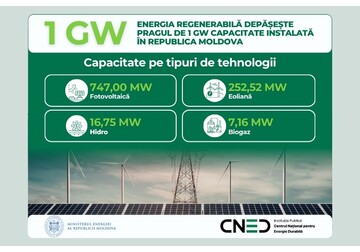
Moldova's installed renewable energy capacity has exceeded the 1 GW (gigawatt) threshold, reaching 1,023.42 MW - the Ministry of Energy
The Ministry of Energy and the National Center for Sustainable Energy announced this, noting that this achievement is an important milestone in the national energy transition and reflects the accelerated development of domestic renewable energy generation capacity. Specifically, 42.44 MW of new renewable energy capacity was installed in the country in the first two months of 2026. At the end of 2025, the total installed capacity stood at 980.98 MW, an increase of 444.02 MW compared to the approximately 580 MW at the end of 2024. Thus, in one year, the total installed capacity has increased by approximately 69%. The sector's dynamics are impressive, as the installed capacity of renewable energy sources has increased 13.23-fold over the past five years. Compared to 2020, when the total installed capacity was only 77.37 MW, the increase amounted to 946.05 MW, with 2025 playing a decisive role in this evolution. Photovoltaic energy remains the most widespread technology in Moldova, with an installed capacity of 747.00 MW, accounting for 73% of the total renewable energy capacity. It is followed by wind energy, which reached 252.52 MW (25%). The capacity of hydropower and biogas plants is 16.75 MW (1%) and 7.16 MW (1%), respectively. This evolution was driven by both the influence of government policy and market dynamics. State support mechanisms facilitated the active participation of 9,049 prosumers (consumers-producers of electricity from renewable sources) as of the end of February 2026, including 5,051 participants in the net metering mechanism and 3,998 participants in the net billing mechanism. They facilitated the installation of 202.34 MW of capacity, accounting for 20% of the total installed capacity of renewable energy sources. At the same time, 157.34 MW (15%) of capacity was installed under the feed-in tariff support mechanism, 33.24 MW (3%) in accordance with the provisions of the renewable energy legislation, and 60 MW (6%) through the feed-in price mechanism. In total, support mechanisms facilitated the installation of 452.92 MW, accounting for 44% of the total existing capacity. A significant share of capacity, amounting to 570.50 MW (56%), was installed on the open market, of which 328.71 MW is photovoltaic, 225.29 MW is wind, and 16.50 MW is hydropower. This fact confirms that energy production from renewable sources is a viable and attractive economic activity for investors. A key milestone in the sector's development is the organization of the first auctions for renewable energy capacity in 2025, which will implement a fixed-price support mechanism. Thanks to this mechanism, 60 MW of photovoltaic capacity has already been installed as part of the first auction launched for the development of wind and photovoltaic power plants. According to the Ministry of Energy and the National Center for Sustainable Energy, the results obtained are in line with national goals and international commitments to reduce greenhouse gas emissions and promote energy sustainability. Accelerated development of renewable energy production capacities contributes to the diversification of energy sources, reducing dependence on imports and strengthening Moldova’s energy security. // 03.04.2026 – InfoMarket