The World Bank will provide $40 million to implement the Strengthening Moldova’s Disaster Risk Management and Resilience Project
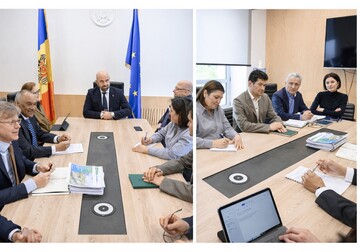
The implementation of this project was discussed during a meeting between Vladimir Bolea, Minister of Infrastructure and Regional Development, and a World Bank delegation that visited our country from April 21 to 24 as part of a mission to support the project’s implementation. Discussions focused primarily on the implementation of Project Component 3.1, aimed at reducing seismic risk in buildings. At the same time, issues of interest to the Ministry of Infrastructure and Regional Development regarding support for urban development programs in both Chisinau and other cities across the country were addressed. As part of the project, modern technical standards for seismic design, seismic microzonation maps, and a mobile application for assessing and classifying buildings by seismic risk level will be developed. Specific requirements for the seismic retrofitting of buildings will also be formulated, which will include measures to enhance climate resilience aimed at protecting existing infrastructure from the impacts of climate change. Another important topic of the meeting was the development of floodplain maps and maps of landslide-prone areas. These tools will help justify urban planning for settlements and support their sustainable and balanced development. Vladimir Bolea admitted that during a recent visit to Japan, he was impressed by the level of infrastructure development. “There, they don’t fight nature; they learn to live with it. I believe that we in Moldova should also adopt this approach—not trying to fight nature or change it, but learning to live in harmony with it. In this regard, we are focused on developing modern tools and technical solutions that reduce natural risks and enhance the resilience of our communities,” emphasized the Minister of Infrastructure and Regional Development. As previously reported, Moldova will receive a $40 million loan from the World Bank on concessional terms for a 30-year period with a 5-year grace period to implement the Strengthening Moldova’s Disaster Risk Management and Resilience Project. The loan will be repaid every six months. The project implementation period is 5 years. Its goal is to enhance Moldova’s preparedness and response to natural disasters and climate-related shocks that threaten lives, homes, and critical infrastructure, as well as to ensure a rapid and effective response in the event of such a crisis or emergency. As part of the project, the World Bank will support the development of a system for alerting citizens about emergencies and natural disasters via mobile phone. Citizens will receive alerts about emergencies and natural disasters on their mobile phones. $5 million will be allocated for the development of the public warning system. Specifically, a mobile-based Public Warning System (PWS) with national coverage will be installed and put into operation. This will enable the rapid dissemination of emergency warnings, which will save lives and reduce property damage. The national public alert system based on mobile electronic communications, integrated with existing meteorological, hydrological, and geological information systems, will significantly enhance the country’s preparedness to combat natural disasters such as floods, fires, and earthquakes. In addition, $22.5 million will be allocated for the purchase of emergency response vehicles and other equipment, including search-and-rescue and logistics containers, to be used by the State Inspectorate for Emergency Situations. Another $1.5 million is earmarked for ensuring public preparedness for emergencies. Additionally, $6 million will be invested in improving hydrometeorological services. Hydrometeorological observation systems will be modernized, and forecast visualization systems and meteorological workstations will be installed at the State Hydrometeorological Service. The project also includes a component related to supporting policies, regulatory measures, and technical studies for more effective assessment and management of climate-related natural risks. $2 million will be allocated for a feasibility study on seismic risk reduction, as well as for the development of a national methodology for mapping seismic and natural disaster risks for both residential and public buildings. // 24.04.2026 — InfoMarket