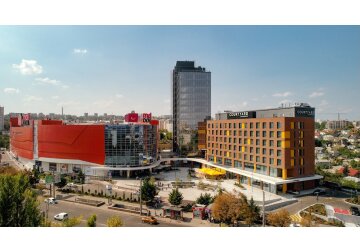
Five buildings in Chisinau have obtained the highest LEED certification. For the Moldovan market, this marks a strong confirmation of a new quality benchmark.
Five buildings in Chisinau have confirmed compliance with one of the highest international standards in building operations, technical maintenance, and sustainability - LEED v4.1 O+M Platinum.
These buildings are an important part of the city’s infrastructure and are used daily by thousands of people. They are Shopping MallDova, MallDova Center (Endava Tower), Medpark International Hospital, Courtyard by Marriott Chisinau, and Radisson Blu Leogrand Hotel Chisinau, all built by SUMMA.
Atilla Șancı, Summa’s Regional Director in Moldova: “We have been active in the Republic of Moldova for nearly 30 years, and obtaining LEED Platinum certification for five buildings at the same time confirms that economic development can go hand in hand with responsible resource use, high-quality spaces, and a long-term vision. This certification also reflects the way quality standards for urban spaces in Chișinău are evolving and increasingly aligning with European benchmarks. These buildings play an important role in the daily life of the city, and the fact that they meet such high international standards is, above all, meaningful for the community. The five-month evaluation process also showed that continuous investment in building efficiency brings real benefits, both from a business standpoint and in terms of the projects’ long-term relevance.”
For Chisinau, one aspect is especially important: the LEED v4.1 O+M Platinum certification confirms that the conditions created in these buildings meet the highest international standards of comfort, responsible management, and environmental care.
LEED (Leadership in Energy and Environmental Design) is a globally recognized certification framework used in 187 countries to assess and benchmark sustainable building design, operations, and performance. Developed by the U.S. Green Building Council, it is widely regarded as one of the world’s leading standards in the field.
Platinum is the highest level of LEED certification, awarded to projects that earn at least 80 out of 100 possible points across five core areas: Energy and Atmosphere, covering the efficiency of engineering systems and energy monitoring; Water Efficiency, including water-saving solutions; Indoor Environmental Quality, such as ventilation, lighting, acoustics, and thermal comfort; Sustainable Sites and site management; and Materials and Resources, including waste management and environmentally responsible operational operations.
The evaluation and certification process was carried out with the involvement of BuildGreen Romania, a company specialised in certification and consultancy for sustainable buildings, and included a rigorous assessment covering the previous 12 months, both on site and based on the existing documentation. One of the key findings was a measurable reduction in consumption across all five buildings compared to other similar properties.
Răzvan Nica, CEO and founder of BuildGreen Romania: “LEED v4.1 O+M Platinum certification confirms a high level of building performance based on concrete indicators: from energy and water efficiency to indoor environmental quality and sustainable management practices. The fact that this level was confirmed simultaneously for five buildings in Chisinau reflects the maturity of the approach to real estate operations and the growing attention paid to international quality standards on the Moldovan market. This is an important signal both for the professional community and for the users of these buildings.”
Through this simultaneous certification of five buildings, the Republic of Moldova marks an important step in advancing a culture of construction and building management grounded in responsibility, efficiency, and a strong commitment to the quality of the environment in which people live and work. This first-of-its-kind achievement places Chișinău within a new urban development context, where international standards are becoming increasingly present in the spaces that define everyday city life.