News

The National Bank’s new policy: from lenient oversight to sanction standards?Data about the Activity of Moldovan Commercial Banks on April 30, 2026Tarmo SILD: Energbank has been profitable ever since it came under the ownership of Iute GroupThe MDL mirrors the EUR volatility: Moldovan economy adjusts to new realityInflation “not by the book,” or Welcome to the crisis? The National Bank increases banks' share of equity capital in their operating activitiesIs the National Bank “financing” the state budget to the detriment of the economy? And what do the IMF and commercial banks have to do with it?Inflationary measures amid high inflation, or anticipation of the National Bank of Moldova's Stop-and-Go policyDr. Sándor Csány: Being the 4th largest, OTP in Moldova will grow both organically as well as through possible mergers and acquisitions It seems to be a place, but it is notScott HOCKLANDER: For me, the persistence of Moldovan citizens is not only a learned lesson, but also a great exampleSorin MASLO: "The year 2022 was a turning point for the "Cricova" Wine Combine, the turnover increased by almost 25%"Deposit rates are at their peak. Market conjuncture or Why banks need individuals’ depositsValeriu LAZĂR: "If the state does not support business today, tomorrow it will have no one to collect taxes from.Chisinau Airport as a reflection of statehoodMonetary measures against non-monetary inflationBanks as the fulcrum of the economy: they have increased profits and are preparing for the challenges of the 2H 2022The Ministry of Finance and investors in the State Securities market at the peak of placement volumesThe banking market: turmoil and increased demand. No panicIs Moldova ready for the economic consequences of the war in the neighboring country?Are we heading for hyperinflation? It all depends on the correct diagnosis and the prescribed treatmentWhat is happening in the Government Securities Market and what does the National Bank have to do with it?The wine industry is on the verge of a revolution: Is the industry-specific law bankrupting enterprises? The trap for the oil products marketLászló DIÓSI: Foreign investments come to Moldova due to banking system stabilityWhen there is no program with the IMF, we issue are government securities ...Nikolay BORISSOV: “Acquisition of Moldindconbank is the best procurement in the Moldovan market, albeit the most risky one”Oil Ping Pong GamesBanking 2020 - pandemic, profitableWeird 2020: humility, depression, rebellion, accepting a new realityThe Hunger Games of the foreign exchange marketHow to tame liquidity?Veaceslav IONITA: The government killed the business, but flirted with the populationPeople and Business: Natural and Unnatural SelectionAlexandru BURDEINII: Being ethical becomes vital in business nowadaysMoldova’s Key Macroeconomic IndicatorsPrices at filling stations

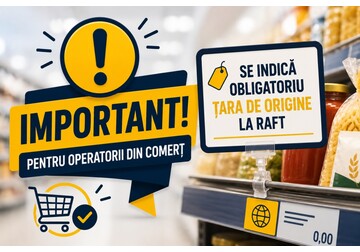
Starting August 10, stores with an area exceeding 30 square meters will be required to indicate the country of origin of food products directly on price tags

Starting August 10, stores with an area exceeding 30 square meters will be required to indicate the country of origin of food products directly on price tags

The National Agency for Food Safety (ANSA) noted that the relevant changes are provided for in the Law on Domestic Trade. The new requirements apply to retail establishments in categories B, C, and D (with an area of more than 30 square meters) and are aimed at increasing transparency for consumers and ensuring product traceability at all stages of distribution. The changes will not affect retail outlets with an area of 30 square meters or less. Under the new rules, for prepackaged products, the country of origin must be indicated on the price tag if its inclusion on the packaging is mandatory or if the manufacturer voluntarily includes it. The information on the price tag must fully correspond to the information on the product label. For unpackaged products, as well as goods packaged directly at the point of sale at the consumer’s request or for direct sale, the origin of the products must be indicated based on shipping documents and data from the traceability system. The law also establishes uniform requirements for the presentation of this information. The price tag must indicate the full name of the country of origin; the flag of the country of origin may be used only as an additional graphic element. The use of the flag alone, without the country’s name, is prohibited. The label must be placed on the price tag or next to the product and printed in a font at least 0.3 cm high. ANSA recommends that retailers update their price tags in advance and verify that the information on the shelves matches the data on the packaging and accompanying documents. Agency inspectors will begin verifying compliance with the new requirements. Violations of the new rules are subject to administrative penalties. Officials face fines ranging from 60 to 90 conventional units (3,000 to 4,500 lei), while legal entities face fines ranging from 120 to 240 conventional units (6,000 to 12,000 lei). // 17.07.2026 — InfoMarket.

News on the subject