News

The National Bank’s new policy: from lenient oversight to sanction standards?Data about the Activity of Moldovan Commercial Banks on April 30, 2026Tarmo SILD: Energbank has been profitable ever since it came under the ownership of Iute GroupThe MDL mirrors the EUR volatility: Moldovan economy adjusts to new realityInflation “not by the book,” or Welcome to the crisis? The National Bank increases banks' share of equity capital in their operating activitiesIs the National Bank “financing” the state budget to the detriment of the economy? And what do the IMF and commercial banks have to do with it?Inflationary measures amid high inflation, or anticipation of the National Bank of Moldova's Stop-and-Go policyDr. Sándor Csány: Being the 4th largest, OTP in Moldova will grow both organically as well as through possible mergers and acquisitions It seems to be a place, but it is notScott HOCKLANDER: For me, the persistence of Moldovan citizens is not only a learned lesson, but also a great exampleSorin MASLO: "The year 2022 was a turning point for the "Cricova" Wine Combine, the turnover increased by almost 25%"Deposit rates are at their peak. Market conjuncture or Why banks need individuals’ depositsValeriu LAZĂR: "If the state does not support business today, tomorrow it will have no one to collect taxes from.Chisinau Airport as a reflection of statehoodMonetary measures against non-monetary inflationBanks as the fulcrum of the economy: they have increased profits and are preparing for the challenges of the 2H 2022The Ministry of Finance and investors in the State Securities market at the peak of placement volumesThe banking market: turmoil and increased demand. No panicIs Moldova ready for the economic consequences of the war in the neighboring country?Are we heading for hyperinflation? It all depends on the correct diagnosis and the prescribed treatmentWhat is happening in the Government Securities Market and what does the National Bank have to do with it?The wine industry is on the verge of a revolution: Is the industry-specific law bankrupting enterprises? The trap for the oil products marketLászló DIÓSI: Foreign investments come to Moldova due to banking system stabilityWhen there is no program with the IMF, we issue are government securities ...Nikolay BORISSOV: “Acquisition of Moldindconbank is the best procurement in the Moldovan market, albeit the most risky one”Oil Ping Pong GamesBanking 2020 - pandemic, profitableWeird 2020: humility, depression, rebellion, accepting a new realityThe Hunger Games of the foreign exchange marketHow to tame liquidity?Veaceslav IONITA: The government killed the business, but flirted with the populationPeople and Business: Natural and Unnatural SelectionAlexandru BURDEINII: Being ethical becomes vital in business nowadaysMoldova’s Key Macroeconomic IndicatorsPrices at filling stations

New monkey species with orange lips found 'hiding' in DR Congo forest

New monkey species with orange lips found 'hiding' in DR Congo forest

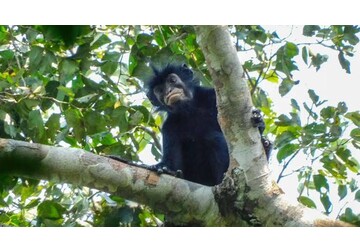
A monkey that has striking pinkish-orange lips and a black face - and lives in the forests of the Democratic Republic of Congo - has been confirmed as a new species to science.

The black-furred primate was spotted and photographed hidden away in the high tree canopy of dense tropical forests in Lomami National Park, in the central east of the country.

Conservationists working there first reported seeing this unusual-looking animal back in 2008. But they captured just one blurry photograph.

After another sighting 10 years later, an international team set out to find and study the monkey and revealed that it was a previously unknown species.

This is only the fifth African monkey species to be discovered in the last 75 years.

Junior Amboko, a PhD student at Florida Atlantic University, played a leading role in the search, which involved audio recordings, photography and detailed genetic studies.

The findings were published in the journal PLoS One.

Amboko told BBC News it was an "amazing feeling" to look into the face of an animal that so few people knew existed.
"Discovering" a species, in this context, means officially recording and confirming it has evolved to be genetically distinct. Some local people already knew of the monkey's existence and refer to it by a common name - Likweli.

But Amboko said the monkeys were "kind of shy" - and tended to hide high in the trees.

"As part of our search, we interviewed people in 52 villages close to where the animals live. And only people in eight villages [had ever seen] them," he recalled.

The research team - from DR Congo, the US and Germany - gave the animal the Latin name Colobus congoensis in recognition of the natural diversity in the country.

It belongs to the larger group of colobus monkeys. "These are really important African monkeys that don't have thumbs," explained Prof Kate Detwiler from Florida Atlantic University.
"They're these herbivores of the canopy that are a critical part of the ecosystem. We think they have a lot to do with processing seeds and germination in the forest."

Prof Detwiler speculates that their unusual, bright facial markings could be a visual signal to other animals, potentially attractive to a mate or that it could allow the animals to identify each other.

The monkeys also have a distinctive "roaring" call. "You often hear them, but don't see them," said Amboko.

They think the animals are rare and restricted to a part of the forest where they can find the food and habitat they need.

The animals are hunted for meat, so the researchers hope that now that Colobus congoensis is classified as a distinct species it can be officially protected.

The researchers say they still have a lot of questions about this newly described, secretive species. They plan to carry out a more detailed survey to estimate their population and study their behaviour.

bbc.com

News on the subject