Newton’s law of gravity passes its biggest test ever
Galaxy clusters obey the inverse square law across hundreds of millions of light-years
More than 3 centuries after Isaac Newton proposed his law of gravity, cosmologists have confirmed it using the largest objects in the universe. Newton’s famous inverse square law had long been verified in laboratory experiments and within the Solar System. The new study, published last month in Physical Review Letters, extends the law to the largest scales possible: galaxy clusters separated by hundreds of millions of light-years.
“We know it holds incredibly well terrestrially and within individual galaxies,” says Priyamvada Natarajan, an astrophysicist at Yale University. “They’re testing it to cosmological scales.” The result is not surprising, she says, but it tightens the vise on an alternative theory, modified Newtonian dynamics (MOND), that tinkers with the effects of gravity to explain away dark matter, the invisible stuff whose gravity appears to bind stars within galaxies.
Newton’s law says the gravitational force between two massive objects varies inversely with the square of the distance between them. Published in 1687 in the Principia Mathematica, the formula immediately enabled Newton to explain the orbits of the planets, as quantified in Johannes Kepler’s three empirical laws of planetary motion. A century later, Henry Cavendish confirmed the law in the lab by suspending a small dumbbell from a fine wire and bringing other weights close to its ends. By measuring the twisting of the wire, he determined how the minuscule tug of gravity between the weights varied with the distance separating them. Physicists today perform refined versions of the Cavendish experiment to search for deviations from the inverse square law that could signal new short-range forces.
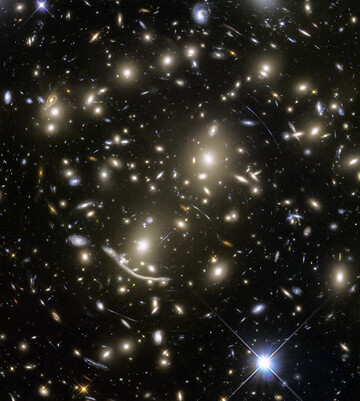
Now, researchers with the Atacama Cosmology Telescope (ACT) in Chile have pushed such tests in the opposite direction to the largest conceivable scales. “Galaxy clusters are literally the biggest structures in the universe,” says lead author Patricio Gallardo, an ACT collaborator and cosmologist at the University of Pennsylvania. Each of these swarms can contain hundreds of galaxies, bound by their mutual gravity. A cluster can weigh a quadrillion times as much as the Sun and span tens of millions of light-years.
The researchers probed the force across hundreds of thousands of clusters by combining separate statistical measures of their positions and the speeds with which they move. Just as planets closer to the Sun move faster, two clusters that are closer together will move faster relative to each other, says Kris Pardo, a co-author and a cosmologist at the University of Southern California. So, how the relative speed of any two clusters varies with the distance between them probes the nature of gravity.
But not in a simple way. That’s because the relative speed of two clusters depends not just on the gravitational tug they generate themselves, but also on the gravity of all the surrounding clusters. To account for that complication, the researchers first extracted a measure of the spatial distribution of galaxies from the Sloan Digital Sky Survey, which since 2000 has mapped millions of galaxies. To this spatial distribution they applied a generalized force law with adjustable parameters to predict how the relative speed of cluster pairs would vary with distance.
The researchers then compared that prediction with velocity data taken by the ACT, which operated from 2007 to ’22. The ACT measured the afterglow of the Big Bang, the cosmic microwave background (CMB), and was particularly good at spotting galaxy clusters. As photons from the CMB pass through a galaxy cluster, they collide with electrons within it, gaining or losing energy depending on whether the cluster is moving toward or away from Earth—an effect known as the kinematic Sunyaev-Zeldovich (kSZ) effect. The effect makes clusters easy to spot and provides a direct handle on their speeds. “That’s the jewel-in-the-crown observation for them,” Natarajan says.
To avoid confounding effects from the expansion of the universe and space-stretching dark energy, the researchers focused on clusters 5.6 billion to 7.7 billion light-years away—a snapshot in cosmic time. The team probed accelerations as small as 10 femtometers per second squared, Pardo says, one-quadrillionth of Earth’s gravity. Over distances of 80 million to 800 million light-years, the force of gravity varied as one over the distance to the 2.1 power, plus or minus 0.3, neatly confirming Newton’s law of gravity.
Newton’s win comes at MOND’s expense. Proposed in the 1980s to avoid invoking dark matter, the theory doesn’t change Newton’s law of gravity, but instead alters Newton’s second law of motion—force equals mass times acceleration—at extremely low accelerations. But if MOND were accurate, then on the largest scales gravity would effectively vary with one over the distance, not distance squared. MOND already struggles to describe the evolution of the universe, and the new data deliver another blow, Gallardo says.
Perhaps more important, the study shows the power of measuring velocities with the kSZ effect, Pardo says. ACT’s successor, an array of microwave telescopes called the Simons Observatory, has begun taking data. It will measure the kSZ effect with far greater precision, providing a tool to trace dark energy and the expansion history of the universe, Pardo says. “There’s a lot more that can be done with this method.”
science.org