Ten thousand years ago, human evolution went into overdrive
Ancient DNA reveals “massive” genetic shifts tied to rise of farming, wheels, and metal tools
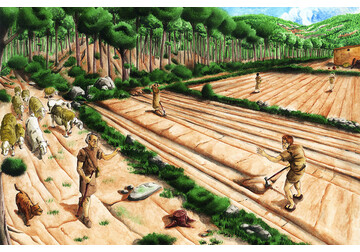
After modern humans made it to Europe some 50,000 years ago, they hunted and gathered in small groups for scores of generations. Then, 10,000 years ago, people in Europe began to farm and settle down. About 5000 years later, cattle herders from the steppes of Eurasia surged into Europe with the wheel and metal tools and weapons, ending the Stone Age and ushering in the Bronze. Cultural and technological changes kept accelerating, from the rise of the first cities to the spread of empires to our modern age of trains, planes, cellphones, and artificial intelligence.
All that societal upheaval may have supercharged our biological evolution as well, according to a study of nearly 16,000 ancient human genomes published this week in Nature. Researchers leveraged the exponential growth of ancient DNA samples to measure human genetic change over 18,000 years and found hundreds of genetic shifts across Europe’s population in a relatively short time. “It’s a powerful new approach to detecting natural selection from ancient DNA,” says Iain Mathieson, an evolutionary geneticist at the University of Pennsylvania. For example, the analysis finds new signs that natural selection nudged traits such as tuberculosis resistance and lower body fat to become more common in western Eurasians during this time.
To look for evidence of evolution in humans, researchers compared the DNA of ancient people living in Europe and the Middle East—where paleogeneticists have concentrated their sampling—with each other and with modern-day individuals. Within the past 10,000 years, hundreds of particular versions of genes have become measurably more or less common, a sign of natural selection at work. “The genome is under massive selection pressure over the last 10,000 years,” says Harvard University geneticist Ali Akbari, a co-author on the study. “Everything has changed about the way we live, and that’s reflected in our genome and how it’s trying to catch up.”
His team’s analysis shows that beginning about 10,000 years ago, after the introduction of farming, 479 genetic variants became more or less common in the European gene pool, a sign of adaptation. “It makes sense to me that the advent of agriculture would have induced selection pressure for various things,” Young says. For example, variants connected to tuberculosis resistance became more common starting 6000 years ago, then decreased over the past 3000 years. Variants linked to higher body fat became less common, genes for red hair became more common about 4000 years ago, and those for male pattern baldness declined over the past 7000 years. “The genome is alive with signal,” Reich says. He sees “a period of unusually intense … and also fluctuating natural selection—variants shoot up in frequency, then down.”
Sometimes the environmental pressures behind the changes are obvious, says Lluis Quintana-Murci, a population geneticist at the Pasteur Institute. For example, genes connected to higher body mass became less common once farming emerged, perhaps because crop domestication reliably produced surplus calories. “I found it supercool they can show that,” he says.
Another suite of mutations, mostly associated with disease resistance and autoimmune conditions, spiked in frequency starting in the Bronze Age, about 5000 years ago. That’s when Europe’s population density started to rise exponentially and people began to live closer to each other and to domesticated animals. “The Bronze Age probably saw massive change in pathogenic exposure, leading to selection touching genes related to immunity and host-pathogen interactions,” Quintana-Murci says.
Better understanding of selection pressures could boost medical understanding of diseases that still plague us today. The team’s results confirm findings from another recent paper showing that genes that heighten multiple sclerosis risk became more common in the Bronze Age. With thousands more individuals in the data set, “we’re getting closer to being able to answer some of these selection pressure questions,” says Harvard statistical geneticist Alison Barton, a co-author of the paper.
In other cases, the selection pressures behind genetic shifts remain murky. Using published studies and a database that combines health, lifestyle, and genetic data from hundreds of thousands of modern people in the United Kingdom, the team found that clusters of genes associated with traits such as walking pace, as well as genes correlated with behavioral outcomes such as income and years of schooling, became more common over the past 5000 years.
But it’s not obvious how these clusters of genes gave prehistoric people an evolutionary boost. “This study represents almost a decade of intense work, but it’s really just scratching the surface,” says Harvard evolutionary biologist Annabel Perry, another co-author. “They didn’t have college in the Neolithic, so what is the trait that’s really changing? This is an invitation for researchers to do the digging to find those associations.”
Migration and mingling of populations can also trigger fluctuations in the frequency of various genes, so the researchers applied methods from medical genetics to rule out those causes. Not everyone agrees they succeeded. The researchers treat changes in genetic ancestry over time as evidence of selection—but whether those ancestry shifts reflect selection, and if so on which traits, is not resolvable using their approach, says Arbel Harpak, a population geneticist at the University of Texas at Austin. “The study is best viewed as offering amazing data and provocative hypotheses that will require much further scrutiny, rather than a settled account of adaptation in Eurasia,” he says.
Reich hopes future work will explore these questions in other parts of the world. Several recently posted
preprints—including one by some of the authors of the Nature paper—suggest similar dynamics were at work in other populations. Other time periods might also have seen rapid evolutionary change, but haven’t been or can’t be sampled. “The most exciting time period might be between 1,800,000 and 300,000 years ago when hominin brains triple in size and modern humans appear,” he says. “We don’t have that data.”
science.org