
The illegal e-cigarette market in Europe has reached €6.6 billion and continues to grow
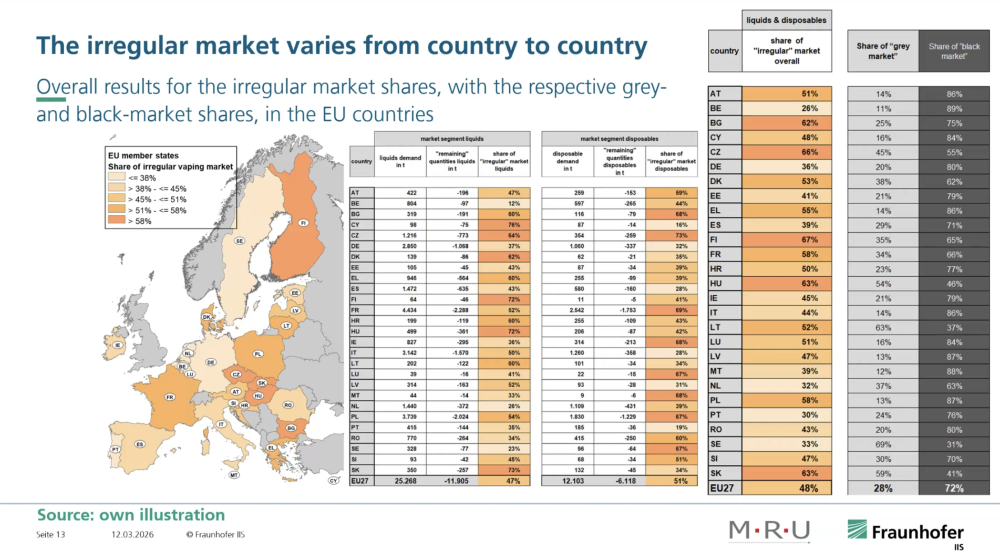
According to a study conducted by the Fraunhofer IIS and the consulting firm MRU, this accounts for nearly 48% of the total market. Of this, about 35% is attributed to the fully illegal market, and approximately 13% to the “gray” segment—private imports of goods that do not meet requirements or are not taxed.
The study, presented at an international press conference in March 2026, analyzes the supply structure, trade flows, and actual scale of vape consumption in Europe. As emphasized by the project leader, Uwe Veres-Homm, a specialist in international supply chain analysis at the Fraunhofer IIS, the main challenge of the study was a lack of data. “Official statistics reflect only legal imports and sales. To understand the true size of the market, we had to build an econometric model that compares data on demand and international trade,” he noted.
One of the industry’s distinctive features is the scale of production in China. According to experts’ estimates, China accounts for about 90% of e-cigarette imports into the EU, particularly from the Shenzhen region. Germany, the Netherlands, and Belgium serve as central hubs for subsequent distribution within Europe. From there, shipments are often transferred to trucks and transported across intra-European borders with less control. This allows illegal goods to enter the domestic market and circumvent tax obligations.
The logistics infrastructure supporting the market is closely linked to international e-commerce. According to European Commission estimates, approximately 800 million parcels were shipped from China to EU countries in 2024 alone. A significant portion of these shipments contains e-cigarettes or related products. The scale of these flows seriously complicates customs control: inspections are conducted only on a selective basis, as it is physically impossible to inspect millions of shipments daily.
The market situation is further complicated by regulatory differences within the European Union. Different countries have varying tax rates on e-liquids and different requirements for product sales. This fragmentation creates conditions for parallel imports and cross-border trade. Virtually unregulated e-commerce is becoming an additional driver of the gray market’s growth.
At the same time, the market itself continues to expand. According to researchers’ estimates, on average about 3.1% of the European population over the age of 15 uses e-cigarettes—that is approximately 11.9 million people: in some countries, the share of users reaches 7–8% of the population, while in others it is below 1%.
Product diversity remains a separate issue. European registers already list about 470,000 different devices and e-liquids for e-cigarettes. Moreover, e-liquids contain over a thousand different ingredients, which complicates safety oversight of these products.
The situation in non-EU countries located near the European market largely mirrors these trends. In Moldova, for example, a ban on the online sale of e-cigarettes has been in effect since 2022. However, part of the trade has shifted to social media and messaging apps, where products are sold directly to consumers, including minors.
According to the study’s authors, effective regulation requires a comprehensive approach. Among the possible measures, they cite the harmonization of regulatory rules within the European Union, the creation of digital tracking systems for shipments, and closer cooperation with producer countries.
Experts believe that market stabilization can be achieved through several practical steps. First, it is necessary to standardize product definitions and classifications. Second, digital traceability of supply chains, including serialization technologies and risk analysis, can play an important role. Third, experts consider it necessary to strengthen cooperation with the countries of origin of the goods, primarily with China, where the majority of e-cigarettes are manufactured.
One approach could be the digital registration of manufacturers and export shipments, which would allow for tracking the movement of goods at all stages of the supply chain.
Experts also note that the e-cigarette market will continue to grow. According to Fraunhofer IIS estimates, by 2030 the total European e-cigarette market could grow to €10.8 billion, and the share of the unregulated segment, if current trends continue, will increase by approximately 8.6% per year.
Under these conditions, researchers believe that the key task for regulators is not only to monitor tax revenues but also to ensure product safety and market transparency.
For Eastern European countries, including Moldova, the problem of illegal vape trade may prove particularly acute. Experts note that regulatory differences between countries and the complexity of monitoring international supply chains allow illegal products to penetrate local markets with relative ease. //18.03.2026 — InfoMarket.