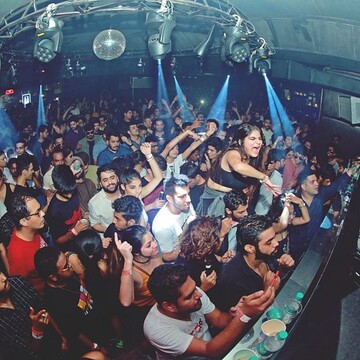
The Sober High Taking Over India’s Nightlife
Young Indians are trading hangovers for a faith-fueled buzz as devotional jamming goes mainstream.Floodlights sweep across the 16th century fort’s ramparts as thousands stream inside — women in colorful saris, men in kurta pajamas, college girls in kurtis over jeans. One small girl dressed as the goddess Radha, her flower crown askew, tugs at her parents’ hands in excitement.The air hums with anticipation familiar to any concert crowd. A bassline drops. Performers flanked by dancers take the stage, their voices building to a crescendo. People clap and sway, some with eyes closed, singing along — not to a pop anthem, but chanting the names of God.Scenes like this in New Delhi are multiplying across India’s biggest cities as Gen Z and millennials, often with their families in tow, gravitate toward a different kind of nightlife. There’s no alcohol or celebrity DJs. Instead, crowds sing invocations to Hindu deities like Ram and Krishna over bass-heavy beats and amplified drums. Known as bhajan clubbing, the format takes a devotional tradition once rooted in temples and family prayer and repackages it for a younger generation.From small cafes to shopping malls and now stadiums, such gatherings are scaling up. Ticketing platforms list bhajan clubbing alongside rock concerts or comedy shows, while Google search interest has climbed since late 2025. “Our goal is to give people a Tomorrowland-like experience, but devotional,” says Nikunj Gupta, whose company Sanatana Journey organizes such events, referring to the electronic dance music festival in Belgium.The rise of bhajan clubbing, also called bhajan jamming, reflects a broader shift in India, where religion is increasingly visible in public life and being openly, joyfully Hindu has become, for many young Indians, not just acceptable but aspirational. From pilgrimages to meditation retreats to bespoke online prayer services, India’s religious and spiritual market is projected to almost double in value to more than $135 billion by 2034.The growth is driven by a mix of forces: Prime Minister Narendra Modi’s emphasis on a more overtly Hindu national culture, a social media boom that’s helped make Hinduism fashionable and a post-pandemic search for meaning. A generation shaped by Covid-19 — isolated, anxious, and online — is seeking something a bar tab cannot provide.The trend has parallels elsewhere. In the US, megachurches have long blended worship with the aesthetics of live entertainment. Across Europe, alcohol-free ecstatic dance gatherings have expanded since the pandemic, while communities such as Daybreaker — a sober morning dance movement founded in New York — now operate in dozens of cities worldwide.“Earlier, going to a club and drinking was a status symbol,” says Gourank Gupta, 23, as chants echo across New Delhi’s Purana Qila fort on a recent Sunday evening. “Now it feels like the status symbol is living a healthy life.”Such gatherings offer the energy and social connection of a night out without the pressure to drink or use substances to fit in, says Gupta, who works for a software company. The next morning, he adds, brings “no hangover, no regret, just a sober high.”Away from the stage, the scene resembles a temple fair. Stalls line the perimeter, selling prayer items such as incense sticks and camphor, copies of the holy book Bhagavad Gita and delicacies such as kachoris and jalebis. Marigold and saffron garlands hang from trees. Groups sit cross-legged on the ground, palms folded, eyes half-closed, listening to the music.For Liza Gupta, 28, who has attended a handful of bhajan clubbing events, it’s a quieter and safer alternative to other nightlife. “It felt like a treasure,” she says, watching people dance with “hearts filled with love of God.”The popularity of bhajan clubbing underscores how religious practice remains deeply embedded in Indian society, even as younger generations reshape its forms. Kirtan — call-and-response devotional chanting — has long been part of social and spiritual life, whether in homes, neighborhood gatherings or temples. What has changed is the setting, with traditions recast in a concert-like format.“We’re a culture rooted in song and dance,” says Anoop Lather, who chairs Delhi University’s Culture Council. “We have a song for every occasion — from when a mother conceives to when a person dies. It just takes different forms over the generations.”The gatherings draw families together: Parents attend alongside children, and students who might rarely visit temples find themselves singing alongside older relatives. “It bridges a gap,” Lather says.For 24-year-old Khushi Puri, who attended the fort gathering, the appeal is both cultural and personal. “It’s an escape from the monotony of the city’s party circuit,” she says, “but also a way to feel more connected to my roots, and to spend time with my parents — something you wouldn’t do at a regular club or concert.”Academics see a deeper social shift beneath the spectacle. As people migrate from smaller towns to cities, they seek out community and like-minded people, says Ramu Manivannan, a political scientist and former head of the Department of Politics and Public Administration at the University of Madras. “People try to create a kind of safety net after their hard day at work,” he says. “They want the time to reflect.”Social media has accelerated the trend, with videos of packed crowds chanting in unison, lights strobing behind them, circulating widely on Instagram.Modi has praised bhajan clubbing as a blend of spirituality and modernity. It’s also popular at India’s lavish, multiday weddings. Last month, Anant Ambani, the youngest son of Indian billionaire Mukesh Ambani, celebrated his birthday with a bhajan clubbing event. Corporate India has taken notice, too: ITC Ltd., a conglomerate spanning hotels, packaged food and information technology, has used its incense brand to sponsor large-scale devotional music festivals.The format is spreading beyond India’s biggest metros and into Hindu-majority neighbors such as Nepal. In Amritsar, a city in the northern state of Punjab, 29-year-old Tania Khurana hosted her first bhajan clubbing event at a cafe last month. It sold out within days, with demand spilling onto a long waiting list, prompting her to book a larger venue for the next edition. The social media manager now plans to pursue the events full time — a move she frames less as a business decision than a personal one. “I am not myself if I am not connected with God,” she says.The pull is unmistakable. On the night of a major cricket final — the kind that usually stills the nation — a crowd gathered instead to chant devotions at a shopping mall in Gurugram, some 30 kilometers (18.6 miles) from New Delhi. In a country where the sacred has long been folded into the everyday, bhajan clubbing feels less like a reinvention than a reframing for a generation searching for meaning beyond the familiar circuits of nightlife.Bloomberg.com