Kazakhstan’s Latest Billionaire Started Out as a Car Salesman
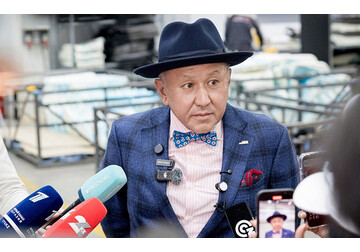
Nurlan Smagulov started out selling Ladas when the USSR collapsed before riding the transformation of Kazakhstan’s economy.
When the Soviet Union collapsed in 1991, the city of Almaty moved at a quieter pace. Known for its wide boulevards, opera house and the world’s highest ice rink, cars were a luxury and Western goods were scarce.
Today, Almaty is the busy commercial hub of Kazakhstan’s booming economy, and if one man encapsulates the journey from communism to capitalist consumerism, it’s Nurlan Smagulov.
The latest addition to the Bloomberg Billionaires Index from the central Asian country, Smagulov rode the transformation, first as a car importer, then as a retail property tycoon and more recently as the founder of an art museum in Almaty. What makes the 60-year-old stand out from his superrich compatriots is that he didn’t make his money from commodities or finance, or indeed politics.
Kazakhstan’s per-capita gross domestic product has risen from less than $1,500 at the demise of the USSR to more than $14,000, on a par with its more powerful neighbor Russia, thanks to the development of three big oilfields.
Fast-growing cities, a swelling middle class and the ensuing rise in consumer spending reshaped the economy, which has been growing at more than 5% a year since 2000. The country’s population, meanwhile, rose by a third to about 21 million people.
“I was certain about Kazakhstan’s economic prospects before, and still am,” Smagulov said in a recent interview at his office on the third floor of his Mega shopping mall in Almaty. “Our business thrives on increasing consumer demand and spending by our population.”
Smagulov owns three shopping malls, including Kazakhstan’s largest, while the auto business has 19 different distribution agreements. His vehicle assembly plants account for about two out of five cars produced in Kazakhstan.
That faith in his fellow citizens has given Smagulov an estimated wealth of about $1.5 billion, according to the Bloomberg Billionaires Index. The figure compares with the $9.2 billion amassed by Vladimir Kim, the wealthiest Kazakh, who made his money from copper mining.
As Kazakhstan gained independence in December 1991, Smagulov said he saw an opportunity to make money by selling autos. There was a shortage, and a car was seen as a “very prestigious and a very desirable acquisition,” he recalled.
But he needed money. To raise cash, he would buy vehicles such as Russian Kamaz trucks at a wholesale market in Almaty with a three-day payment deadline and then quickly sell them on for a higher price, pocketing the difference.
He used the proceeds to start purchasing cars abroad. Demand from the underserved local population ended up being so high that he made his first $1 million in about four years by importing Ladas from Russia and Toyotas from Japan, he said. It was the beginning of his company, Astana Motors.
Then things really took off in Kazakhstan. In 1993, the country switched to a new national currency, the tenge, from the ruble. It also signed a deal with Chevron to develop the giant Tengiz oilfield. By 2000, the discovery of the Kashagan oilfield in the Caspian Sea was announced.
The enrichment of the country led to greater urbanization and Smagulov expanded into retail real estate, opening the first Mega shopping mall in Almaty in 2006.
It was another bet on the city’s consumers, and also on Almaty’s growth. The mall was built close to the snow-capped mountains in the south of the city on the site of an abandoned Soviet radio-electronic plant, across the road from a wholesale food market near a trolleybus terminus.
Initially, Smagulov tried to fill the mall with anything that could attract visitors, including bowling. Mega deployed shuttle buses to bring visitors from other neighborhoods. It worked. The area became more desirable as people shopped and played, while developers moved in to build modern high-rise apartment blocks.
The mall expanded in 2013, almost doubling its space and filling with more international brands. Now he plans an 80 billion tenge ($170 million) redevelopment next to it that will include a 19-story office tower while also building the 100 billion tenge Mega Garden mall in Astana, the Kazakh capital.
“Our shopping centers are located in large cities, and naturally, the influx of urban residents and their growth impacts us,” Smagulov said. “The same applies to cars. Our population growth rate is one of the highest in the world.”
It’s not all risk-free, though. Smagulov’s businesses are exposed to tighter lending rules for car purchases and any currency weakening that could erode purchasing power. There’s also potential political upheaval, including social unrest that led to looting of some malls in 2022.
After those riots, President Kassym-Jomart Tokayev sought to consolidate his power, sidelining figures from strongman predecessor Nursultan Nazarbayev, who led the country from 1991 until 2019. He kicked off reforms aimed at narrowing the gap between rich and poor, including increasing taxes for higher earners and raising tax on consumer goods.
For now, the country’s vast resources continue to underpin the economy, while war in the Middle East and its eventual aftermath might open opportunities, according to Smagulov. Kazakhstan has boosted earnings from transiting Chinese goods to Europe and sits between the world’s second largest economy, Russia, South Asia and the Middle East, making it a strategic corridor for infrastructure and trade.
And as business booms, Smagulov has turned to his collection of contemporary art, bringing renowned American sculptor Richard Serra’s 155-metric-ton steel sculpture Junction to the Almaty Museum of Arts, which opened in September.
The current collection cost Smagulov about $70 million, he said, while constructing the museum was another $50 million. It had about 188,000 visitors last year in the few months it was open, and he plans to grow that figure to 500,000 this year. Smagulov also plans to open another building at the museum by 2030 aiming to double annual visitors to 1 million.
“I had to make pragmatic steps — I had to bring the great works,” he said while touring the collection at the museum. “When you have Richard Serra, you get into the premier league. Having such an artist in the museum declares to everyone that this place is very significant.”
bloomberg.com