


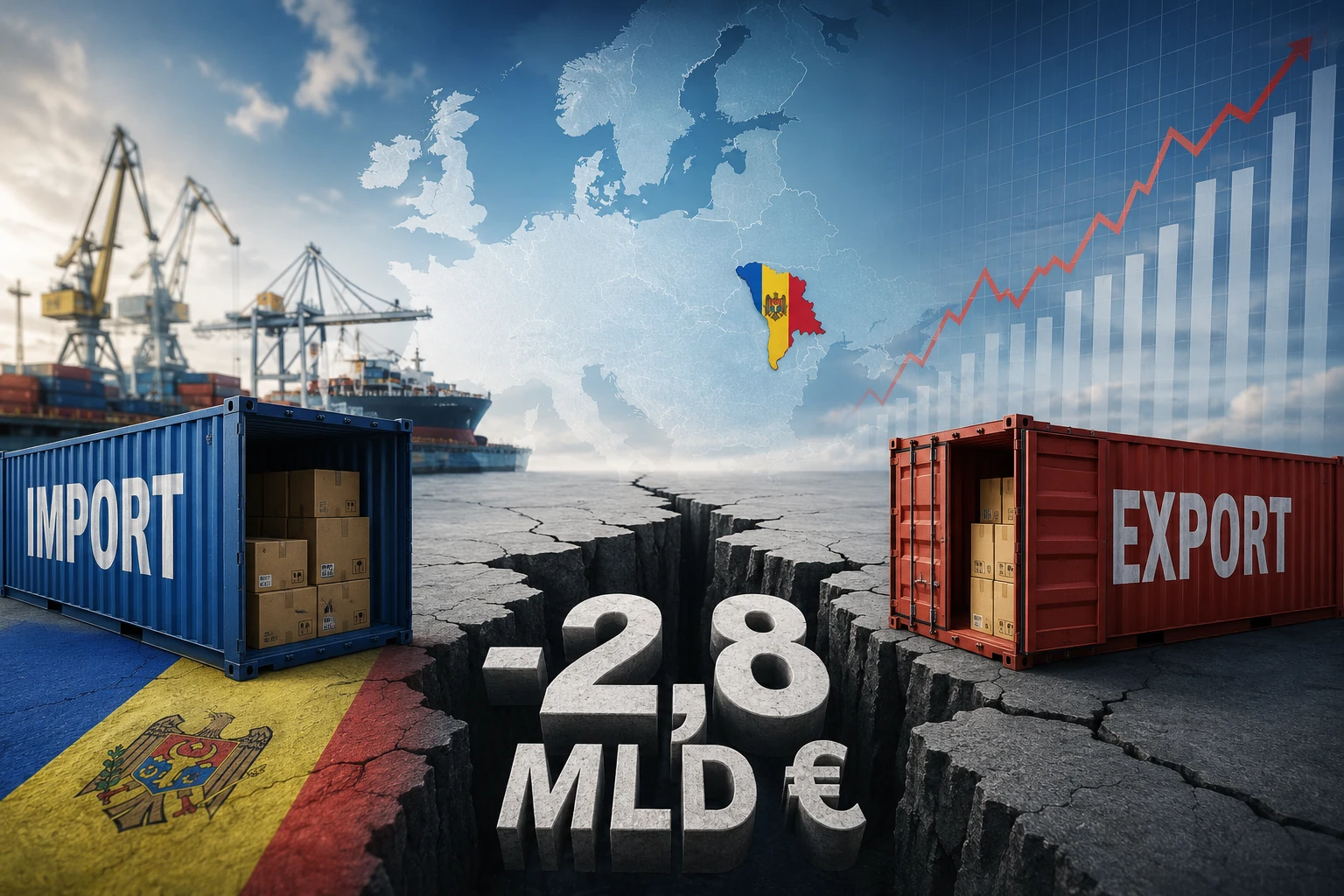
Moldova’s trade deficit continues to grow, although the rate of increase does not yet appear to be sharp. From January through May 2026, the country imported €2,795.5 million more in goods than it exported. Compared to the same period last year, the gap widened by 89.8 million euros, or 3.3%. In other words, over the course of five months, the Moldovan economy not only failed to reduce the trade imbalance but actually added nearly 90 million euros to it.
May showed a slight improvement only when compared to the previous month. The trade deficit stood at 548.4 million euros—14.6% less than in April. However, compared to May of last year, it actually increased by 3.6%. Therefore, the monthly decline cannot yet be considered a shift in the overall trend: the cumulative deficit since the beginning of the year remains larger than last year’s.
The key point in the new data is not only the size of the deficit but also its geographic distribution. More than half of the total deficit stems from trade with European Union countries. Over the five-month period, the trade deficit with the EU reached 1 billion 456.4 million euros, an increase of 6%. Another 1,297.4 million euros resulted from trade with other countries outside the EU and the CIS. Here, the increase was significantly more modest—0.8%.
The trade deficit with CIS countries amounted to only 41.8 million euros, and this figure decreased by 6.1%. Thus, the bulk of the trade imbalance has long been driven not by traditional eastern markets, but by trade with the European Union and major suppliers from other regions.
Moldova’s largest trade deficits were with two countries—Romania and China. The deficit with Romania amounted to 643.8 million euros, an increase of 6.2%, while the deficit with China stood at 559.2 million euros, up 7.6%. Together, these two trade flows account for about 43% of the country’s total trade deficit.
Ukraine ranks third with a deficit of 270.7 million euros, although the deficit there decreased by 5.6%. The deficit with Germany amounted to 214 million euros and remained virtually unchanged, increasing by only 1.1%. Next are Poland, France, Hungary, Turkey, and Italy.
Certain sharp changes require careful assessment. For example, the trade deficit with Russia rose by 49.1% at once, but in absolute terms it amounted to 54.6 million euros—significantly less than the deficits with Romania, China, Ukraine, or Germany. Similarly, the trade deficit with Croatia increased 1.6-fold, but its volume—56.6 million euros—does not have a decisive impact on the overall figure.
A trade deficit in and of itself does not mean that all imports are problematic. A country may purchase equipment, raw materials, technology, and other goods from abroad that are necessary for the development of production. However, the published data do not show which portion of the increased deficit is related to investment imports and which is related to consumer goods. Therefore, it is impossible to assess the nature of the deficit based solely on the total amount.
However, the steady growth of the trade deficit points to a more fundamental problem: Moldova’s export earnings still do not offset the economy’s need for imported goods. The geography of foreign trade is changing, the European Union’s role is growing, and certain trade flows are expanding or contracting, but the basic ratio remains the same—the country buys significantly more goods from abroad than it sells.
As a result, the trade deficit must be covered by revenue from services, remittances from abroad, external financing, and other foreign exchange sources. As long as the economy has access to such inflows, the system can remain stable. But the wider the trade gap becomes, the greater the dependence on resources that come from sources other than goods exports.
Therefore, a 3.3% increase in the deficit appears moderate only in percentage terms. In absolute figures, this amounts to nearly 2.8 billion euros in just five months. And the key message from the statistics is not a one-time deterioration in the indicator, but the fact that the expansion of trade and the shift toward new markets have not yet led to a reduction in the external trade imbalance. //July 18, 2026 – InfoMarket.