


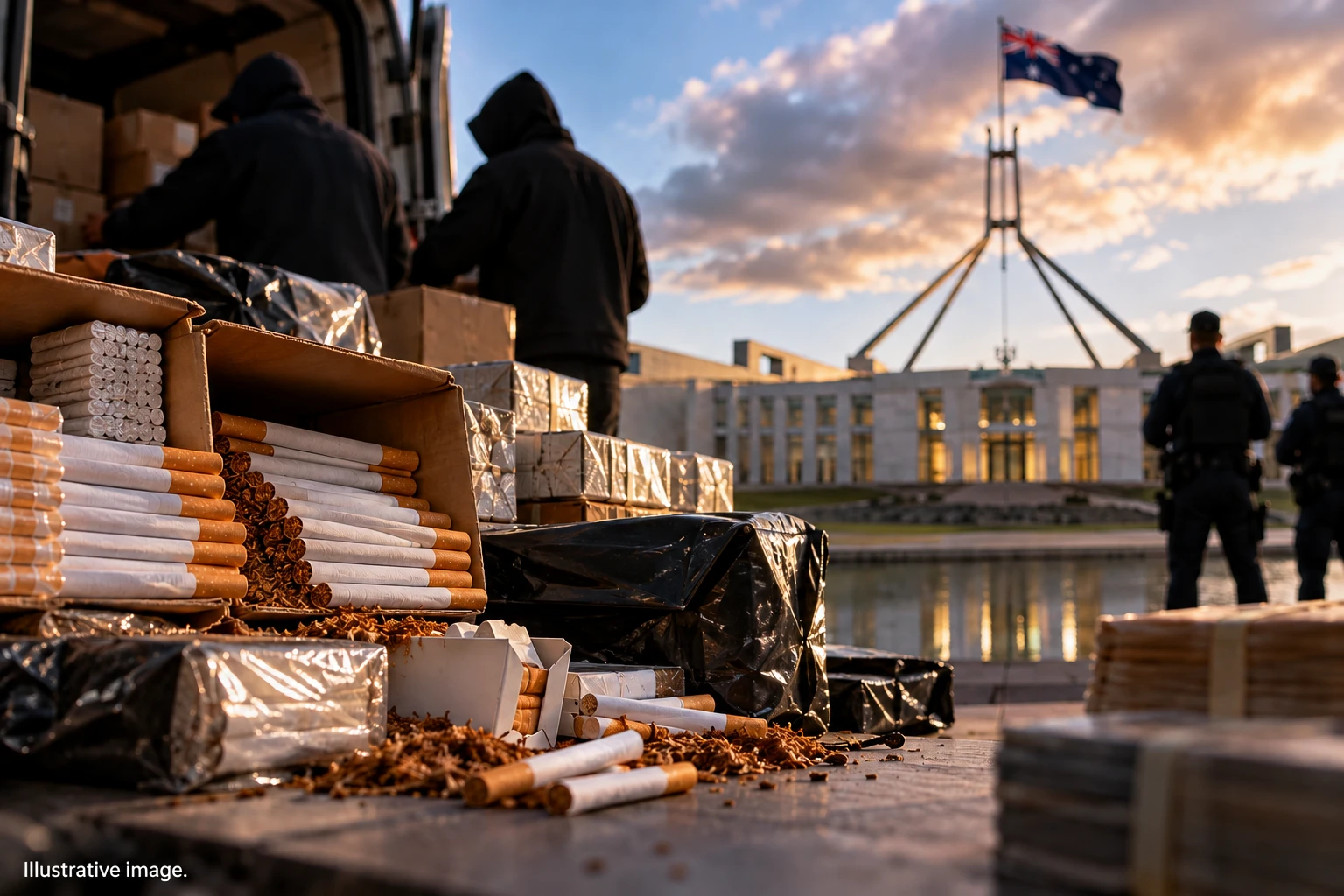
In August 2026, a Senate committee in Australia released a report on the crisis in the illicit tobacco market, describing the situation as an unprecedented market failure and a historic failure of public policy. The committee recommended suspending further increases in tobacco excise taxes and reviewing their levels. Amid the parliamentary inquiry, opposition political forces proposed cutting excise taxes by 75–80%.
In late September, the Financial Times published an overview of the consequences of more than a decade of tax-hiking policies: the share of illicit tobacco reached, according to one estimate, 80%; nicotine consumption rose by nearly 40%; and budget revenues from tobacco excise taxes fell by nearly 75%: from 16.3 billion Australian dollars (AUD) in the 2019–2020 fiscal year to an estimated 4.1 billion AUD in the 2025–2026 fiscal year. At the same time, a significant portion of the illicit market has come under the control of organized crime.
Australia's experiment with tobacco excise taxes attracted international attention from the very beginning. Both proponents of strict anti-smoking policies and their critics have been monitoring its "successes." Now, Australia's experience provides an opportunity to assess not only the results of the fight against smoking but also the consequences for the legal market, government finances, and organized crime.
For many years, Australia has consistently raised taxes on tobacco products in an effort to reduce smoking and related diseases. Since December 2016, the price of legal cigarettes has tripled. Today, a pack costs nearly 60 AUD (about 42 USD), with excise taxes accounting for more than 70% of the price. Illegally imported cigarettes are sold for about one-fifth the price. This significant price gap has become one of the main factors driving the expansion of the illicit trade.
The scale of the illicit market is confirmed by several estimates. According to a report by Amber Shuhyta, Australia's National Commissioner for Combating the Illicit Trade in Tobacco and E-cigarettes, published in December 2025, in the 2024–2025 fiscal year, illicit products accounted for between 50% and 60% of the country's tobacco market, with a central estimate of 55%. At the same time, the Australian Bureau of Statistics (ABS) estimated their share of total physical consumption volume in 2025 at 80%, compared to 12% in 2017. These figures are based on different methodologies and cannot be directly compared.
According to an estimate by the Australian Industry Group cited in a parliamentary report, approximately 15 billion AUD worth of tobacco consumption shifts from the legal market to the illegal market each year. However, this amount is not equivalent to direct budget losses. According to calculations by James Martin, an associate professor of criminology at Deakin University, Australians spend approximately 8.5 billion AUD (6.1 billion USD) annually on illegal cigarettes and vaping products, —roughly twice the combined expenditure on cannabis, cocaine, ecstasy, and heroin. These estimates reflect different market indicators.
At the same time, the decline in official sales has not been accompanied by a corresponding decrease in nicotine consumption. According to data cited by the Financial Times, nicotine consumption increased by nearly 40% between 2017 and 2025. The estimate is based on an analysis of nicotine levels in wastewater, which allows for the measurement of consumption regardless of the product's origin. According to government data, illicit products also account for about 96% of the vape market's value.
At the same time, supporters of current anti-tobacco policies point out that the proportion of smokers among Australians aged 14 and older fell from 8.3% in 2023 to 5.6% in 2025. Representatives of the medical community consider high prices to be an important incentive to quit smoking.
The expansion of the illegal trade has been accompanied by a rise in organized crime. According to a parliamentary investigation, the majority of illegal tobacco enters Australia from abroad through channels controlled by transnational criminal groups. The high profitability of this business has led to a struggle for control over supplies and retail outlets, particularly in Melbourne and Sydney.
According to data cited in a report by an Australian Senate parliamentary committee, between 2023 and 2024, there were between 200 and 300 arson attacks in the country linked to criminal groups' struggle for control of the illicit tobacco market. The parliamentary report mentions three cases of fatalities resulting from violence linked to this market. Among the victims was a 27-year-old woman who died when her home was set on fire. Legal retailers face not only a loss of customers but also extortion, threats, and attacks aimed at stealing cigarettes for resale.
To combat the illegal trade, the Australian government has allocated 365 million AUD starting in 2024 to strengthen controls over shipments and retail outlets. In particular, the Australian Border Force, in collaboration with Chinese authorities, intercepted a shipment of 60 million cigarettes worth approximately 92 million AUD from Shanghai to Sydney. However, illegal sellers are adapting to these checks by using the internet, temporary retail outlets, barbershops, and other businesses not associated with traditional tobacco retail.
Against this backdrop, a debate has begun in Australia regarding a review of tax policy. A Senate parliamentary committee recommended immediately suspending further increases in excise taxes—including their regular indexation—and considering a reduction in rates in conjunction with strengthened law enforcement measures, modernizing border controls, and expanding access to regulated alternative nicotine products. The committee proposed that the specific amount of the new excise taxes be determined based on the results of an independent study.
Political parties went even further. In August 2026, One Nation proposed reducing tobacco excise taxes by 75%, and in September, the opposition Coalition presented a plan to cut them by 80%. The Coalition also advocated for the legalization and taxation of regulated vapes and nicotine pouches for adults. According to estimates from the Parliamentary Budget Office, presented by the opposition, implementing the proposed package of measures could increase tax revenue by approximately 8 billion AUD over four years.
The Australian government does not yet support a radical reduction in excise taxes. Health Minister Mark Butler advocates stepping up the fight against organized crime without abandoning anti-smoking policies. Medical organizations also warn that making cigarettes cheaper could weaken incentives to quit smoking and lead to an increase in tobacco-related diseases.
History offers similar examples. During Prohibition in the United States (1920–1933), the ban on the production and sale of alcohol created a massive illegal market in which criminal groups, including Al Capone's mafia (Al Capone). Smuggling and the underground trade in alcohol became a source of enormous profits, corruption, and violence.
The current situation in Australia is different: tobacco is not banned there, but years of excise tax increases have created such a large gap between legal and illegal prices that the illicit trade has become an exceptionally profitable business. With insufficiently effective oversight, this contributes to the expansion of the black market, a decline in legal sales, and intensified competition among criminal groups for sources of income. // 15.10.2026 – InfoMarket.