


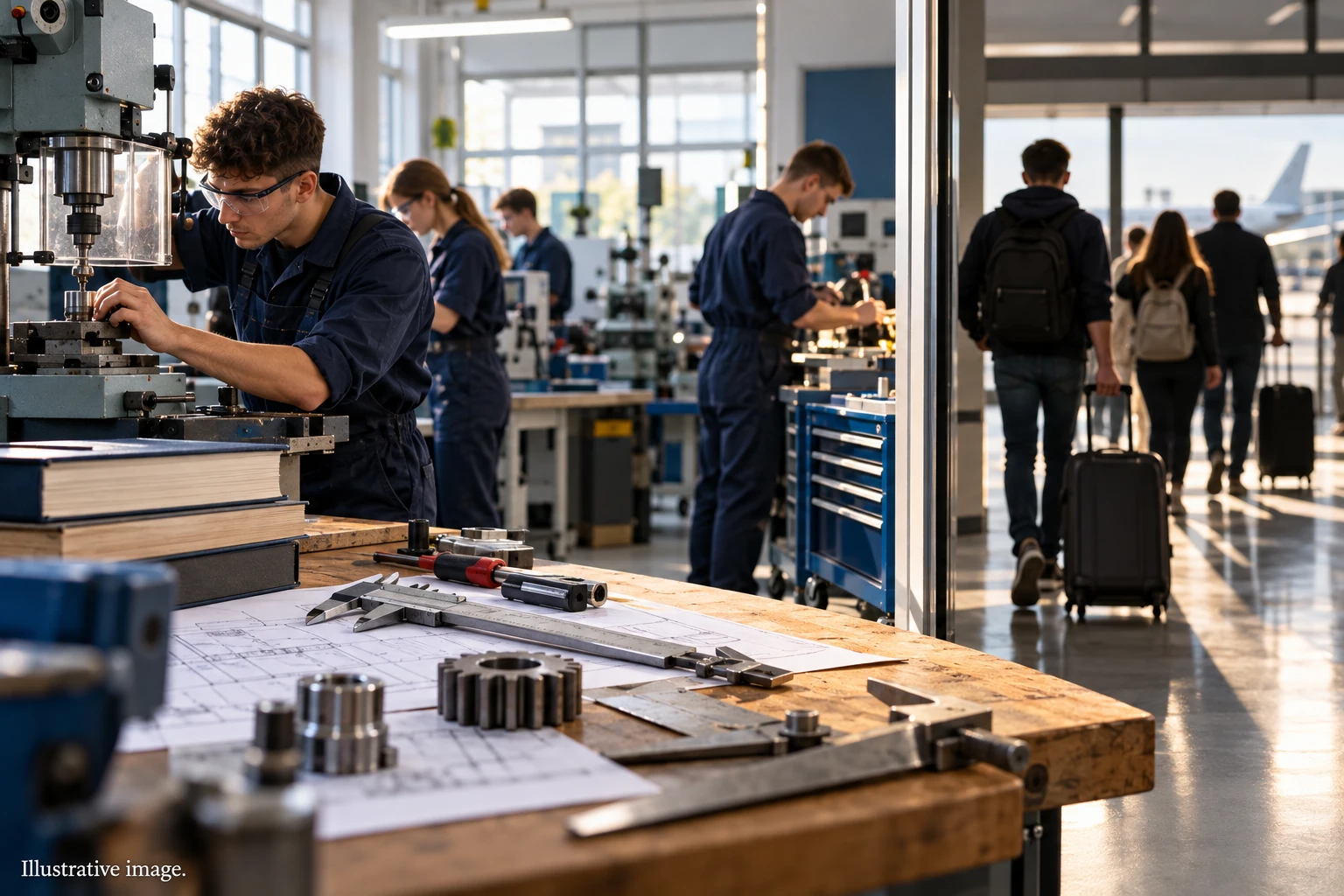
Moldova plans to invest €80 million in the modernization of vocational and technical education by 2032. The funds will be used to renovate 25 educational institutions, which serve more than 21,000 students—approximately 40% of all students in this system. However, an economic question arises: to what extent will investments in buildings, workshops, and equipment help businesses address the shortage of skilled workers, especially in the context of labor migration?
The program calls for the renovation of 47 buildings: 24 academic buildings, including workshops and laboratories, as well as 23 dormitories. In 15 institutions, both classrooms and dormitories will be modernized; in another ten, dormitories will undergo major renovations and be equipped. Eleven institutions are located in Chișinău, and the remaining 14 are in other cities across the country. Of the total amount, €40 million will be contributed by the Republic of Moldova through the Reform and Growth Facility, €33 million will be provided by the Council of Europe Development Bank in the form of a loan, and another €7 million will be provided as a grant through the Neighborhood Investment Platform.
Today, there are 79 vocational and technical education institutions operating in Moldova: 32 vocational schools, 34 colleges, and 13 centers of excellence. Approximately 50,000 people are enrolled in these institutions. Thus, the modernization will cover a significant portion of the students but less than one-third of the educational institutions.
The program is geared toward the needs of sectors such as agriculture, the food industry, construction, energy, and information technology. In these sectors, workers' qualifications directly impact labor productivity, the adoption of new technologies, and enterprises' ability to expand their operations.
However, the mere existence of modern laboratories and workshops does not in itself guarantee that graduates will acquire the skills required by employers. To ensure this, the equipment must correspond to the technologies used in enterprises, and the curriculum must be regularly updated to reflect changes in production.
At the same time, Moldova is developing dual education, in which students combine classroom instruction with practical training at companies. In 2026, 2,757 people enrolled in such programs, filling more than 96% of the available spots. In the 2026–27 academic year, dual education programs are offered at 47 institutions across more than 70 programs. More than 300 companies have expressed their willingness to participate in training students. According to the Ministry of Education, the employment rate for graduates of dual education programs has been around 60% in recent years.
Dual education allows companies to participate in training employees in line with their own production needs. The expansion of this system is not designated as a separate funding line within the €80 million infrastructure program. Therefore, it is crucial to what extent the renovated educational institutions will be able to utilize the new facilities in collaboration with businesses.
In 2026, enrollment in vocational and technical institutions increased by 15%, according to data provided by the Ministry of Education. However, the rise in enrollment does not solve another problem—labor migration. Improving the quality of vocational education expands opportunities for graduates not only in Moldova but also abroad. The decision to stay in the country depends on the availability of jobs, wage levels, and prospects for professional growth. Therefore, even high-quality training for specialists does not guarantee that they will continue to work in the Moldovan economy.
By 2032, the government will be able to assess the program's success based on the number of renovated buildings, equipped workshops and laboratories, and improvements in students' learning and living conditions. The key indicator of the investment's effectiveness is not the number of renovated facilities, but their impact on preparing workers for the Moldovan economy. If the modernization of education is not accompanied by the development of businesses and the creation of attractive jobs, Moldova risks ending up with modern educational institutions whose graduates will, in part, work abroad. // 15.10.2026 — InfoMarket.