


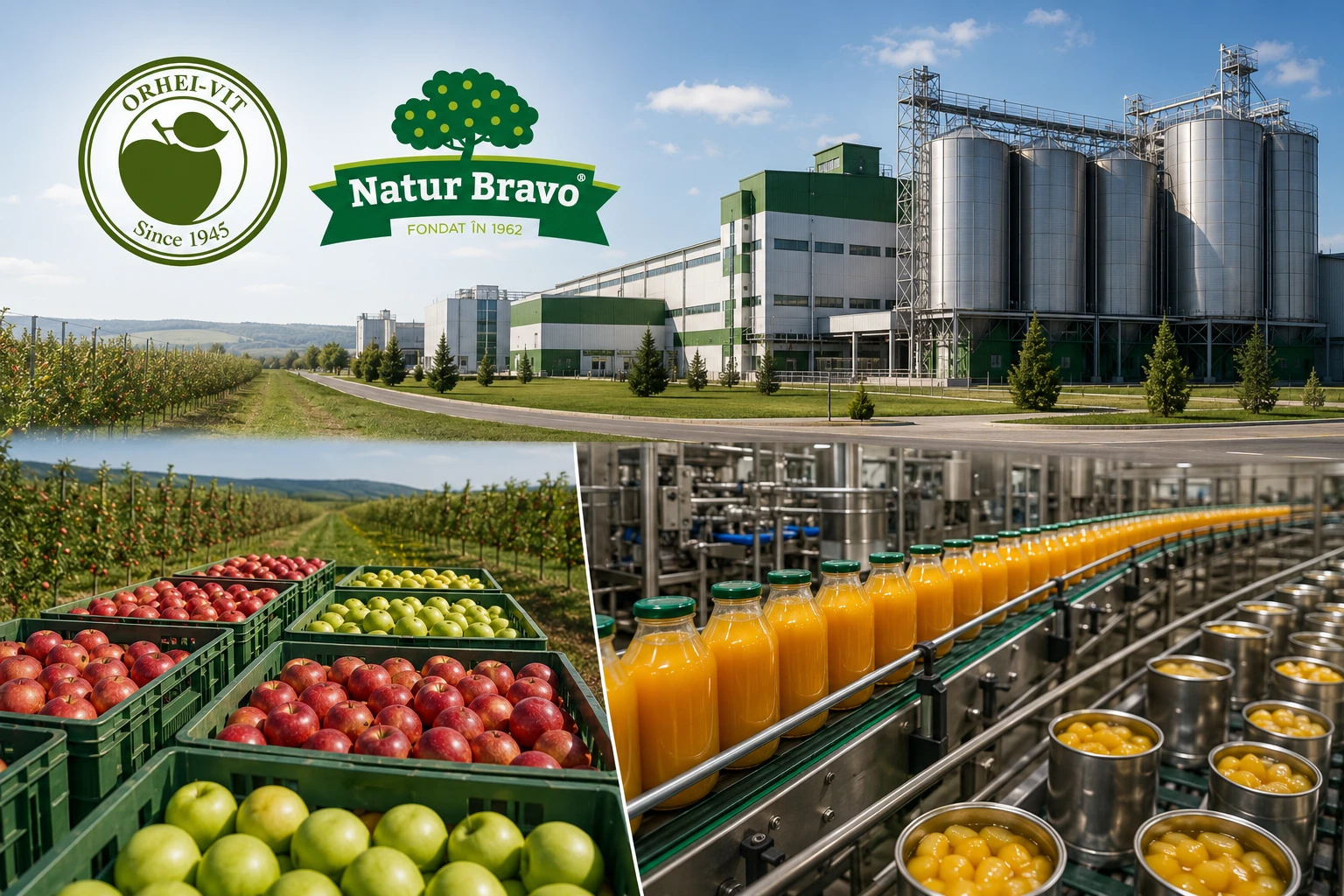
Orhei-Vit, Moldova’s largest fruit and vegetable processing company, is preparing to acquire a portion of Natur Bravo’s assets. The deal has not yet been approved, but it has already raised a key question for the Competition Council: what will happen to the suppliers and employees of the Kupchin facility once the assets of the struggling producer are transferred to a larger market player.
Orhei-Vit notified the Competition Council of the planned merger on February 4. During its preliminary analysis, the regulator concluded that following the deal, fruit and vegetable suppliers who had been working with Natur Bravo could lose access to the sales market. This poses a fundamental risk to the agricultural sector: there are few processing plants in the country, and the ability to sell a harvest often depends not only on price but also on the availability of a buyer capable of purchasing the necessary volumes.
To address the regulator’s concerns, Orhei-Vit proposed a package of commitments. Within three months of receiving authorization, the company is prepared to send cooperation proposals to all current Natur Bravo suppliers. Rejection will be possible only for objective reasons—for example, if the products do not meet quality requirements, the supplier is unable to provide the agreed-upon volume, or has ceased operations.
A more significant commitment concerns procurement volumes. Orhei-Vit promises to purchase annually from Natur Bravo’s current suppliers, over the next three years, at least 90% of the average volume of fruits and vegetables that the company purchased from them over the previous three years. The company also stated that it will apply the same evaluation criteria, payment terms, procurement conditions, and pricing policy to all suppliers—both its own and those transferred from Natur Bravo.
A separate set of commitments relates to the plant in Kupchin. Orhei-Vit is prepared to hire all employees of the plant who wish to continue working, provide them with appropriate working conditions, professional development programs, and market-rate compensation. If the Competition Council approves the proposed model, the company will be required to report twice a year on its compliance with these commitments.
In fact, the regulator is attempting not to block the merger, but to limit its potential negative consequences. This is a telling approach: the transfer of assets to a stronger owner can, in and of itself, preserve production, jobs, and the procurement of agricultural raw materials. At the same time, however, consolidation increases farmers’ dependence on the decisions of a single large processor.
The financial results of the two companies explain the economic logic behind the deal. Orhei-Vit ended 2025 with sales revenue of 717.7 million lei and a net profit of 49.5 million lei. Despite a 15% decline in revenue and a 30.8% drop in profit, the company remained profitable and maintained the scale of its operations: the company operates production facilities in Orhei, Briceni, and Caușeni, as well as an agricultural enterprise, and employs more than a thousand people.
Natur Bravo’s situation is significantly more challenging. The company’s revenue fell from 314.6 million lei in 2024 to 263.8 million lei in 2025. The net loss for the same period rose from 3.6 million to 25.5 million lei. In other words, this is not simply about Orhei-Vit’s expansion, but about the transfer of some of the financially weakened producer’s assets under the control of the industry’s largest player.
For the market, this means further concentration in the processing sector. For Natur Bravo, the deal could be a way to preserve its operating assets. For Kupchin, it’s a chance to save jobs. For farmers, it is an opportunity to retain a buyer, but at the same time, it carries the risk of becoming even more dependent on a single large enterprise.
That is precisely why the key factor will not be the approval of the deal itself, but rather the content and enforcement of the obligations. The guarantee to purchase 90% of previous volumes is valid for only three years. After this period ends, Orhei-Vit will be able to renegotiate its relationships with suppliers without any special restrictions, unless the Competition Council establishes a different mechanism.
The Orhei-Vit and Natur Bravo deal highlights a broader problem in Moldova’s agricultural processing sector: weaker enterprises are gradually losing their independence, while production is becoming concentrated among companies that have capital, sales markets, and the ability to weather poor seasons. Such consolidation could improve the industry’s efficiency, but only if competition, jobs, and a guaranteed market for local producers do not disappear along with the unprofitable assets. //July 21, 2026 – InfoMarket.