


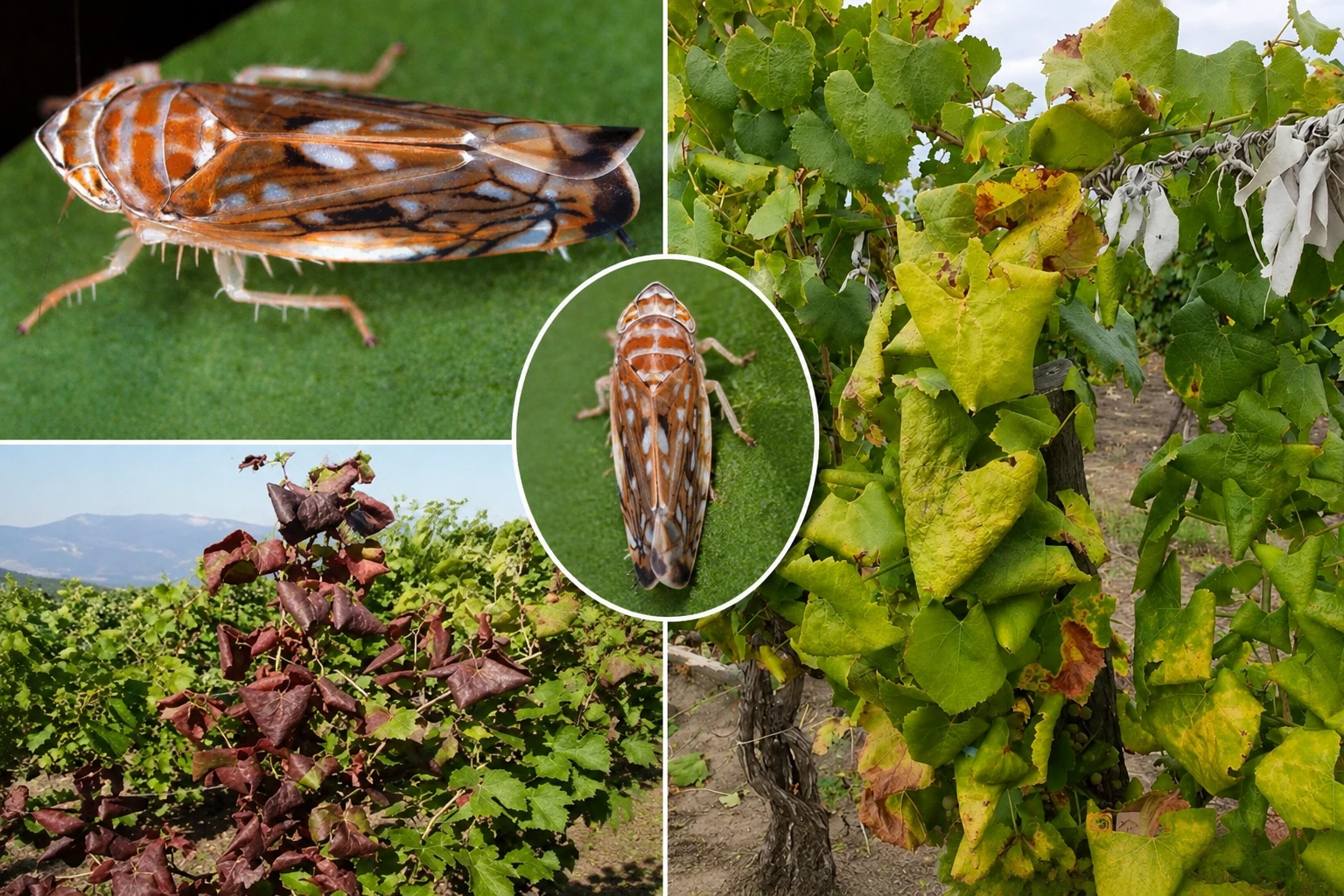
One of the most dangerous quarantine pathogens affecting grapevines—Grapevine flavescence dorée phytoplasma, which causes the so-called golden yellowing disease—has been officially detected for the first time in Moldova's vineyards.However, the significance of this case extends far beyond the mere fact of the infection's detection: it was found, among other places, in mother vineyards, which are used to produce propagation material for grapevines. And this occurred at a time when Moldova is seeking access to the EU market for the export of grapevine planting stock.
The National Food Safety Agency (ANSA) reported on August 28 that outbreaks were identified during phytosanitary surveillance in both fruiting vineyards and mother vineyards. The presence of the pathogen has been confirmed by laboratory tests.
ANSA is already delineating the boundaries of the infected areas, has ordered the removal of affected plants, and is restricting the movement of cuttings, grafts, seedlings, and other material for vegetative propagation. Mother vineyards where the pathogen has been detected must be removed from the relevant registry.
These measures are not extraordinary. This is precisely the purpose of phytosanitary quarantine control: to detect an outbreak before the disease spreads widely. However, in this case, the status of the pathogen itself is significant.
The European and Mediterranean Plant Protection Organization (EPPO) classifies Grapevine flavescence dorée as a Category A2 quarantine organism—a quarantine organism that has already been detected in certain countries in the region but has limited distribution and is subject to official control.
In the European Union, it also has the status of a quarantine pest. The disease is present in a number of EU wine-producing countries, including France, Italy, Romania, Hungary, Spain, and other countries; however, its spread is controlled, and mandatory measures are in place in infected areas to destroy infected plants and combat the vector.
The main danger lies in the mechanism of transmission. "The phytoplasma is transmitted from vine to vine primarily by the grapevine leafhopper Scaphoideus titanus—a small insect that feeds on grape sap and serves as the main vector of the disease.The infection can also spread through infected cuttings and seedlings. Therefore, its detection in mother vineyards is particularly critical: it is from there that planting material is sourced for establishing new vineyards.
Mother plantations are the starting point of the entire chain of planting material production. Their phytosanitary status determines whether the resulting cuttings and seedlings will be able to pass certification and be sold. ANSA explicitly states that infected mother vineyards will be removed from the registry.
There is another important context to consider. Until now, international databases have listed Moldova as a country free from Grapevine flavescence dorée. According to EPPO, the most recent confirmed status was based on surveys in which the disease was not detected.
It is also important to note that Moldova is currently seeking authorization to export grapevine planting material to the European Union. Today, the import of Vitis plants from most third countries into the EU is prohibited. Moldova has requested that the European Union grant an exemption from this ban. In January 2026, the European Food Safety Authority (EFSA) published a separate phytosanitary risk assessment of Moldovan grapevine seedlings.
The documentation prepared by Moldova indicated that Grapevine flavescence dorée is controlled through national monitoring and that no violations were detected during previous laboratory tests. EFSA assessed the likelihood of harmful organisms entering the EU via Moldovan grapevine cuttings specifically in light of the existing control system and the data provided by Moldova.
In March, the issue had already been reviewed by the relevant committee of the European Commission. European Commission representatives noted at the time that a decision must first be made specifically regarding the phytosanitary ban, and only then should the equivalence of Moldovan planting material to European standards be considered.
The detection of Flavescence dorée does not automatically mean a rejection of Moldova's application. The disease is also present within the EU itself, and European regulations provide for the management of infected areas, the destruction of infected plants, and the establishment of buffer zones.
But now Moldova will have to prove not only the effectiveness of its system for preventing a disease that was previously thought not to exist, but also its ability to contain already confirmed outbreaks, remove infected planting material from circulation, and prevent the further spread of the infection.
The scale of the problem is still unknown. ANSA has not reported the area of the infected vineyards, the number of identified outbreaks, or the number of affected mother vines. There is also no data yet on how widespread the vector leafhopper is in these areas.
It is not yet clear whether this latest discovery is a localized phytosanitary incident or will develop into a problem for the industry. Moldova has been building the control system necessary to gain new opportunities for exporting agricultural products to the EU for several years. In the case of grapevine planting stock, this process has already reached the review stage at the European Commission. Now, the effectiveness of this system will have to be demonstrated not on paper, but in a real quarantine outbreak. //September 1, 2028 – InfoMarket.