


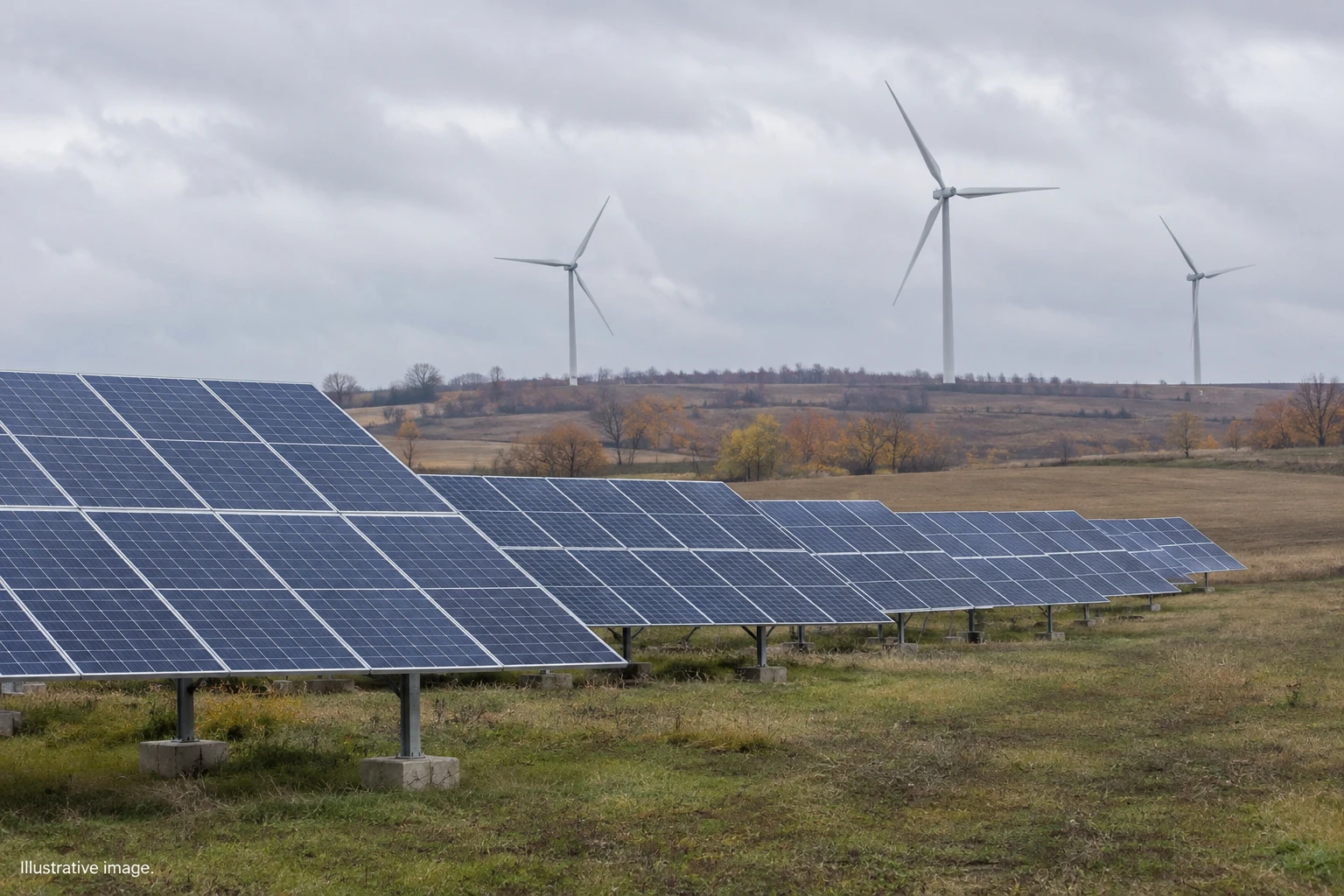
Moldova is ramping up solar and wind power generation in an effort to reduce its dependence on imports. However, some solar and wind power producers operating without guaranteed feed-in tariffs have already reduced or suspended generation due to new financial settlement rules. The government requires payment for deviations between actual and planned generation volumes, while investors claim they lack sufficient capacity to manage the resulting costs. At the same time, the authorities are attracting new investment in green energy by offering long-term guarantees and focusing on battery-based energy storage systems. On the one hand, the country is encouraging the construction of new capacity; on the other, operating conditions for some existing power plants are becoming economically unviable.
By the end of September 2026, Moldova's installed renewable energy capacity reached 1,137 MW, having increased by 156 MW—or 15.9 percent—over the course of nine months. Solar power plants account for nearly 852 MW, while wind power plants account for another 260 MW. Of this total, 654 MW—or 57.5% of the total capacity—comes from producers who sell electricity at market prices, without a state-guaranteed purchase price.
The conflict primarily affected solar and wind power producers operating in the free market. Their interests are represented by companies responsible for system balancing: Navitas Energy, ML Energy Group, Videsec&Co, Trade Energo Plus, and Alectrona Energy. Collectively, they operate 334 generating facilities with an installed capacity of 584 MW. The producers announced a reduction in generation starting November 16 and a possible complete shutdown starting November 17. According to Renergy, by November 16, production had been halted or restricted at facilities with a total capacity of approximately 526 MW. The reason was a sharp increase in electricity balancing costs: according to market participants, they were charged 60.2 million lei (excluding VAT) in July alone.
Solar and wind power plants depend on weather conditions, so actual generation does not always match preliminary forecasts. Any resulting deviations must be compensated for to maintain the stability of the power grid. Since July 1, 2026, Moldova has been using a single imbalance price settlement mechanism in line with the European model. However, such a system requires the ability to adjust declared electricity volumes in a timely manner.
According to producers, organized auctions lack sufficient liquidity, there are no transactions during certain hours, and bilateral trading is not functioning properly. The situation has been complicated by the termination of previous contracts with regulated suppliers and Energocom's decision, effective in August, to stop purchasing under flexible contracts. As a result, companies are not always able to find buyers or adjust supply volumes, but are forced to pay for any resulting imbalances.
According to producers, in July, the imbalance price reached the established thresholds of 7,900 or 12,000 lei per MWh in 465 out of 744 hourly intervals. In 386 intervals, the price was negative. These figures may overlap. The calculations for July were published only on October 12. Producers also claim that Moldelectrica is late in providing the data necessary to assess the financial consequences of imbalances. The validity of the charges requires verification by the regulator.
Energy Minister Dorin Junghietu emphasizes that this is not a matter of fines, but of mandatory settlements between market participants and the system operator. According to him, 11 out of 20 balancing groups complied with the rules. There is economic logic behind the government's position: maintaining the stability of the power system entails costs that cannot be passed on to other market participants or consumers. However, it is necessary to determine to what extent the charges reflect the actual costs of balancing.
Following the reduction in generation on November 16, a meeting was held between producers and the Ministry of Energy, ANRE, and Moldelectrica. The possibility of changing the calculation formula was discussed, including with regard to charges for July through October. The next meeting is scheduled for November 23. Producers are proposing a transition period until July 1, 2027, during which either the previous imbalance calculation formula or the dual-price mechanism would be applied. A final decision has not yet been made.
The regulator itself acknowledges the market's problems. ANRE has postponed the mandatory transition of medium and large enterprises to the free electricity market from January 1 to July 1, 2027, due to insufficient trading liquidity and limited competition. Thus, consumers are given additional time to adapt, while renewable energy producers have already faced the financial consequences of the new rules.
Herewith, the government continues to attract investment in new capacity. On November 12, the government approved the results of an auction for the construction of 170 MW of wind power plants with batteries totaling 150.57 MWh in capacity. The winners will receive a support mechanism with predictable terms for selling electricity for 15 years. The weighted average price of the winning bids was 1.25 lei per kWh, excluding VAT.
Thus, the government is offering long-term guarantees to new investors, while some existing producers in the free market have faced unforeseen expenses. Batteries can help reduce imbalances, but for power plants already built with bank loans, installing them means additional investment. Furthermore, batteries do not replace the ability to sell surplus electricity in a timely manner or purchase missing volumes of electricity.
The consequences of shutting down green power generation could affect the entire power grid. According to the Ministry of Energy, from November 9 to 15, domestic production accounted for about 40% of electricity consumption on the right bank of the Dniester—42,083 out of 103,701 MWh. The remaining demand was covered by imports from Romania and Ukraine. These figures refer to the period prior to the announced shutdown but illustrate the country's dependence on external supplies, which could intensify if domestic generation declines.
The reform proved to be inconsistent. New financial obligations took effect before the conditions for full-scale electricity trading were in place. At the same time, the government is offering long-term guarantees to new investors, while existing power plants are seeking a revision of the payment terms, which they claim make production unprofitable.
As a result, Moldova risks finding itself in a situation where newly built power plants will sit idle, and the demand for electricity will have to be met through additional imports. The development of energy storage systems will help reduce these imbalances, but without transparent calculations, effective trading, and predictable rules, further investment in green energy will be in question. // 18.11.2026 – InfoMarket.