


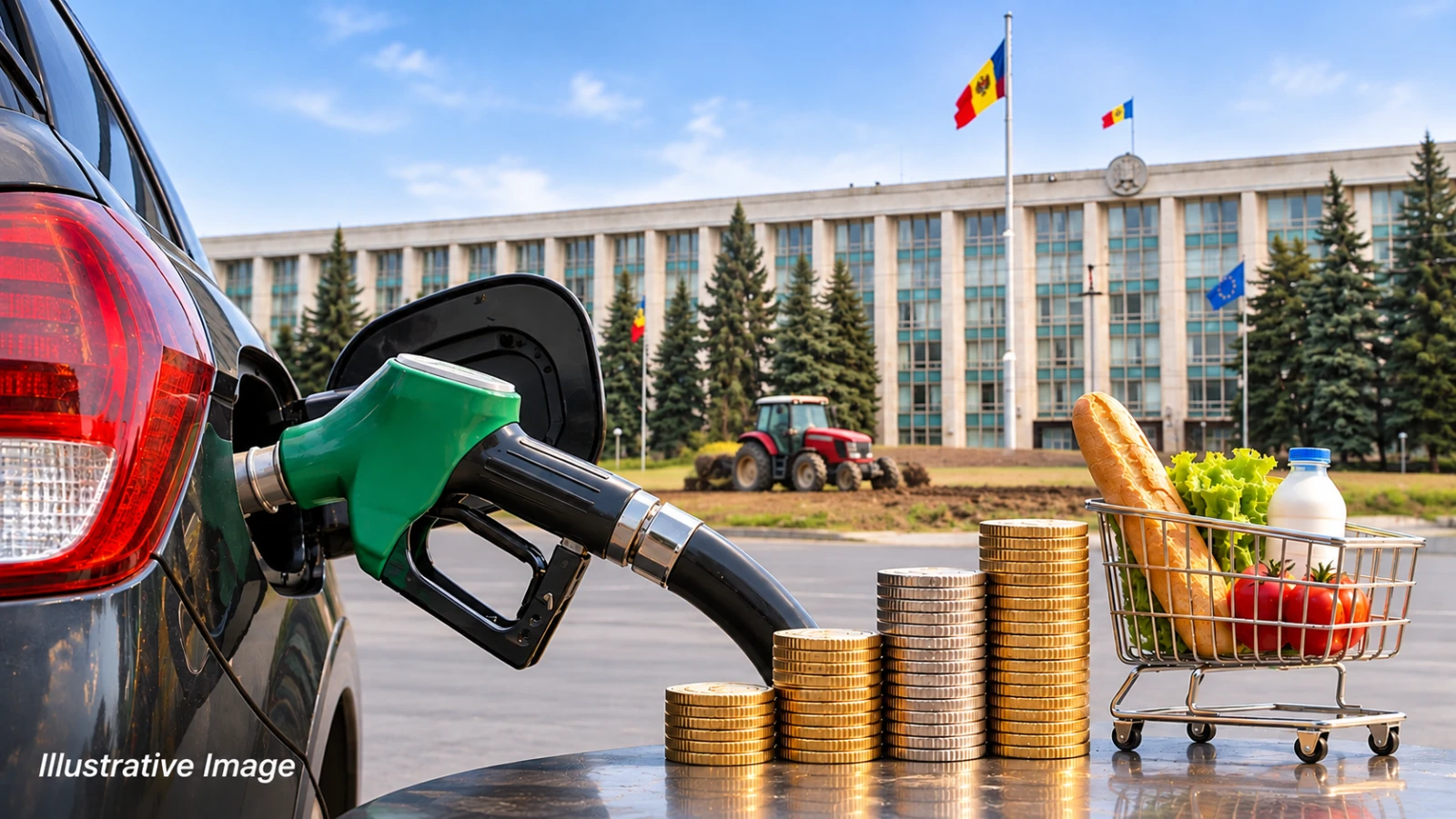
The Moldovan government has opposed the temporary suspension of the 20 percent VAT on gasoline and diesel fuel, despite the state of emergency in the energy sector and rising prices for petroleum products. Authorities explain their position by citing the need to preserve budget revenues and fund government obligations. However, for transportation, agriculture, and other sectors, fuel remains a significant component of production costs. The government is seeking to maintain tax revenues, while the economy continues to feel the effects of the protracted energy crisis.
At a meeting on November 12, the government reviewed a legislative initiative by the MPs from the Socialist Party that would temporarily reduce the VAT on gasoline and diesel fuel from 20% to zero. The Ministry of Finance issued a negative opinion on the bill. The authors of the initiative proposed this measure to mitigate the impact of rising prices on the public and businesses during the state of emergency in the energy sector.
In justifying its negative opinion, the government points out that eliminating the VAT would lead to a significant reduction in budget revenues. At the same time, the authors of the initiative did not specify sources to compensate for the lost revenue. According to the authorities' assessment, this poses risks to the financing of planned expenditures, including salaries, pensions, and social programs. Without compensation, the government would have to reallocate funds, cut budget programs, or increase borrowing.
This is not the first such initiative. Back in the spring of 2026, the government opposed proposals to lower the VAT on fuel to 10%, as well as to 12% with a simultaneous reduction in excise taxes. Thus, maintaining the current taxation of petroleum products has become a consistent policy of the authorities.
But there is another side to the issue. For consumers, VAT directly affects the cost of filling up a car. For businesses, the consequences depend on the tax regime: VAT payers entitled to a full deduction can offset input tax, although paying it temporarily ties up working capital. For other buyers, VAT becomes part of their expenses. At the same time, rising fuel prices increase production, transportation, and logistics costs regardless of how the tax is offset.
How much could the price drop if VAT were eliminated? Assuming the pre-tax price remains unchanged, reducing the rate from 20% to zero would mathematically lower the final price by 16.7%, not 20%. For example, if a liter costs 30 lei including VAT, it would cost 25 lei without the tax. However, a reduction in the tax rate does not guarantee a proportional decrease in prices at gas stations: some of the tax savings may remain with suppliers and retailers. The actual effect depends on the purchase price, the exchange rate, excise taxes, retail markups, and the extent to which the tax reduction is passed on to end consumers.
For some reason, the government offers another argument: a zero VAT rate does not solve the problem of the security of petroleum product supplies, since it does not increase reserves, diversify imports, or develop logistics infrastructure. However, this argument does not address the main issue of the tax initiative. Its goal is to make fuel more affordable for consumers, not to ensure physical supply. Therefore, it is incorrect to evaluate the proposal solely from the perspective of import security.
Among the anti-crisis measures already adopted, the authorities cite the mechanism for setting a maximum price for diesel fuel, restrictions on the export and re-export of petroleum products from the port of Giurgiulești, a 40-liter limit on fuel sales in containers, and a reduction of at least 20% in fuel consumption by government agencies. Again, most of these measures are aimed at managing supply and consumption, rather than reducing the financial burden on consumers.
As an alternative to a blanket reduction in the VAT rate, the government proposes providing targeted support to the most vulnerable consumers and sectors. This approach allows budget funds to be concentrated on those who are particularly in need of assistance, whereas a zero rate would apply to all buyers regardless of their income and needs. However, targeted support requires clear criteria, funding, and a functioning mechanism for delivering assistance. The anti-crisis measures listed by the authorities primarily regulate fuel supply and consumption rather than offsetting rising fuel prices.
This choice is particularly acute against the backdrop of inflation. According to the National Bureau of Statistics, in October 2026, annual inflation in Moldova reached 10.77%, more than double the National Bank's target of 5% (±1.5 percentage points). At the same time, over the past 12 months, diesel prices rose by 82% and gasoline prices by 46.8%. Petroleum products have risen in price significantly faster than the general level of consumer prices, putting increased pressure on household purchasing power and production costs.
In the context of double-digit inflation, the decision not to lower the VAT may be justified by the need to preserve budget revenues. However, maintaining the tax does not in itself solve the problem of rising fuel prices. If the government considers targeted support to be a more effective alternative, the question arises as to which specific categories of consumers will receive such assistance, in what amount, and from which sources. For now, the budget losses from reducing the VAT are being estimated, while the economic consequences of maintaining the current tax burden remain without a comparable assessment. // 14.11.2026 - InfoMarket.