


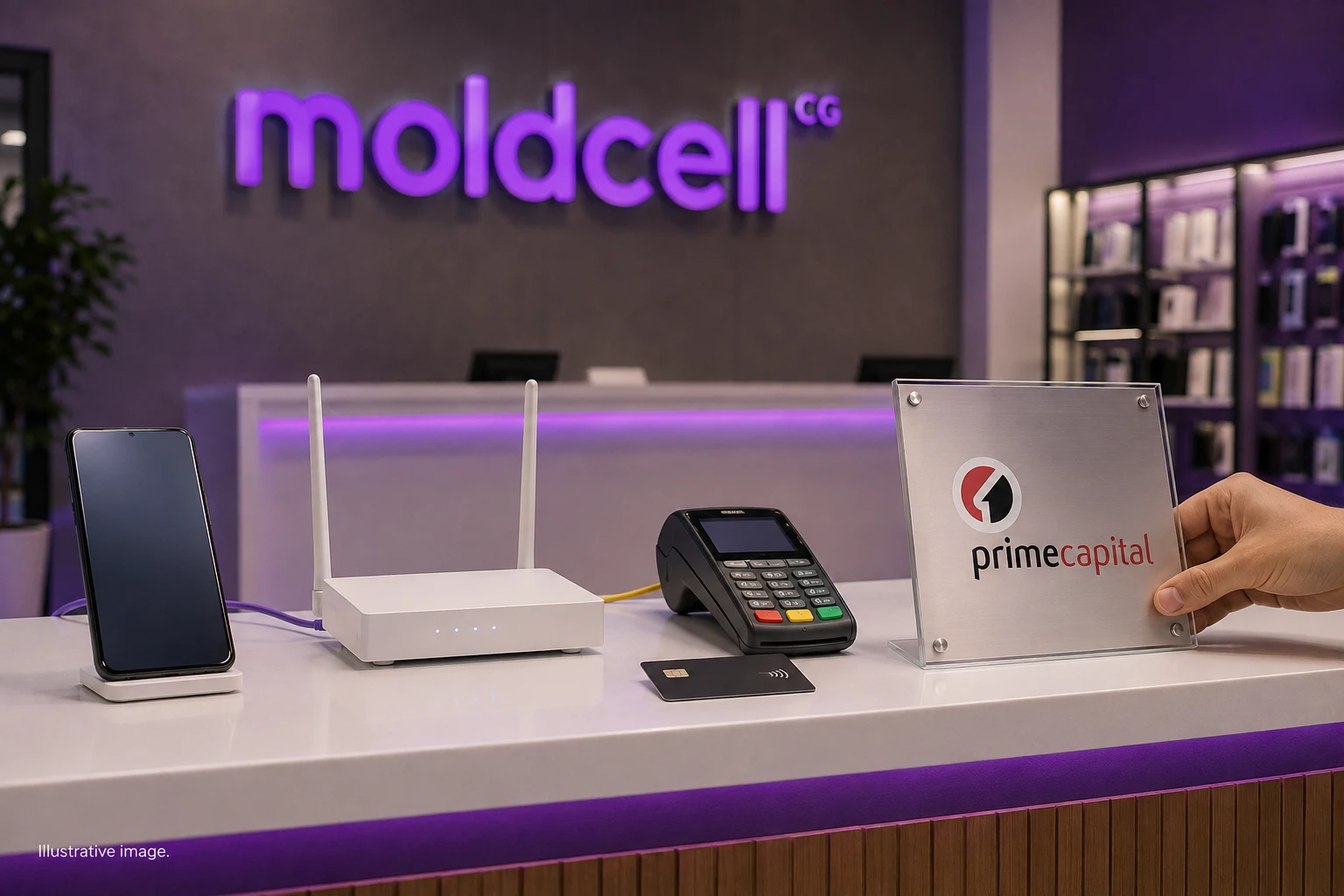
On August 4, 2026, Moldcell announced the completion of its acquisition of a 67% stake in Prime Capital, a non-bank lending institution. For the operator, this is more than just an investment in a new business: lending is now being added to its existing offerings of mobile communications, internet, e-wallet, and payment services. The company will be able to combine payments, money transfers, and loans into a single ecosystem.
The operator first announced its intention to acquire Prime Capital back in July 2025. A year later, Moldcell announced the completion of the deal, the details of which—including its value—have not been disclosed. The remaining 33% was acquired by NCM United SRL.
The seller of the 100% stake was Cyprus-registered Trittico Holdings Limited—the former sole owner of Prime Capital. In its initial announcement regarding the pending transaction, Moldcell identified Trittico as part of the U.S.-based private equity group NCH. In an extract from the Public Services Agency published by Prime Capital prior to the change in ownership structure, Moris Tabacinic and George Rohr—the founders of NCH—were listed as the beneficial owners of Prime Capital.
Prime Capital was not Trittico's only Moldovan asset. It is also the sole owner of Coliseum Palace SRL—the company that served as the developer of the residential complex of the same name on Nicolae Dimo Street in Chisinau. However, Coliseum Palace SRL has been in the process of liquidation since April 2026. Another company established by Trittico in 2006, Island Capital, has also been in the process of liquidation since April 2026. Thus, the liquidation of these two companies and the sale of Prime Capital effectively bring NCH's 20-year presence in Moldova to an end.
In the Competition Council's notification regarding the transaction, NCM United SRL is named as Moldcell's new local partner, and the economic concentration itself is described as the establishment of joint control by Moldcell and NCM United over Prime Capital.
NCM United SRL was registered on July 4, 2025—shortly before the first report of the pending transaction. Carmina Vicol owns 60% of the company, while Nicoletta Filip and Monica Vicol-Droste each own 20%. Carmina Vicol is the CEO of Prime Capital. This structure allows for the continued involvement of a local management team familiar with the company's loan portfolio and clients.
It is worth noting the existence of another Moldovan company with almost the same name—Prime Capital 2, registered in 2008 under IDNO 1008600039937. This is an independent legal entity, with Carmina Vicol listed as its sole owner and administrator. Prime Capital 2 is included in the National Bank's current register of non-bank credit organizations. However, Prime Capital 2 is not mentioned at all in either the operator's announcement regarding the acquisition of Prime Capital or in the Competition Council's statements.
The subject of the Moldcell transaction is another company—OCN Prime Capital, with IDNO 1005600041908. So far, Prime Capital 2 has not been named in either the operator's announcement regarding the acquisition or in the Competition Council's announcements.
The target of the transaction—OCN Prime Capital (IDNO 1005600041908)—was registered in 2005 and has been operating in the Moldovan market since 2006. It began as a specialized mortgage lender and later expanded its activities to include financing for home repairs and construction, consumer loans, loans to small and medium-sized businesses, agricultural lending, and factoring.
According to Prime Capital's own data, over the past two decades it has provided approximately $200 million to about 10,000 clients. This represents the cumulative amount of financing disbursed over the entire period of operation, not the size of the current loan portfolio.
As of the end of 2025, Prime Capital's assets totaled 329.1 million lei. Long-term financial investments amounted to 291.4 million lei, while current financial investments stood at 15.7 million lei.
Prime Capital's equity at year-end stood at 180.9 million lei, while liabilities, including provisions, totaled approximately 148.3 million lei. Bank loans and other borrowings amounted to 141.2 million lei.
The last full year before the transaction was completed was a challenging one for Prime Capital. Revenue from sales declined from 68.6 million lei in 2024 to 63.7 million in 2025. Net income fell from 29.7 million to 8.4 million lei—a decline of nearly 72%. The financial results were impacted by an increase in administrative and financial expenses, as well as a decrease in operating profit.
In 2025, the Moldcell Group reported consolidated revenue of approximately 1.58 billion lei, net income of nearly 126 million lei, and total assets of 1.65 billion lei. In other words, Prime Capital's assets are equivalent to about one-fifth of the Moldcell Group's assets.
Prime Capital's main value lies not so much in its current profits as in its established lending infrastructure. The company has specialists in borrower assessment, existing products, a customer history, financing agreements, regional branches, and experience working with collateral. Building such a system from scratch would require time, specialists, and navigating a separate regulatory process.
Moldcell already holds a license to issue electronic money, granted by the National Bank in 2022. Through Moldcell Money, users can pay for services, transfer money, use the MIA instant payment system, and access a digital Visa card. Prior to the acquisition of Prime Capital, the operator provided a payment channel but did not have its own credit institution.
The economic rationale behind the deal is based on the integration of channels. The mobile operator has a broad customer base, an app, a network of stores, a user identification system, and constant digital contact with its customers. Prime Capital brings expertise in credit risk assessment and loan origination. In the future, the application process, decision-making, fund transfer, and loan repayment can be consolidated into a single digital workflow.
For Moldcell, this is an opportunity to generate revenue not only from telecommunications and payment transactions but also from interest and fees. For Prime Capital, it means access to a broader audience and a potential reduction in customer acquisition costs. A user who already pays for telecommunications, utilities, or money transfers through the app may be less expensive for the lender than a customer acquired through separate advertising or via a physical branch.
However, the merger itself does not guarantee lower interest rates. Prime Capital remains a non-bank lending organization and cannot accept deposits from the public. It must finance its lending activities using its own capital, bank loans, shareholder loans, and external credit lines.
Banks derive a significant portion of their funds from deposits and therefore have access to cheaper financing, especially for long-term mortgage loans. Speed, convenience, and a streamlined digital process could become a competitive advantage for Moldcell and Prime Capital, but not necessarily lower interest rates. The actual impact on the borrower will depend on the speed of decision-making, the total cost of the loan, fees, collateral requirements, and methods for assessing creditworthiness.
A separate risk is associated with the use of customer data. A single group will include a telecommunications operator, an e-money issuer, and a lending institution. In theory, information about payment behavior could help assess borrowers more accurately. However, the fact that these companies are owned by the same entity does not automatically give them the right to freely combine telecommunications, payment, and credit data.
The practical integration of these services will depend on the legal basis under which the companies exchange data, what information they use, and how clearly they explain this to the customer.
The National Bank's specific requirements for responsible lending apply primarily to consumer loans to individuals. They do not cover financing for legal entities and business loans to the same extent. This is important for Prime Capital, as the company works not only with individuals but also with small and medium-sized businesses and agricultural producers.
Regulators must also ensure that product bundling does not result in the imposition of tied services. The law explicitly prohibits non-bank lending oraganizations from making the provision of a loan contingent upon the purchase of additional services offered by the lending oragization itself. Extending this restriction to products offered by another legal entity within the same group will require an assessment of the specific sales model. In any case, the customer must understand which company provides each service, how much it costs, and where to file a complaint.
Moldcell is gradually moving beyond the traditional telecommunications business. The operator is not transforming into a bank, but is bringing two regulated financial sectors—payment infrastructure and non-bank lending—under a single corporate umbrella. This lays the foundation for a fintech model in which the customer's journey begins with an e-wallet and may continue with obtaining a loan. // 06.08.2026 – InfoMarket.