


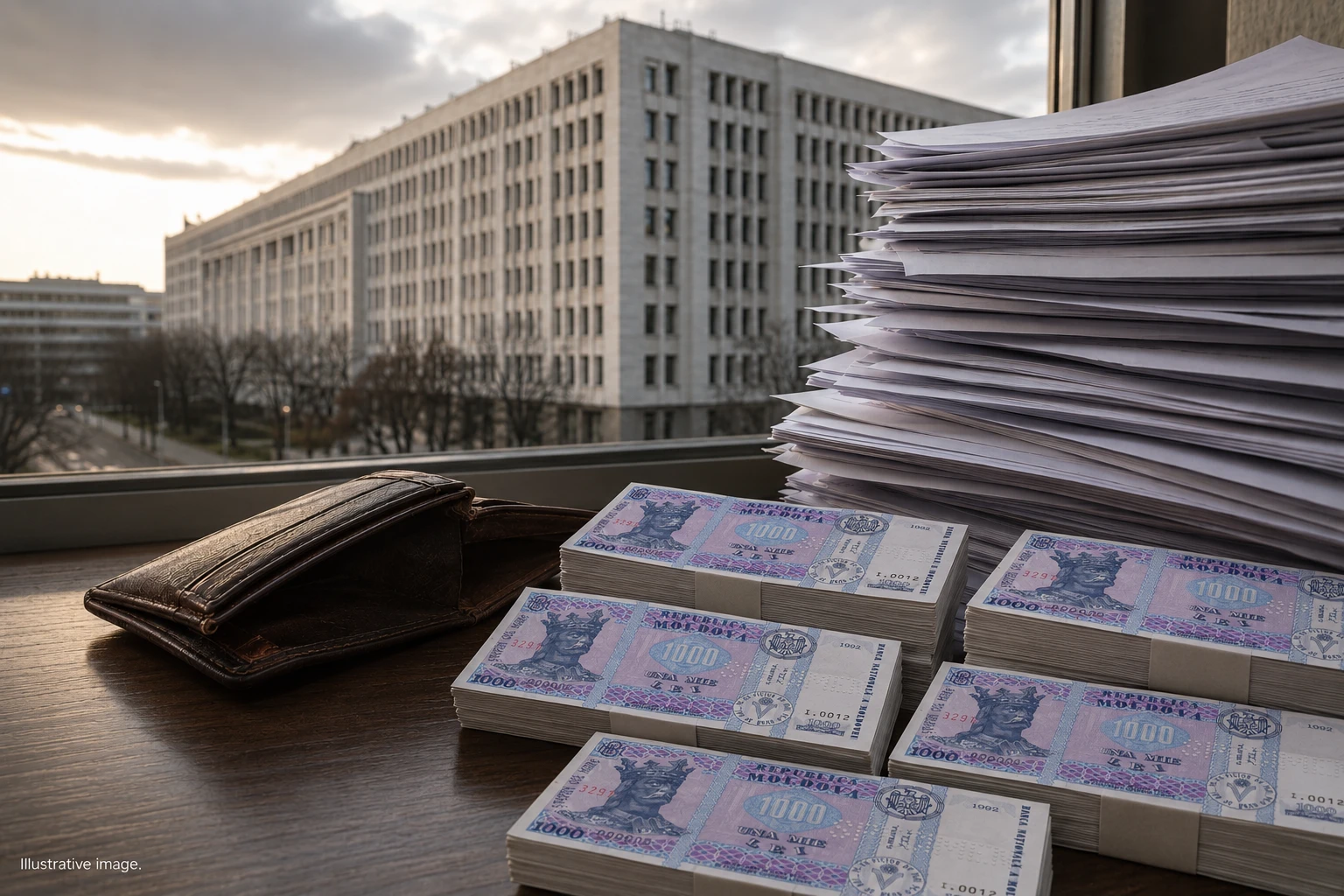
Moldova’s state budget revenues rose by only 0.7% in the first half of 2026, while expenditures increased by 4.2% and the deficit by more than 21%. These figures do not yet indicate problems with the implementation of the annual budget, but they do highlight the limited nature of the financial reserve. The new government has already confirmed that some taxes will be adjusted and certain tax breaks will be eliminated. The question now is not whether a tax increase can be avoided entirely, but rather who exactly will bear the additional burden.
From January through June, state budget revenues totaled 37 billion 029.6 million lei—270 million lei more than during the same period in 2025. Expenditures reached approximately 46.24 billion lei, an increase of 4.2%. The deficit stood at 9.21 billion lei, compared to approximately 7.6 billion lei a year earlier.
This does not yet constitute a failure of the budget plan. Revenues and expenditures are received unevenly, and for the full year of 2026, the state budget deficit is initially projected at 20.9 billion lei, or 5.5% of GDP. With revenues of 79.67 billion lei, expenditures are projected at 100.57 billion lei. Thus, approximately 44% of the annual deficit has accumulated over the first six months.
A more significant indicator is the gap between revenue and expenditure trends. The government is spending more than it did a year ago, while total revenue has barely increased. At the same time, the weak growth in total revenue cannot be attributed to a decline in tax collection: revenues administered by the Tax and Customs Services have increased. The overall result was held back by a decline in other sources, primarily grants.
It is important here not to confuse the state budget with the entire national public budget. Contributions to state social and mandatory health insurance go into separate budgets and cannot be used as evidence of growth in the state budget’s own revenues. It is the state budget that finances a significant portion of transfers to social, health, and local budgets; therefore, an increase in their own revenues does not alleviate the pressure on central government finances.
The adopted budget already assumed that expenditures in 2026 would grow faster than revenues: by 7% and 5.1%, respectively. The government attributed the increase in the deficit to investments in infrastructure and the economy. However, at the same time, the government must find funds for new expenditures, including public sector wage reform and other announced reforms.
However, the search for additional revenue must be accompanied by a review of the government’s own expenditures. The government needs to assess the effectiveness of budget programs, the structure of the administrative apparatus, and the number of civil servants. This is not about mechanical staff cuts, but rather an audit of government functions: which ones overlap, which can be digitized, and where costs do not yield commensurate results. Without such an assessment, raising certain taxes and eliminating tax breaks will appear to be a shift of the costs of the growing government apparatus onto businesses and citizens.
Against this backdrop, the tax policy for 2027 becomes a means not only to reform the system but also to broaden the tax base. The first draft, presented by the previous government, combined a reduction in the tax burden for some groups with an increase for others.
It proposed reducing the income tax rate from 12% to 7% for individuals with annual incomes of up to 1 million lei and setting a 15% rate for higher incomes. For companies, a zero rate was envisaged on retained earnings, but upon distribution, the tax was to be 15%, and the tax on dividends was to increase from 6% to 7%.
The draft also called for a reduction in VAT exemptions and reduced rates, the accelerated alignment of excise taxes with EU minimum levels, and the introduction of new excise taxes on e-cigarette liquids, sweetened carbonated beverages, and fireworks. For self-employed individuals, the proposed rates were 15% for income up to 1 million lei and 30% for income exceeding that threshold. According to the previous government’s calculations, the entire package was expected to reduce the 2027 budget deficit by approximately 6 billion lei.
However, this version can no longer be considered the government’s current proposal. Following the cabinet reshuffle, Finance Minister Victoria Belous announced that the document would be revised and resubmitted for consultation. The government has abandoned plans to raise the VAT on medicines from 8% to 20%, as well as the so-called “wedding tax.” It remains unclear whether the remaining proposed rates and exemptions will be retained.
At the same time, the minister explicitly confirmed the general direction: tax collection will be strengthened, some tax rates will be adjusted, and exemptions that the authorities deem to have outlived their purpose will be eliminated. Therefore, the Ministry of Finance intends to reassess preferential tax rates. The updated concept is scheduled to be presented by August 6.
Therefore, it would be incorrect to say that the government has completely ruled out raising taxes. Increases in certain taxes and the reduction of some tax breaks have been confirmed as the direction of future policy. However, it cannot yet be said that the overall tax burden will increase for everyone: at the same time, taxes on labor or reinvested profits may be reduced.
The main issue is the distribution of the tax burden. If additional revenue is generated primarily through consumer taxes and the elimination of reduced VAT rates, the costs may be passed on to prices. If the focus is placed on distributable profits and high incomes, the main burden will fall on the relevant companies and taxpayers. If, however, the authorities limit themselves to improving tax administration, the stated budgetary effect may prove insufficient.
The results for the first half of the year do not indicate a budget crisis, but they do show why the government is seeking additional resources. However, budget consolidation should not be limited to raising specific taxes, eliminating tax breaks, and increasing borrowing. The government must also review its own expenditures—the effectiveness of budget programs, the structure of the administrative apparatus, and the justification for its staffing levels. Otherwise, the bulk of the cost of growing obligations will be shifted onto businesses and citizens, while the efficiency of the government apparatus itself will remain outside the scope of reform. //July 28, 2026 – InfoMarket.