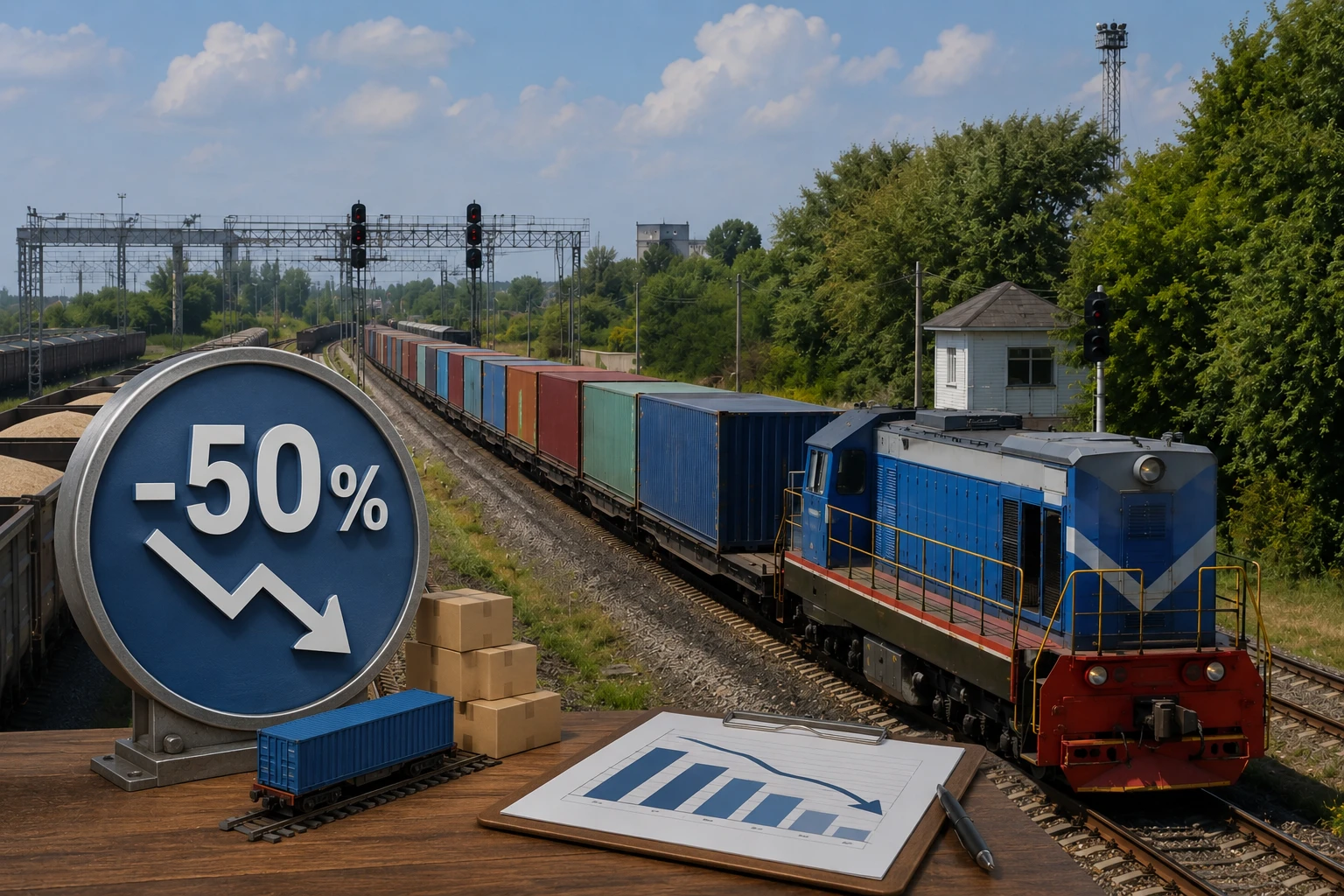
The ministry noted that it understands farmers' concerns; at the same time, it considers it important that public discussions be based on actual data and the terms of the mechanism, rather than on scenarios presented as consequences of events that have already occurred. The Ministry of Infrastructure and Regional Development noted that transit goods do not enter the Moldovan market. The 50% reduction applies exclusively to the rail transit of Ukrainian goods. Transit does not constitute importation and does not automatically place Moldovan products in direct competition with Ukrainian products. Goods remain under customs control until they are exported from the country. Shipments are registered and tracked electronically through the European NCTS system based on customs declarations and guarantees valid until the point of destination. As emphasized by the Ministry of Infrastructure and Regional Development, any decisions regarding import licensing are a separate matter and should not be confused with the tariff applied to rail transit shipments. Moldovan exports will not be displaced by transit flows. Moldova aims to attract approximately 600,000 metric tons of cargo that Ukraine intends to transport via a number of regional routes by the end of 2026. The figure of 4.5 million metric tons, which has been discussed in public, represents the estimated annual capacity of a potential rail corridor, not an agreed-upon volume for the coming months. The state-owned enterprise "Moldovan Railways" will organize transportation based on the actual capacity of the infrastructure, the availability of rolling stock, train schedules, and orders from Moldovan exporters. The Ministry of Infrastructure and Regional Development continuously monitors this data, and the mechanism will be adjusted in the event of delays or pressure on national exports. "The interests of Moldovan farmers and exporters are a prerequisite for the mechanism's operation, not an issue we will analyze only after problems arise. The transit discount provided does not increase costs for Moldovan producers. The preferential rate is a separate commercial offer designed to attract additional cargo volumes. It does not change the rates applied to Moldovan exporters, and the difference will not be passed on to local producers," the ministry stated. The ministry emphasized that for the Moldovan Railways, attracting additional cargo volumes means new revenue. Even with a reduced tariff, guaranteed volumes can bring the company millions of euros and support the operation and development of the railway infrastructure. "The alternative is not to choose between Ukrainian and Moldovan production. The alternative is either to utilize the transit flow—which can generate revenue for Moldova—or to lose it to other regional routes," noted the Ministry of Infrastructure and Regional Development. The ministry emphasized that it had anticipated these risks and is taking measures to prevent them by limiting volumes, planning shipments, monitoring railway capacity, and coordinating actions with operators in Ukraine and Romania. "We respect the right of farmers' associations to report problems. However, repeating hypothetical scenarios does not turn them into facts. At present, there is no evidence that the mechanism has blocked Moldovan exports, increased costs for local producers, or allowed the domestic market to sell goods declared as being in transit," the ministry stated. As noted, the ministry remains open to dialogue with farmers and exporters and will transparently report data on transported volumes, utilized capacity, and potential operational difficulties. "Moldova can support Ukraine, ensure revenue for the railway company, and at the same time protect the interests of domestic producers. These goals are not mutually exclusive if the process is managed responsibly and based on real data," the ministry stated. // 13.08.2026 — InfoMarket
The transit of Ukrainian cargo via Moldova's railways will generate revenue and will not hinder Moldovan exports
The transit of Ukrainian cargo via Moldova's railways will not hinder the export of Moldovan products and will generate significant revenue for the Moldovan Railways—Ministry of Infrastructure and Regional Development