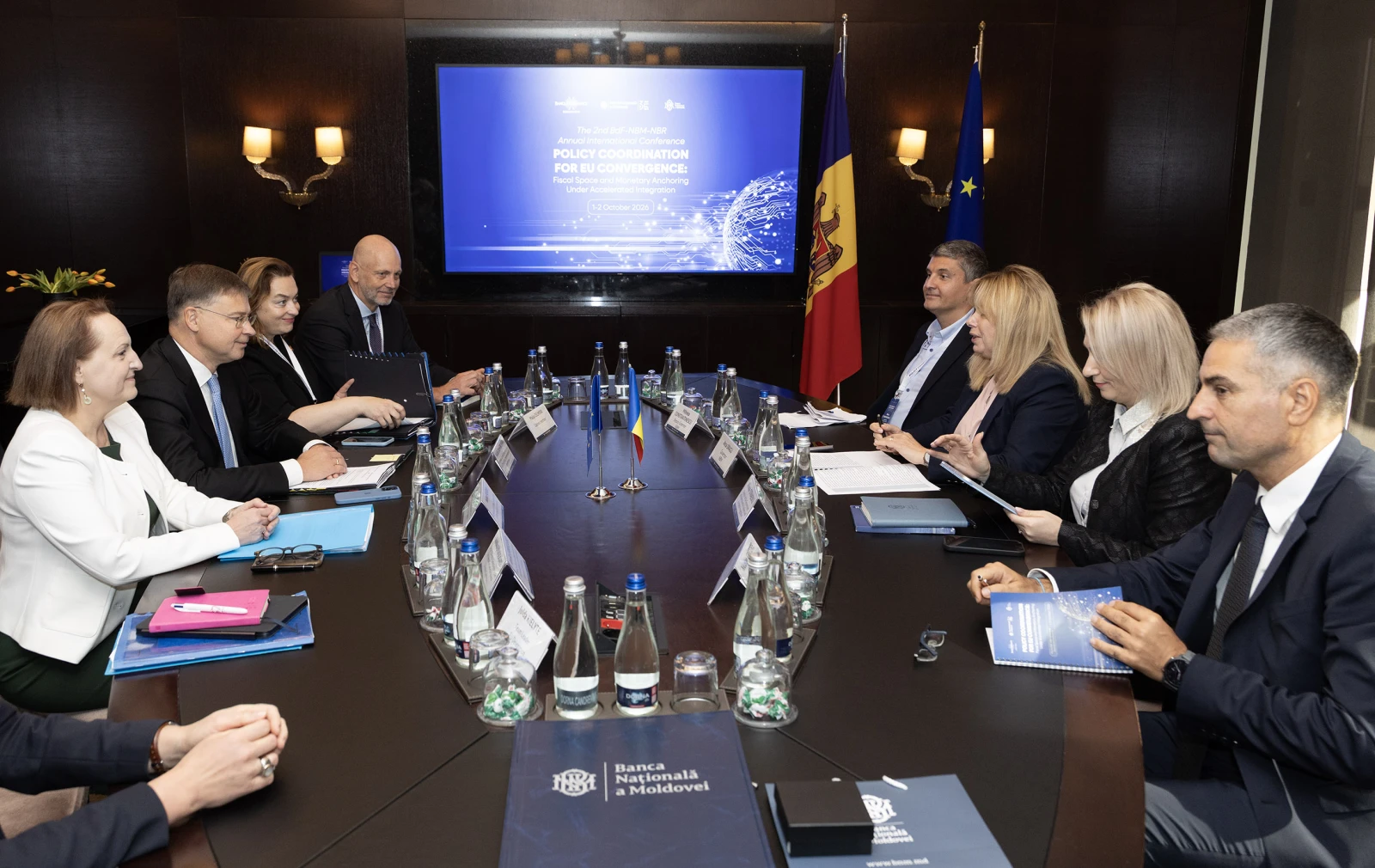
This was discussed during a meeting between Anca Dragu, President of the National Bank of Moldova, and Valdis Dombrovskis, European Commissioner for Economy and Productivity, Implementation, and Simplification. The parties discussed Moldova's European integration, strengthening macroeconomic stability, and reforming the financial sector. Also participating in the discussion were Iwona Piórko, EU Ambassador to Moldova; Annika Eriksgård, Deputy Director-General of the European Commission's Directorate-General for Economic and Financial Affairs (DG ECFIN), and other members of the European delegation. The head of the National Bank highlighted the bank's contribution to harmonizing financial legislation with EU standards, modernizing payment systems, and maintaining the stability of the financial sector, which is capable of stimulating economic development. In this context, the importance of cooperation with the European Commission was reaffirmed for advancing reforms and implementing European standards within the central bank's areas of competence. "Our rapprochement with the European Union opens up opportunities to build a stronger economy, one in which companies can invest and grow, and people can look to the future with greater confidence. To take advantage of these opportunities, we need consistency in implementing reforms and a financial sector ready to support investment. European support can accelerate this transformation, and the task of our institutions is to create conditions under which resources will flow into the real economy, contributing to sustainable growth. "Our experience with joining SEPA shows that the benefits of European integration are tangible even before actual accession to the EU, and this encourages us to continue working on other reforms with the same determination," Anca Dragu emphasized. An important topic of the meeting was the issue of central bank independence. The head of the NBM reaffirmed the bank's commitment to fully aligning its operations with European standards in this area and highlighted the role of institutional independence in ensuring sound monetary policy, maintaining macroeconomic and financial stability, and strengthening public confidence. During the discussion of the macroeconomic situation, particular attention was paid to risks associated with external factors and the financial sector's ability to withstand them. Anca Dragu noted the sector's resilience and the need to improve risk prevention and management tools to support the economy, including during periods of uncertainty. The parties also discussed the opportunities presented by the EU-supported Economic Growth Plan for Moldova, which aims to stimulate investment, increase productivity, and accelerate reforms. The NBM Governor emphasized that, to make effective use of this assistance, sufficient implementation capacity, sound governance, and the effective channeling of resources to the real economy are necessary, while maintaining financial stability. The tangible benefits of deeper integration with the European market were demonstrated by progress in modernizing payment systems. It was noted that Moldova's participation in the Single Euro Payments Area (SEPA) simplifies transfers for citizens and businesses and strengthens financial ties with the European Union. At the same time, the development of the national payment infrastructure increases access to financial services and enhances the efficiency of economic activity. Continuing the discussion on financial integration, the parties addressed the National Bank of Moldova's efforts to obtain EU recognition that Moldova's banking regulatory system is equivalent to EU standards. Anca Dragu noted the support provided by the European Commission in reviewing draft laws related to the EU accession process and emphasized the importance of this dialogue for the further harmonization of national legislation with European standards. // 01.10.2026 — InfoMarket.
The EU and the NBM discussed Moldova's Growth Plan and support for the real economy
The EU-supported Economic Growth Plan for Moldova aims to stimulate investment, increase productivity, and accelerate reforms, and the funds allocated by the EU must be channeled efficiently into the real sector of the economy while maintaining financial stability—NBM