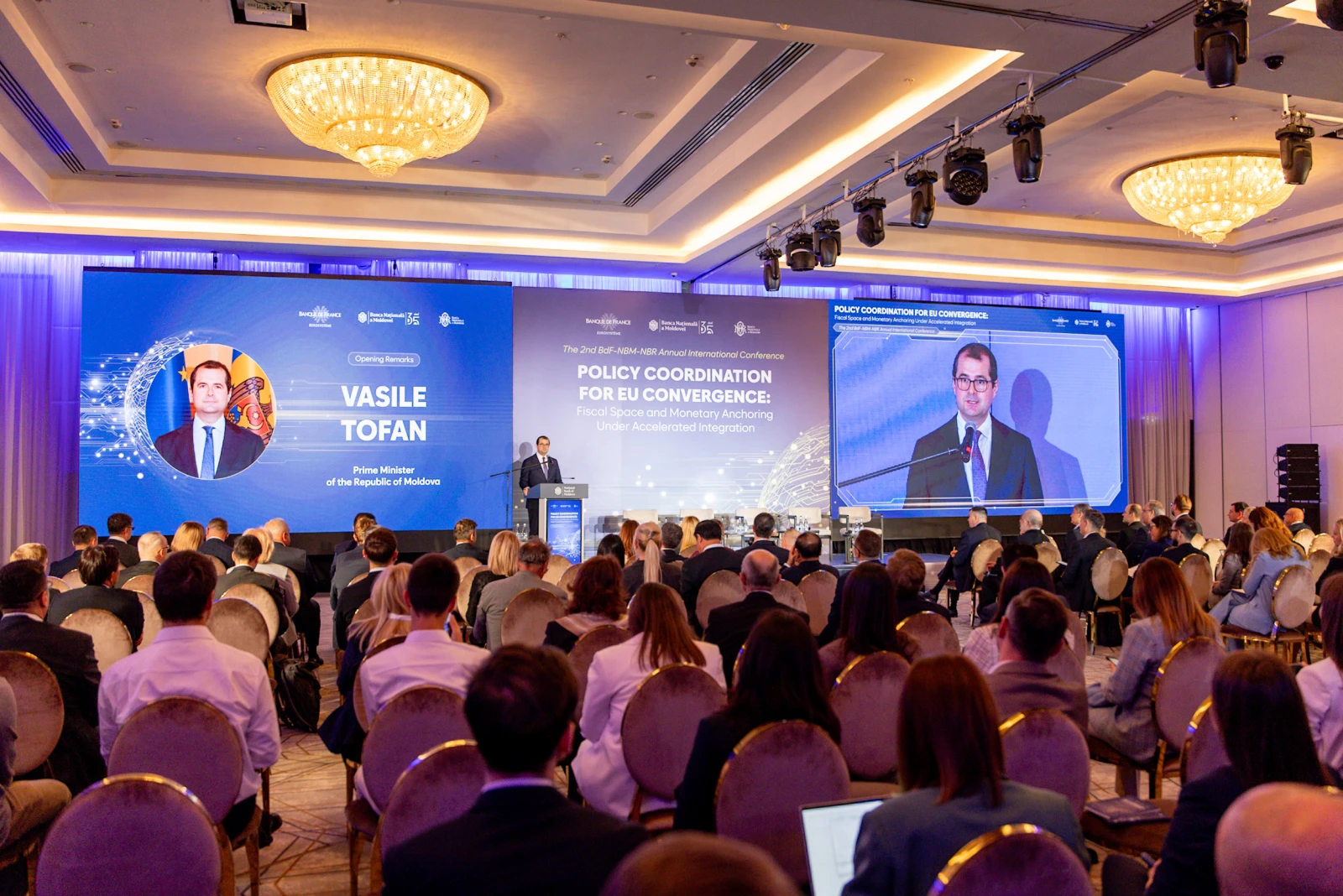
The Prime Minister of Moldova made this statement at the opening of the international conference "Fiscal Space and Monetary Guidelines in the Context of Accelerated Integration" in Chișinău. Over the course of two days, the event will address the acceleration of Moldova's integration into the Single European Market, increasing productivity and attracting investment, as well as the monetary, fiscal, and tax policies necessary to maintain economic stability. Vasile Tofan highlighted the role of a strong banking sector and confidence in the economy in accelerating Moldova's European integration process. The Prime Minister emphasized that the country has a well-capitalized and liquid banking system, and the current challenge is to leverage this stability to develop the real sector of the economy. "The question is less and less about the reliability of our banks or the stability of the monetary system, and more and more about how to transform this strength into investments in the economy. This is precisely where we must focus our policy," Vasili Tofan emphasized. The head of government noted that Moldova currently enjoys increased confidence from investors and external partners thanks to its clear European course, ongoing reforms, and financial support from the European Union and other partners. At the same time, the prime minister pointed out that stability must be accompanied by growth in productivity and economic competitiveness. "We will not be able to grow faster unless we increase productivity. In my view, this is the essence of economic convergence with the European Union. European integration cannot be reduced merely to adopting EU legislation, standards, and institutions. Ultimately, it must mean a more productive economy and a more productive Moldova," the prime minister stated. According to him, creating a more competitive economy requires increased investment, improved infrastructure, export growth, and the development of the capital market, which will enable the economy to support higher wage levels. At the same time, the government will strive to maintain fiscal discipline and channel resources toward investments that strengthen the economy and increase its resilience to external shocks. "We are striving for stability and lower inflation amid accelerating economic growth—growth that is increasingly driven by exports and long-term investments. We want household incomes to approach European levels and, most importantly, for labor productivity in Moldova to meet European standards," the prime minister concluded. On October 1–2, Chișinău is hosting the annual international conference organized by the Bank of France, the National Bank of Moldova, and the National Bank of Romania, titled "Policy Coordination for EU Convergence: Fiscal Space and Monetary Policy Benchmarks in the Context of Deepened Integration." The event is attended by representatives of central banks, European institutions, international financial organizations, and government agencies, as well as economists and researchers. // 01.10.2026 — InfoMarket
Moldova must translate investor confidence into economic growth and competitiveness
Moldova enjoys a high level of trust from external partners and investors, but its financial stability must translate into investment, economic growth, and increased productivity and competitiveness—Vasile Tofan