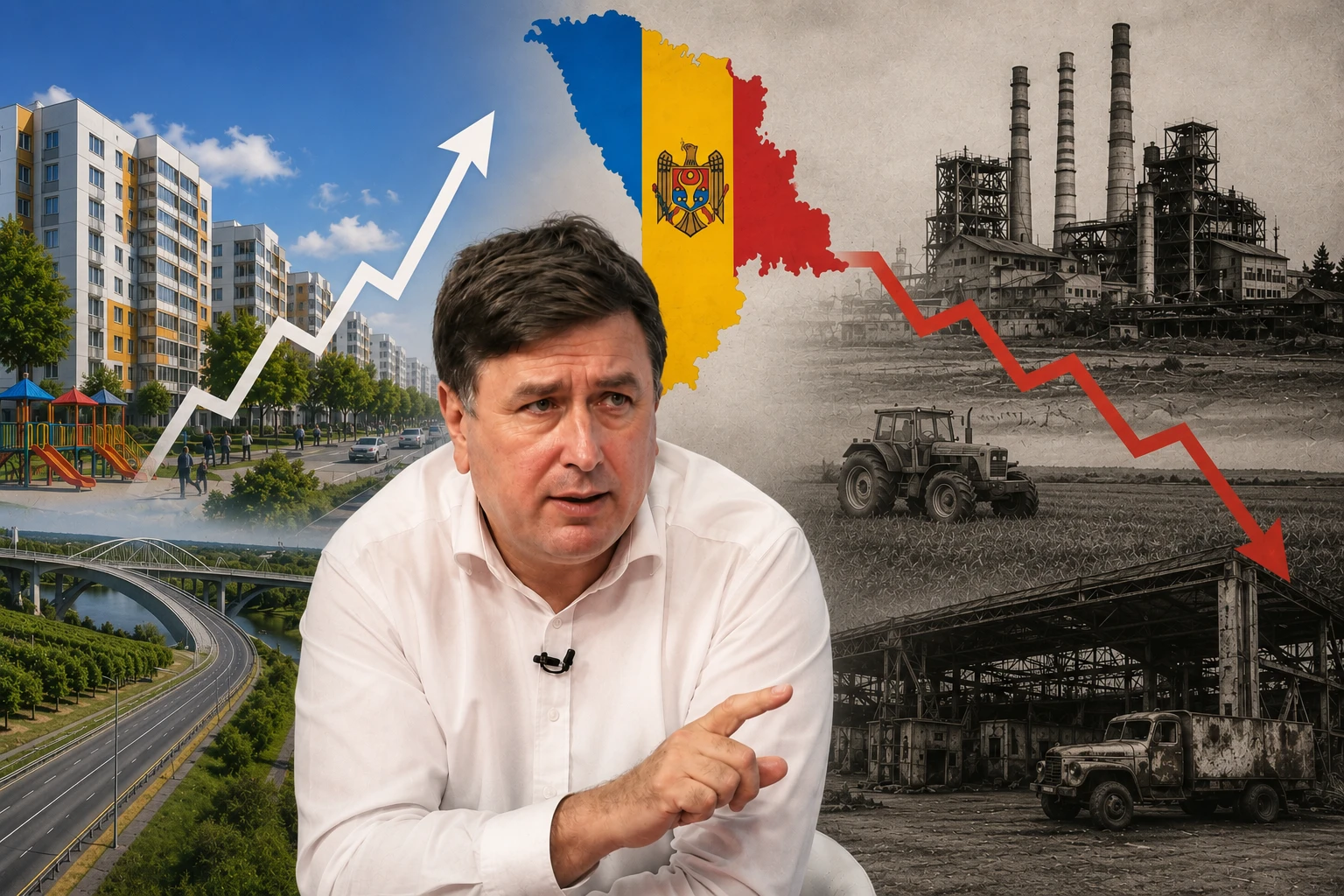
An economic policy expert at the Institute for Development and Social Initiatives (IDIS) Viitorul made this statement in his weekly podcast, during which he analyzed Moldova's socioeconomic development over the 35 years since the country gained independence. According to him, the number of Moldovan citizens with valid identification documents at the beginning of the third quarter of 2026 was approximately 4.04 million, of whom 3.68 million were registered on the right bank of the Dniester and about 360,000 in the Transnistrian region. Of the citizens registered on the right bank, approximately 2.3 million are in the country, and about 1.3 million are abroad. Another approximately 85,000 residents of the Transnistrian region do not yet hold Moldovan citizenship, whereas 10 years ago there were about 224,000 such residents. Taking into account population groups not fully reflected in official statistics—including children born to Moldovan families abroad— Veaceslav Ioniţă estimates the country's potential population at approximately 4,133,000. The expert identified the shrinking labor force as one of the country's main problems: in 1991, about 1.5 million people were employed on the right bank, compared with 582,000 retirees, while in 2026 the number of wage earners is estimated at approximately 650,000, and the number of retirees at 530,000. The ratio of workers to retirees during this period has fallen from 2.68 to 1.23. According to the expert's estimate, real wages are now approximately 2.15 times higher than the 1991 level, which was not reached again until 2008. The number of people earning more than 1,000 euros per month has risen from 1,900 in 2014 to 122,600 in 2025, and may exceed 140,000 in 2026. More than 20,000 people are expected to earn over 2,000 euros in 2026, compared to 1,400 in 2020. The average pension was 4,200 lei in 2025 and is projected to reach 4,600 lei in 2026; however, in real terms, it did not exceed the 1991 level until 2023. In 2026, the purchasing power of pensions is estimated at approximately 120% of the 1991 level. According to the expert's forecast, Moldova's GDP in 2026 will exceed 377 billion lei, but in real terms it will amount to approximately 95.1% of the 1991 level. "In the 35 years since independence, Moldova has still not been able to return to many of the indicators it once had," emphasized Veaceslav Ioniţă. Thus, according to the expert's estimates, industrial output will amount to 103 billion lei (82.8% of the 1991 level), and agricultural output to 51.6 billion lei (95%). The expert described the country's development over the past 35 years as mixed: the economy and employment have not yet recovered to their previous levels, but real wages, purchasing power, infrastructure, and living conditions have improved significantly. // 21.08.2026— InfoMarket.
Living conditions in Moldova have improved, but part of the economy has not returned to the level it was at 35 years ago
Living conditions, well-being, and infrastructure in Moldova have improved, but indicators for some economic sectors have not reached pre-independence levels over the past 35 years—Veaceslav Ioniţă