


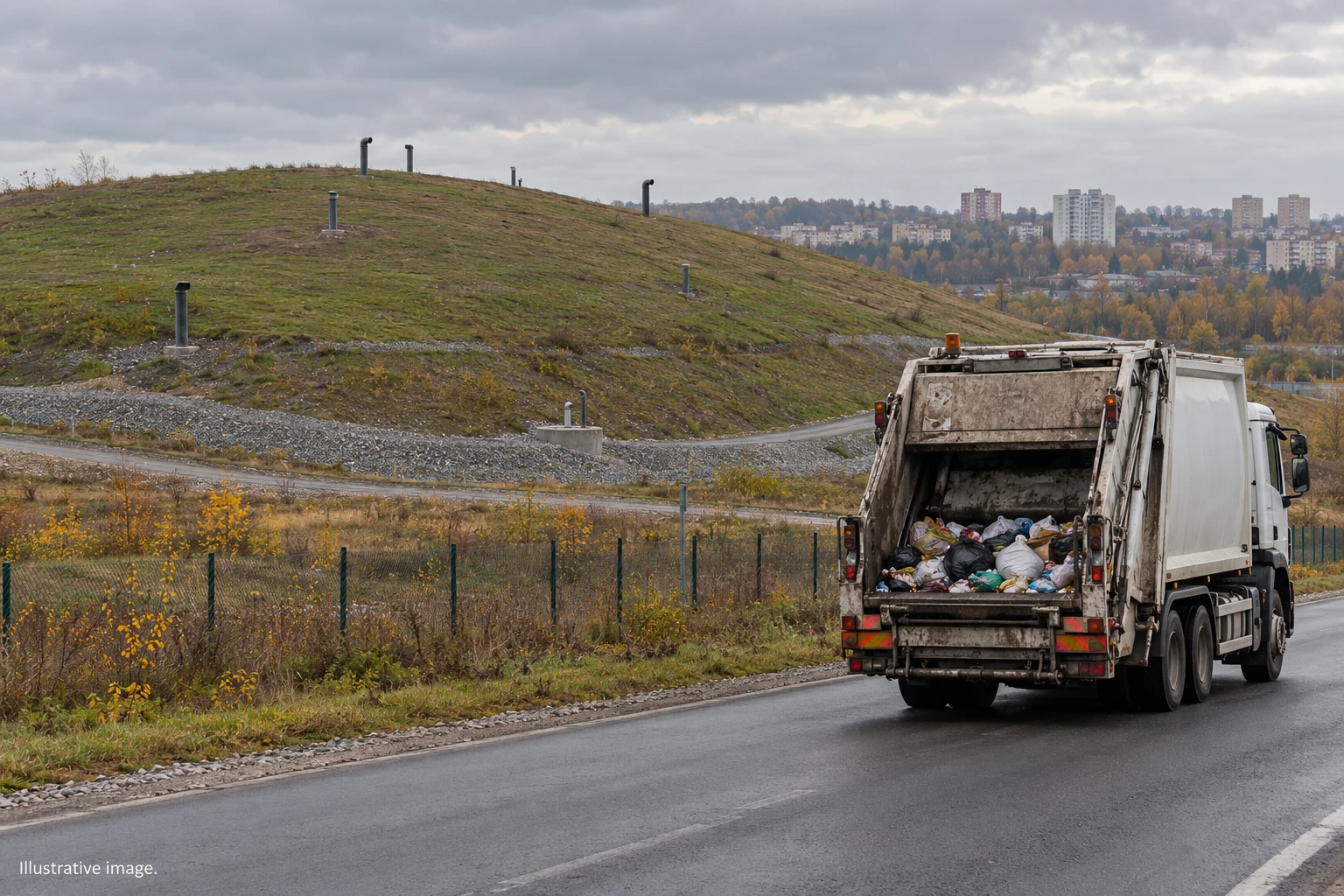
In Chisinau, the remediation of the former landfill on Uzinelor Street—where more than one million tons of waste accumulated between 2010 and 2017—has been completed. The project cost approximately 4 million euros, or 80 million lei. This is a necessary investment in environmental protection and, at the same time, the price to pay for the consequences of a temporary solution that the city relied on for years. The waste remains in place, isolated by protective materials, while the capital still needs to haul away new waste every day.
Systems were installed at the former landfill to collect leachate—the contaminated liquid that forms deep within the waste—and to drain rainwater. Four leachate storage tanks and 26 biogas collection points were installed; the biogas is burned in a special facility. The site has been covered with membranes and soil. These measures should reduce pollution and the spread of odors; however, the protective infrastructure will continue to require maintenance and funding.
The history of the Uzinelor landfill is directly linked to the landfill near the village of Tintareni in the Anenii Noi District. In 2010, its operation was suspended amid complaints from residents about alleged groundwater contamination. The capital redirected waste to a temporary site near Bubuieci. Later, discontent arose there as well: in 2017, residents blocked access to garbage trucks. The problem shifted from one settlement to another along with the waste collection routes.
In the summer of 2017, Chisinau resumed using the landfill in Tînțareni. The compromise provided for the allocation of 6 million lei annually to the village for infrastructure projects. In 2020, the agreed-upon amount was increased to 10 million lei. Initially, the agreement was renewed annually, and at the end of 2021, it was extended through the end of 2024. Preparations for the next extension then began. The landfill will continue to accept waste from the capital in 2026: the city retains a site for waste disposal while committing to the village's development and the modernization of the landfill.
Alternatives to large-scale landfilling were discussed long before the crisis. In November 2006, a preliminary agreement was reported with an Italian investor to build a waste-to-energy plant costing 190 million euros. The facility was supposed to be built within three years. In September 2009, after the municipal council reviewed another agreement, a new promise was made: the Tintareni problem would be resolved within 20 months. In March 2010, the council allocated ten hectares of land for the plant. But the promised facility never materialized.
The municipal council approved another initiative on December 23, 2020: the construction of a plant for the sorting, processing, reuse, and disposal of solid waste as a public-private partnership project. The plan called for the preparation of a feasibility study and the selection of a land plot.
The current municipal project, "Chisinau Solid Waste," costing approximately 26 million euros, includes the reclamation of the old landfill, the modernization of equipment, and the construction of a new transfer station with a sorting line. As of mid-October 2026, construction of the station was ongoing. However, this is a different project that does not include the previously promised thermal treatment plant.
Sorting allows for the recovery of recyclable materials but leaves behind waste that must be treated or landfilled. Private sorting facilities have already been used for Chisinau's waste: after useful materials were separated, the remainder was sent to Tînțareni. The new line alone will not eliminate dependence on the landfill.
At the same time, publicly available materials do not contain a confirmed, up-to-date plan for the construction of a large recycling complex with specific technology, capacity, secured funding, and a commissioning date. Decisions to prepare project proposals have been made, but they do not answer when such a facility will be built or to what extent it will reduce the volume of waste sent to landfills.
The plant's economic viability depends on separate collection, the composition of the incoming waste, processing costs, and the market potential for the resulting products or energy. These calculations must be made prior to construction; otherwise, the city risks ending up with an expensive facility whose maintenance will require constant additional payments.
Modernization should be evaluated based on results: what percentage of waste is returned to the economic cycle, how much continues to be sent to Tintareni, and how the costs per ton change. After decades of promises, the capital needs a feasible plan to reduce landfill use—one that includes facilities, funding, timelines, and those accountable for the results. Otherwise, the current generation will pay to close one temporary landfill, while the next generation will be left with the bill for another. // 28.10.2026 — InfoMarket.