


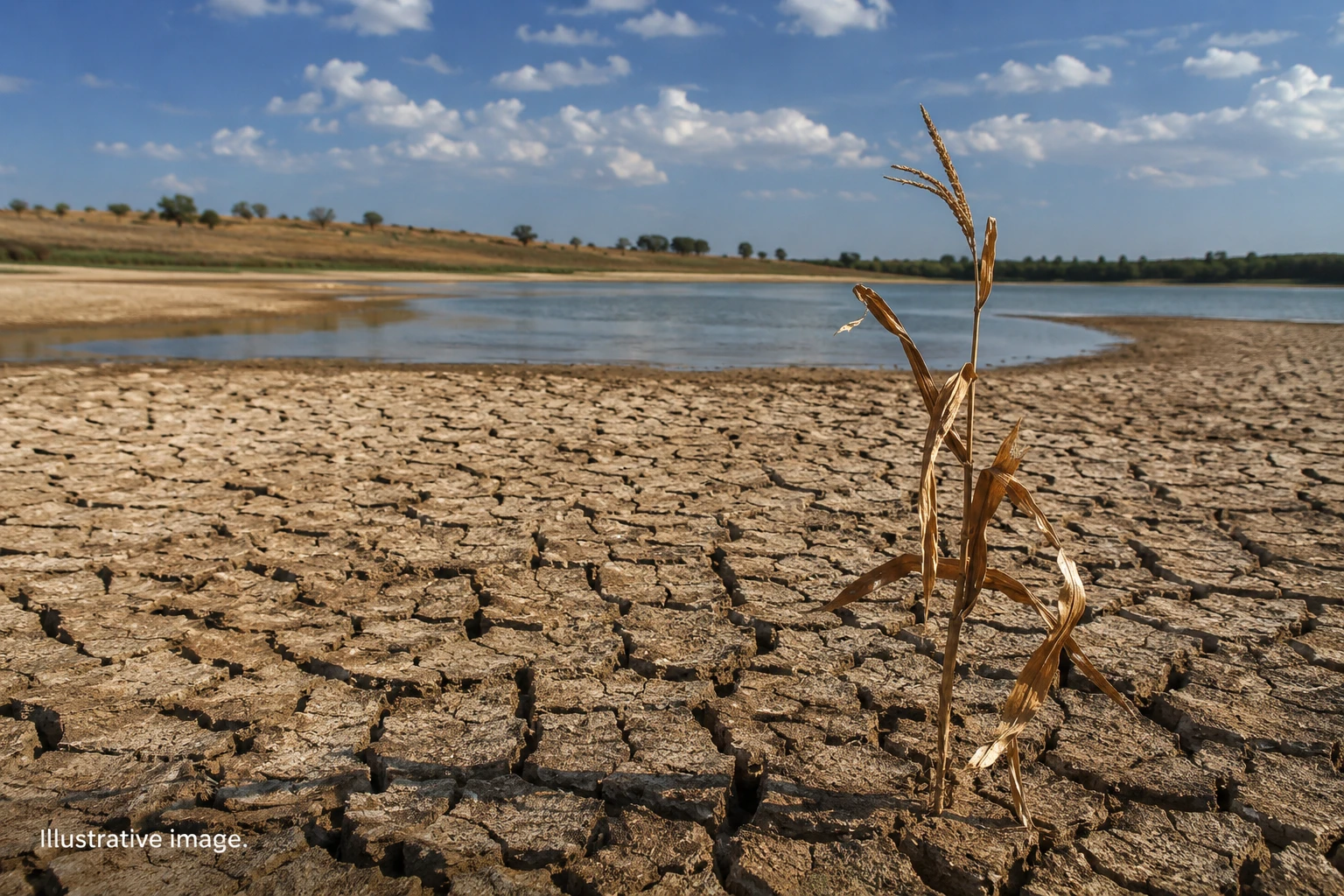
Drought accounts for only about 1% of the natural disasters recorded in Moldova, but it causes 72% of the property damage. Rainstorms accompanied by hail and strong winds account for 66% of natural disasters, while large hail accounts for another 17%. Droughts occur much less frequently, but their economic consequences are incomparably more severe.
Between 2010 and 2024, natural disasters cost the country more than 23 billion lei, and in 2024 alone—4.69 billion lei, or about 1.5% of GDP. The National Program for Natural Disaster Risk Reduction for 2026–2030, approved by the government, outlines how the state intends to address the most costly natural risk: first and foremost, by forecasting it more accurately.
The program's cost is 129.3 million lei. Of this amount, 94.6 million lei—or approximately 73%—is earmarked for modernizing the national climate and hydrological monitoring network. This includes weather stations, telemetry, weather radar, a lightning detection system, data collection and processing, and the development of sector-specific forecasts.
Recent major droughts illustrate the scale of the losses. In 2020, agricultural production fell by more than 26%, and drought-related damage was estimated at approximately 5.9 billion lei, or 3.3% of GDP. In 2022, losses amounted to about 4.9 billion lei, and in 2024, to 3.8 billion. Moreover, these figures represent only direct damage: indirect losses and long-term economic consequences are not included in these estimates.
Climate risk in Moldova has long extended beyond the agricultural sector. Crop losses affect farmers' incomes, exports, prices, employment in rural areas, and ultimately government spending, as authorities are forced to compensate for the effects of yet another drought.
Therefore, investments in forecasting are fully justified. Currently, less than half of the national monitoring network has been modernized, and digital systems remain fragmented. By 2030, the government aims to increase the share of the network that is modernized, digitized, and operating automatically to at least 75%. More accurate information will allow for earlier assessment of drought development, the state of water resources, and other weather-related risks.
But better drought forecasting and reducing economic dependence on drought are not the same thing.
The program lists the main weaknesses of the agricultural sector: inadequate irrigation infrastructure, limited use of climate-resilient agricultural technologies, poor access to risk insurance for farmers, and insufficient use of climate information in making business decisions. To reduce the damage caused by drought, the document highlights the need to modernize and expand irrigation, conserve moisture and soil fertility, and develop climate insurance and early warning systems.
However, in the financial section of the program itself, these areas are allocated significantly less funding. Only 600,000 lei are earmarked for the development of sustainable agricultural and agroforestry practices in vulnerable areas. For the restoration and expansion of forested areas—2.35 million lei. The program does not include a separate major investment line item for the construction or modernization of irrigation infrastructure.
This does not mean that the government is not investing any money at all in irrigation, reforestation, or water infrastructure. Other sector-specific programs and projects exist for these purposes, and the National Risk Reduction Program should not duplicate them. Therefore, the 94.6 million lei allocated for monitoring and the 600,000 lei for agricultural practices should not be viewed as the full extent of government spending to combat drought.
However, within the program itself, the priority is clear: the bulk of the funds is allocated to detecting natural hazards earlier and assessing their development more accurately.
At the same time, a significant portion of the program does not depend on the state's own resources. Of the 129.3 million lei, 12.97 million—or about 10%—is allocated directly from the state budget. Another 97.82 million lei—nearly 76%—is expected to come in the form of foreign aid. For 18.55 million lei—or 14% of the expenditures—the source of funding has not yet been determined. Implementation of the program will depend on annual budget limits and the availability of external funding.
The scale of the problem is clearly illustrated by one comparison: direct losses from natural disasters in 2024 alone were approximately 36 times greater than the total cost of the five-year program. This does not mean that prevention costs must equal the cost of damage: the program does not cover all government investments in irrigation, water, and agricultural adaptation. But the difference illustrates the economic cost of risk.
Moldova will receive a system designed to predict natural hazards much more accurately. This is an essential part of protecting the economy. But the cost of drought will depend on how quickly more accurate forecasts are complemented by investments in water, soil, sustainable technologies, and insurance. This is precisely where the line is drawn between the ability to foresee the next drought and the ability to ensure that it no longer costs the economy billions of lei. // 13.08.2026 – InfoMarket.