


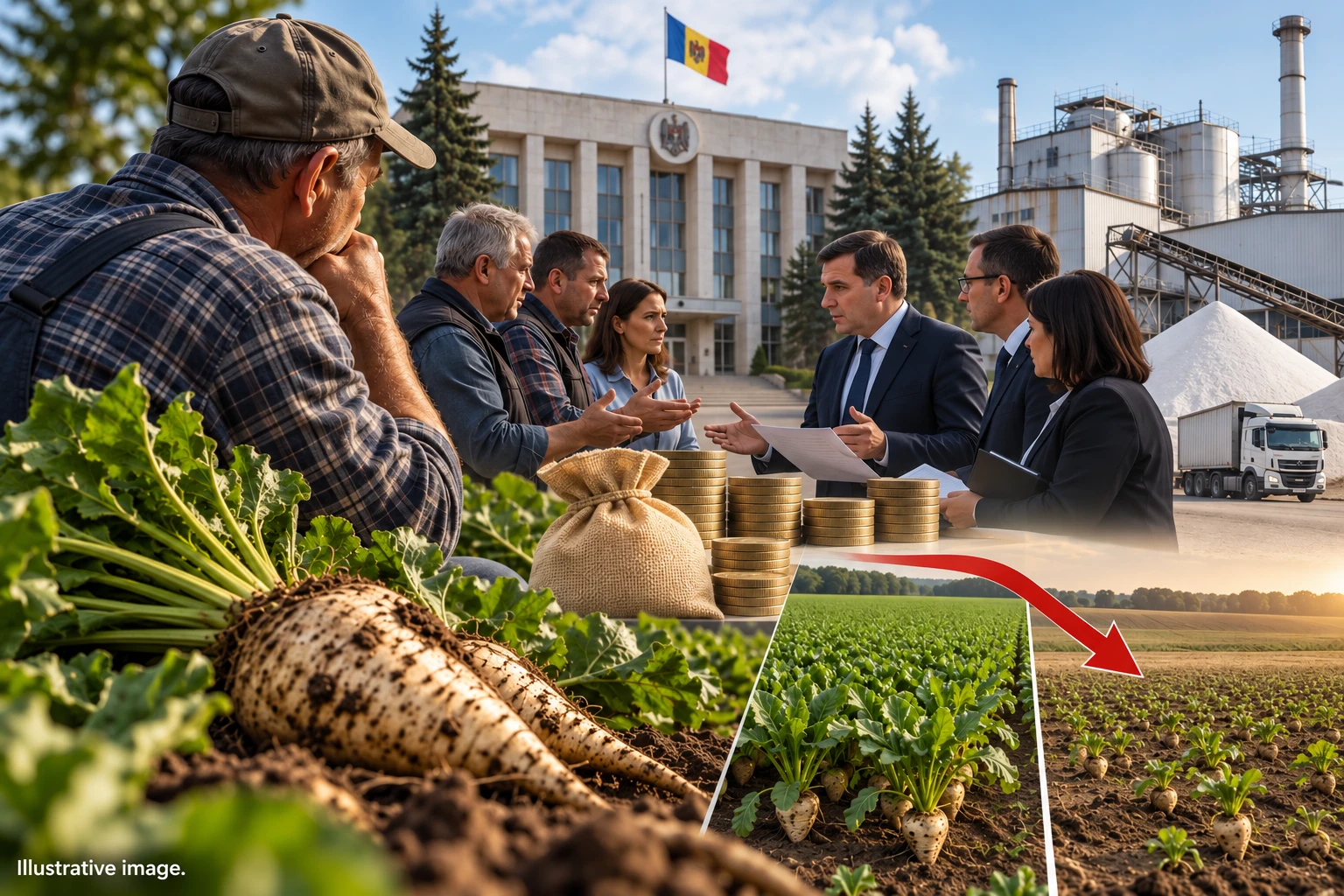
A dispute has arisen in Moldova over the support for sugar beet producers planned for 2026. The Strategic Agricultural Policy Program provides for coupled income support for this crop, with 40 million lei allocated for it this year. However, on October 2, the Moldovan Sugar Beet Growers Association stated that, following a recent meeting with Minister of Agriculture and Food Industry Eugen Osmochescu, farmers had concluded that the payments scheduled for 2026 may not be made. The association appealed to the government, the Ministry of Agriculture, and the Agency for Agricultural Interventions and Payments (AIPA), demanding that the PD-02 support mechanism be launched and that clear deadlines be set for the submission of applications, approval, and disbursement of payments.
For the industry, the issue is important not only because of the size of the subsidy. Over the past ten years, the area planted with sugar beets in Moldova has shrunk by approximately 3.6 times: from more than 30,000 to 8,300 hectares. For a crop whose cultivation is directly linked to the operations of processing plants, the reduction in the raw material base affects not only farmers but also the capacity utilization of sugar factories.
The last two seasons have been difficult for producers. According to the industry association, drought affected more than 60% of the planted area in 2024, and late frosts affected about 65% in 2025. The association estimates that losses last season exceeded 65 million lei, and about 1,900 hectares remained unharvested due to autumn rains. At the same time, the cost of growing one hectare of sugar beets increased from approximately 35,000 to 43,000 lei.
Against this backdrop, government support has become one of the factors farmers consider when planning for the next season. Their argument is that decisions regarding crop selection are made in advance, and a significant portion of the costs is incurred before the harvest is even gathered. Therefore, uncertainty regarding payments increases the risks for producers when deciding on next year's crop.
This is also significant for the processing sector. The country's largest sugar producer, Südzucker Moldova, is working with approximately 6,300 hectares of sugar beets from more than 30 farms this season and expects to receive about 270,000 tons of raw material. Thus, a significant portion of the entire Moldovan raw material base for the sugar industry comes from farms collaborating with this company.
Südzucker Moldova's position is that it is necessary to maintain sustainable local production and a raw material base for sugar beet processing. Commenting on the 2026 harvest campaign, the company's CEO, Pavel Filip, noted that the company's goal extends beyond the results of a single season and is focused on developing a competitive sugar sector that creates added value in Moldova. According to Südzucker, annual sugar consumption in the country is about 70,000 tons, while existing production capacity allows for a higher output.
Another factor is imports. Sugar beet producers point to competition from sugar imported from Serbia and Belarus and attribute this to additional pressure on the domestic market. In recent years, the authorities have also taken measures to limit certain volumes of duty-free sugar imports, arguing that this is necessary to protect domestic production.
However, there is a downside to this. Restricting imports can support local producers and processors, but at the same time reduces foreign competition. Therefore, when formulating policy, the government must take into account not only the interests of agricultural producers and sugar mills, but also prices for the food industry and end consumers.
In fact, this is about striking a balance between several elements of a single supply chain. Farmers need sufficient profitability to continue growing a relatively costly crop. Processors need a stable supply of raw materials to keep their plants running. Consumers and food producers need a competitive price for sugar. Meanwhile, the government must determine to what extent it is justified to support domestic production through budgetary funds and trade measures.
It is still too early to say that a reduction in acreage will inevitably lead to the end of sugar production in Moldova. However, the industry's raw material base has shrunk significantly over the past ten years, and farmers will be making decisions about their 2027 crops in the coming months.
The current debate over 40 million lei is, first and foremost, a matter of the predictability of agricultural policy. The actual impact of government support will depend not only on whether this money is allocated, but also on whether the combination of subsidies, market prices, yields, and import conditions can make sugar beet cultivation economically viable for producers. // 06.10.2026 – InfoMarket.