


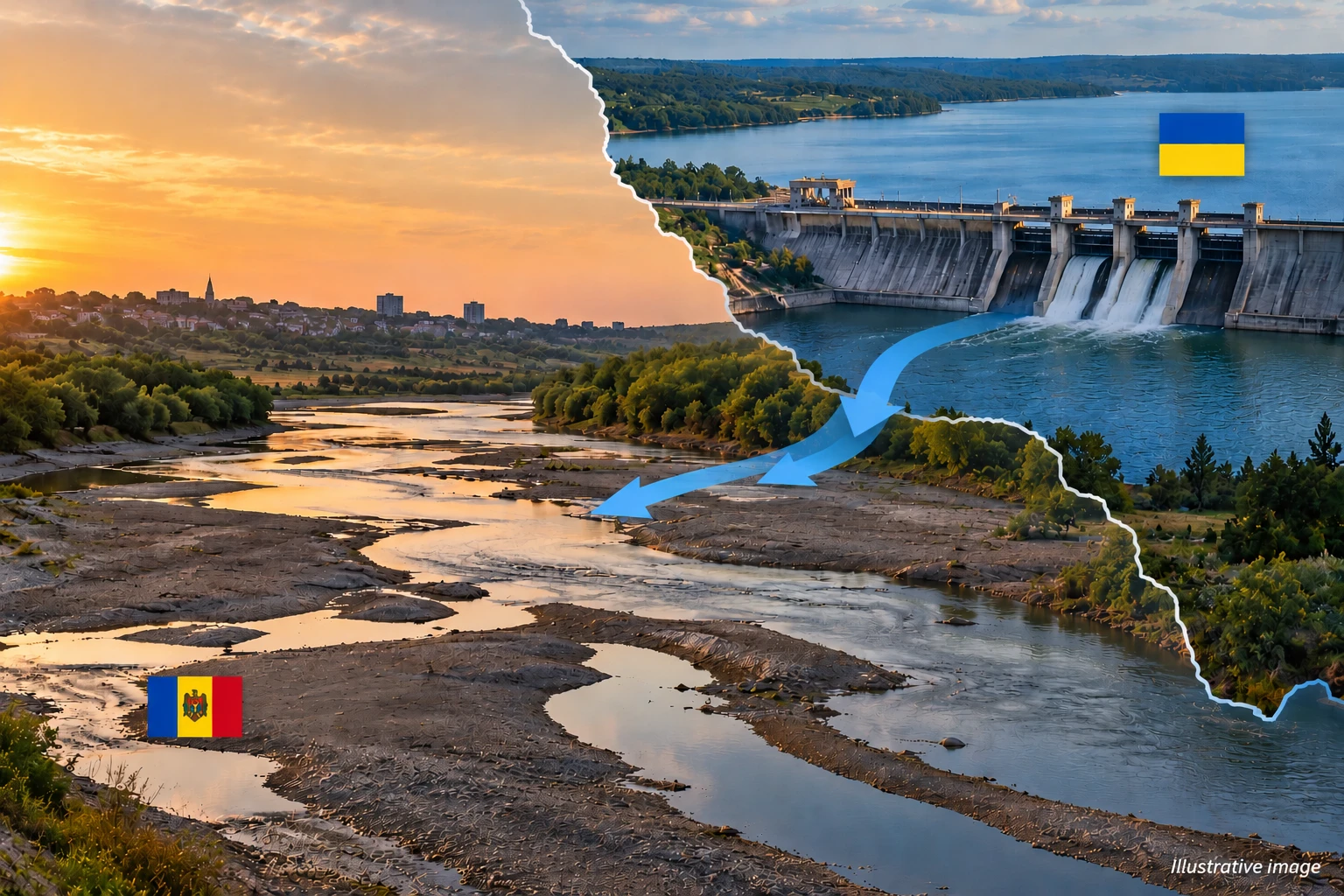
The problem with the Dniester this fall isn't just the low water level. It has revealed a more serious vulnerability: one of Moldova's main sources of water depends on a reservoir and its operating conditions on Ukrainian territory.
By the end of September, the water level in the Novodnestrovsk Reservoir had dropped below 111 meters, compared to a normal level of about 121.5 meters. In other words, the water surface was approximately 10.5 meters below normal. The Moldovan government has already described the current level as critical.
The primary cause is drought. The upper part of the Dniester River basin is located mainly on Ukrainian territory, and it is there that a significant portion of the runoff is generated, which then flows into the reservoir and onward to Moldova. There was insufficient precipitation in the upper reaches of the river this summer and early fall. Moldova's Ministry of the Environment directly attributes the current low water levels primarily to the prolonged drought and lack of precipitation in the upper Dniester basin.
But the drought is only part of the problem. The other issue is that, when water is scarce, a decision must be made regarding how much to retain in the Ukrainian reservoir and how much to release downstream toward Moldova.
And here, the figures are particularly telling. During the first 20 days of September, the Novodnestrovsk Reservoir received an average of about 23 cubic meters of water per second, while about 60 cubic meters per second were released downstream along the Dniester. In other words, the reservoir released approximately 2.6 times more water than it received.
Over the course of 20 days, approximately 40.3 million cubic meters of water flowed into the reservoir, while 103.7 million cubic meters were released. The difference—approximately 63.4 million cubic meters—was covered by the reservoir's own reserves. As a result, during this period alone, its water level dropped by approximately 68 centimeters.
This explains the dispute over the discharge volume. In late August, Ukraine proposed reducing it from 75 to 50 m³/s to deplete the reservoir's reserves more slowly. After negotiations, the parties agreed on 60 m³/s, meaning that Moldova succeeded in ensuring that a larger volume of water continued to flow downstream.
But by mid-September, the situation had worsened. The Ukrainian side proposed an even stricter regime: releasing downstream approximately as much water as was entering the reservoir at that moment—about 22 m³/s. Such a regime would have virtually halted the rapid depletion of its reserves. But Moldova did not accept the proposal. The Ministry of the Environment explained that such a sharp reduction in flow could affect the water supply to the population, the functioning of aquatic ecosystems, and the hydrological balance of the Dniester.
The conflict of interest lies in the fact that, for Ukraine, a high discharge rate means a further reduction in water reserves in its own reservoir. For Moldova, a discharge rate that is too low means a drop in the Dniester's water level and an increasing risk to water intakes.
Yes, the current water shortage is primarily caused by drought. But one thing is equally clear: when water becomes scarce, the amount of water in Moldova begins to depend on decisions made by the Ukrainian side regarding the operation of the Novodnestrovsk Reservoir.
This is a critical vulnerability. So far, it has had almost no impact on tap water: Chisinau's water supply is operating as usual. However, by September 29, the water level at the intake in Cosauci had dropped to approximately 2.16 meters, down from 2.67 meters previously—a decrease of about 51 centimeters. Authorities are already considering technical solutions that will allow them to maintain the water supply as the river continues to recede.
But the Dniester is needed for more than just drinking water. Communities, agriculture, businesses, and the ecosystem all depend on it. The less water there is in the river, the tougher the choice becomes between different consumers. And if periods of low water continue to recur, water will have to be viewed not as a virtually unlimited natural resource, but as one of the infrastructure factors of the economy.
Following the gas and energy crises, Moldova began restructuring its energy system to reduce its dependence on a single supplier and a single route. Doing the same with water is much more difficult: there is no second Dniester nearby.
Therefore, the first thing Moldova can do is to establish the clearest possible rules for managing the river in cooperation with Ukraine. It should not wait to begin negotiations only when the reservoir level approaches a critical point, but rather determine in advance the operating regime for dry years: what minimum flow must be maintained downstream, at what levels it may be reduced, what data the parties must exchange, and how shortages are allocated when there is physically not enough water to meet all needs.
The second priority is to reduce the dependence of domestic water intakes on the Dniester's water level. The current situation has shown that fixed infrastructure is not always capable of automatically adapting to falling water levels. As early as this summer, the Ministry of the Environment specifically highlighted the need to technically adapt water intakes to lower river levels.
The third is to build internal resilience: backup sources, storage capacity, interconnected water supply systems, reduced network losses, and more efficient water use.
This applies particularly to agriculture. In the event of a prolonged drought, drinking water supply will inevitably take priority. Therefore, the development of irrigation should involve not only the construction of new pumping stations and pipelines but also the creation of water reserves and the use of more efficient irrigation technologies.
After many years of struggling with energy dependence, Moldova will have to tackle another challenge: water dependence. The country cannot change its geography, but it must establish an infrastructure and management framework for the Dniester River that ensures decisions made outside the country's borders do not automatically trigger a domestic crisis. // 01.10.2026 – InfoMarket.