


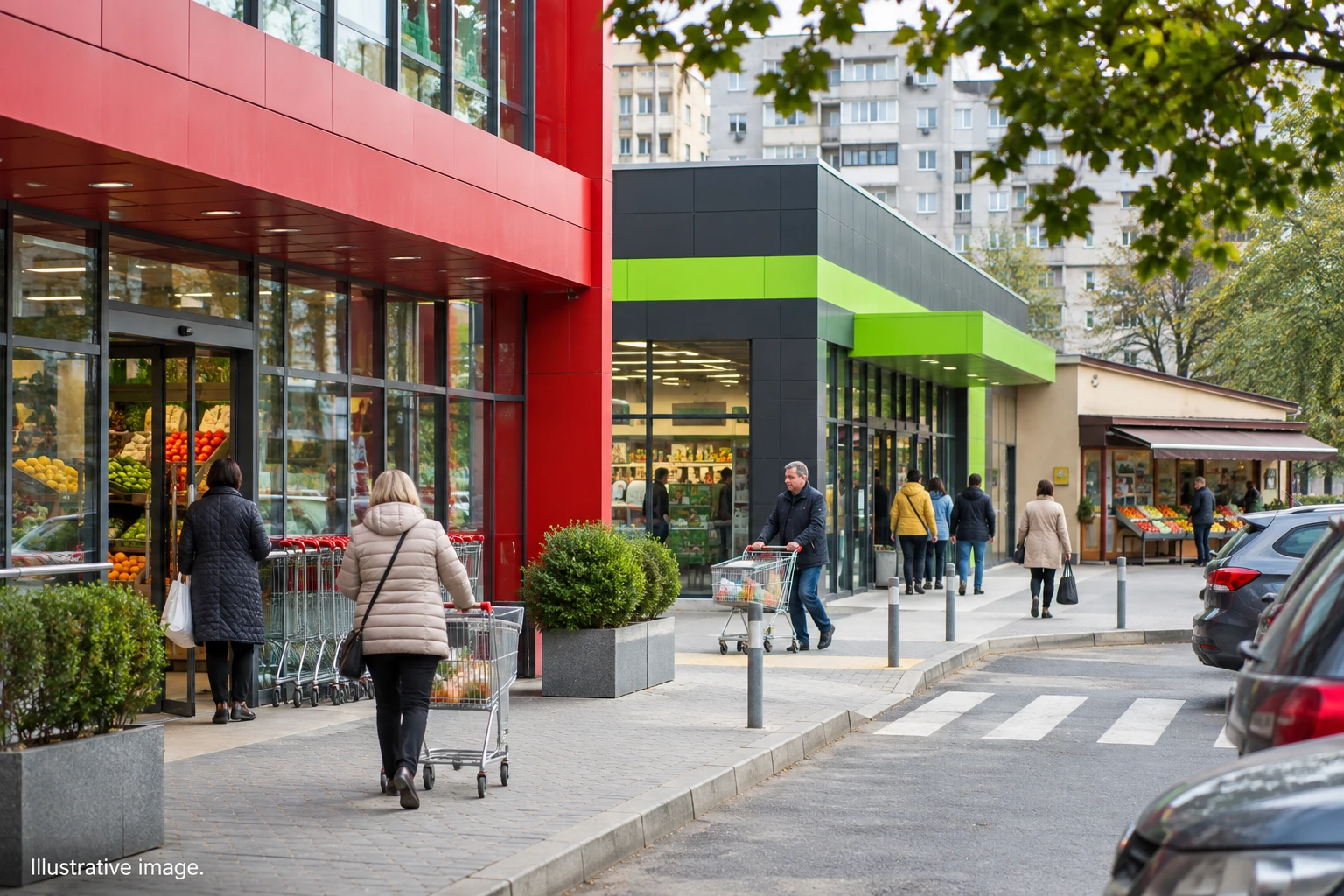
Moldretail Group, Moldova's largest food retailer, which operates the Linella, Fidesco, and Cip Market stores, Bravo, Slavena Megamarket, and Fourchette, has abandoned its bid to acquire the Merci chain after the commitments proposed by the company failed to address the Competition Council's concerns. Over the past five years, the company has received approval to acquire Fidesco and Fourchette, but this latest deal fell through. The Moldovan food retail market is gradually consolidating, and counting the number of stores and retail brands is no longer sufficient to assess the actual level of competition in the market.
Moldretail Group intended to acquire 100% of the share capital of Honest Company, which operates the Merci Gastronomie chain. A notification of the economic concentration was filed on December 15, 2025. The Competition Council identified risks to the competitive environment and, following an in-depth investigation, determined that the commitments proposed by the buyer were insufficient. On November 17, 2026, Moldretail Group notified the regulator that it was abandoning the acquisition. No formal decision was issued to prohibit the transaction.
Merci Gastronomie has been operating since 2020 and has 26 neighborhood stores in Chisinau and Codru. As of the end of 2025, Honest Company's sales revenue increased by 27.6% to 262.5 million lei, while losses decreased from 13.2 million to 11.4 million lei. Merci's revenue accounted for just 1.8% of the revenue of a potential buyer that operated more than 320 stores as of early 2026.
However, when assessing economic concentration, it is not only sales volume that matters, but also the location of retail outlets. In June 2026, the Competition Council reported that Moldretail Group stores are present in all local markets where Merci operates. Upon analyzing areas within a ten-minute walking distance, the regulator identified risks of the buyer establishing or strengthening a dominant position in certain districts.
In July 2021, the Competition Council authorized Moldretail Group to acquire Fidesco, imposing a three-year monitoring period to ensure the company's compliance with its obligations in its dealings with suppliers and its conduct in the relevant markets. Fidesco retained its own brand name, although after a rebranding, its logo became stylistically similar to Linella's. For shoppers, these are two different brands, but from a competition perspective, they are a single operator.
In April 2025, the regulator authorized Moldretail Group to acquire Fourchette-M, which operated the Fourchette and To-To stores. However, this time the buyer committed to selling five stores in Chisinau and Codru to an independent operator and to maintaining commercial relationships with Fourchette-M's existing suppliers for at least three years. In the case of Merci, the proposed commitments proved insufficient.
Market consolidation is not occurring solely through the expansion of Moldretail Group. Its main competitor—Imensitate, part of the Tarol-DD holding company—is also actively expanding.
In September 2024, the Competition Council authorized Imensitate to acquire Vistarcom and Cviza-M. At that time, Imensitate operated 81 stores, while Vistarcom operated 11 stores under the Green Hills and Velmart brands. Cviza-M owned commercial real estate that it leased to Vistarcom. The transaction was approved without any additional obligations.
Unlike Moldretail Group, which retained the Fidesco brand, Imensitate began rebranding the acquired stores under its own Local and Bonus brands. Back in April 2024, Imensitate co-owner Dmitrii Razloga told "Logos-Press" that the acquisition of the chain was primarily driven by the intention to expand Bonus, whose stores require spaces larger than 1,000 square meters. By April 2026, Green Hills and Velmart were no longer listed among Imensitate's active chains.
The holding company is also reviewing its portfolio of non-food retail brands. In March 2025, it was announced that the Avocado chain of household chemicals stores, which had 13 locations, would be replaced by the new Bonita brand, which specializes primarily in cosmetics.
In 2025, Imensitate opened 50 new stores, including 37 under the Local brand. According to data from the FMCG & Retail industry conference, in April 2026 the company operated 148 grocery stores: 123 Local Discounter stores, nine Foxi stores, eight Primul stores, and eight Bonus stores. By comparison, the Linella chain alone had 209 stores.
In total, 220 new stores were opened in Moldova in 2025, compared to 142 the previous year (+54.9%). About 60% of all new store openings were accounted for by Moldretail Group and Imensitate. Thus, the concentration of the food retail sector is increasing not only through acquisitions but also through the expansion of the largest operators' own chains.
The scale of market participants can be assessed based on their financial statements. In 2025, Moldretail Group generated 14.54 billion lei in sales revenue, Imensitate—12.48 billion, Kaufland (the chain of the same name)—3.46 billion, and 47th Parallel (Sen Nr1)—3.09 billion lei. The two market leaders accounted for 80.5% of the four companies' combined revenue, which totaled 33.57 billion lei. These figures represent the revenue of individual legal entities, not their share of the overall food retail market.
The narrowing of the gap between the two leaders is particularly noticeable. According to Data2B, in 2023, Moldretail Group's revenue was 3.1 times that of Imensitate; in 2024, it was 2.4 times; and in 2025, the difference was only 16.4%. Over the past year, Moldretail Group's sales revenue grew by 25%, while Imensitate's grew by 161%. The combined revenue of the two companies increased by 64.6%—from 16.41 billion to 27.02 billion lei.
At the same time, Imensitate has already surpassed its largest competitor in terms of net profit. In 2025, its profit increased by 107.3% to 529.2 million lei, while Moldretail Group's profit decreased by 5.4% to 501 million lei. Against the backdrop of significant revenue growth, net profit margin declined for both companies: for Moldretail Group, from 4.55% to 3.45%, and for Imensitate, from 5.34% to 4.24%. The number of employees at the two companies increased by 31.3% over the year—or by 2,128 people—from 6,799 to 8,927.
The consolidation of retail chains has objective economic reasons. Centralized purchasing, the development of warehouse infrastructure and logistics, and automation help reduce operating costs. In an environment of effective competition, some of these savings can be passed on to customers through lower prices.
However, for suppliers, retail consolidation means that the largest buyers' bargaining power is strengthened and manufacturers become more dependent on their commercial terms. It is no coincidence that, at the same time, Moldova is discussing a cap on the total amount of commercial discounts and retroactive bonuses provided by suppliers to retail chains, limiting them to 20% of the value of supplies.
For Merci itself, walking away from the deal does not mean its economic problems are solved. Despite rising sales, the company remains unprofitable, and its future development will depend on its ability to improve profitability, secure financing, or find another investor.
The sequence of decisions by the Competition Council regarding Fidesco, Fourchette, and Merci shows that as the retail sector consolidates, obtaining approval for new acquisitions is becoming more difficult. However, restricting such transactions will not in itself halt the process of concentration: the largest operators have the financial resources to open their own stores.
Moldretail Group's decision not to acquire Merci indicates that further expansion by the largest retail chains through the acquisition of competitors is facing limitations. However, as the growth trajectory of the two market leaders shows, they do not necessarily need to acquire other companies to increase their market presence. In 2025 alone, their combined revenue grew by nearly 65%. Under these circumstances, the main question is no longer how many retail chains will remain on the Moldovan market, but whether smaller operators will be able to remain competitive amid such rapid expansion by the two market leaders. // 26.11.2026 - InfoMarket.