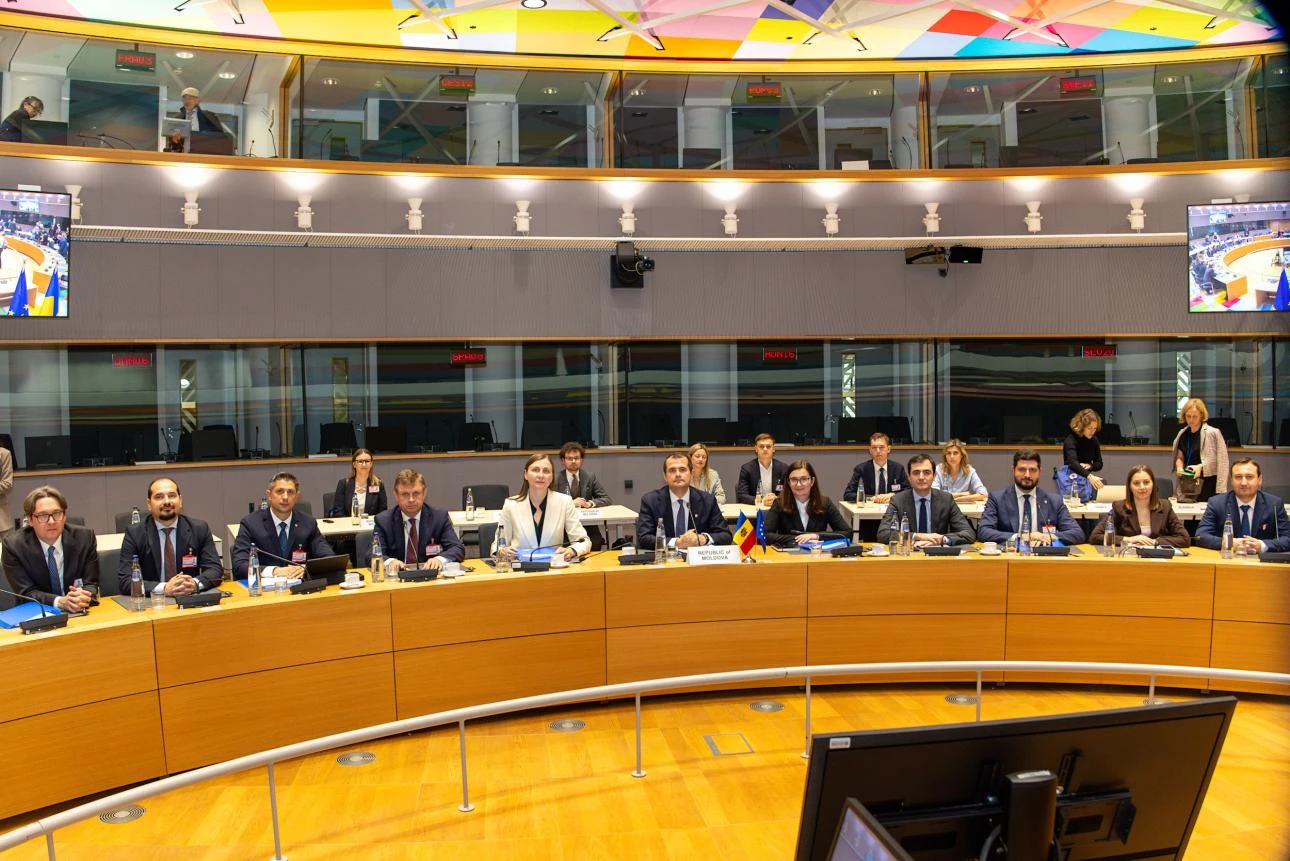
The prime minister made this statement following the 10th meeting of the EU-Moldova Association Council, which took place on October 5 in Brussels. Vasile Tofan noted that European integration is a national project for Moldova, and that the political, technical, and financial support—as well as security assistance—that the country receives from the European Union plays a key role in advancing this process. He highlighted three key points from today's meeting, noting that, first, the EU accession process continues to move forward. Vasile Tofan recalled that this summer the parties opened clusters 1 and 6, and are now working on opening the remaining clusters and ensuring a timely assessment of compliance with the interim criteria. "Our goal is to complete the technical work necessary to conclude negotiations by early 2028 and prepare Moldova for EU membership by 2030. These are ambitious deadlines. But we are not afraid of ambitious challenges. We are not asking for standards to be lowered or for loopholes to be sought. We advocate for a predictable process based on concrete achievements, where progress in reforms is followed by progress in negotiations," the prime minister emphasized. According to him, secondly, the implementation of the Economic Growth Plan is moving forward. Over the last reporting period, Moldova has fulfilled its commitments on 18 reforms. As part of the reform program, Moldova has already implemented about 95% of the measures planned for this period. He noted that economic integration is already yielding concrete results. The Prime Minister emphasized that in the first half of the year, the EU accounted for about two-thirds of Moldova's goods exports—approximately 1.3 billion euros. At the same time, growth exceeded 10%, despite the challenging global situation. According to the Prime Minister, this is a clear example of how important the European Union is to the Moldovan economy. Thanks to the SEPA system, the average cost of a transfer in euros is now about 1 euro, whereas fees used to start at 20 euros. In addition, the Convention on the Common Transit Procedure simplifies the transport of goods. Roaming rates within the European Union have decreased, making it easier to stay in touch with loved ones. "All of these are very concrete examples of European integration. We have repeatedly heard from both the European Commission and EU member states that Moldova is a model candidate, especially given our starting point. But the closer we get to the finish line, the greater our responsibility becomes. Brussels can provide us with market access, funding, expertise, and political support. However, Brussels cannot force our institutions to operate more efficiently. It cannot implement projects on our behalf. It cannot simplify our procedures. "This part of the work must be done in Chisinau," the prime minister stated. Vasile Tofan pointed out that we are currently at a decisive moment. While just a few years ago it seemed practically impossible to many that Moldova could become an EU member, today the parties are discussing specific timelines and goals for Moldova's accession to the larger European family and the fulfillment of this historic mission of our generation. "Opportunities like this are rare. We must not let them slip away, and we will make every effort to ensure this happens," the head of government stated. Addressing the third point of discussion—security and energy issues—he noted that the security situation surrounding Moldova has become more complex. Repeated violations of Moldova's airspace by Russian drones and missiles pose a serious threat to our country's population and civilian infrastructure. Vasile Tofan expressed his gratitude to the EU for its support in strengthening Moldova's resilience and defense capabilities through the European Peace Fund. According to him, airspace surveillance and air defense are absolute priorities for the Moldovan authorities. Moldova also remains a reliable neighbor and friend of Ukraine. "These commitments require decisions that are not always easily accepted domestically, including those regarding ensuring the transit of Ukrainian grain through Moldovan territory. We are doing this because maintaining Ukraine's access to export routes is crucial for regional stability and global food security," the prime minister stated. According to the prime minister, another pressing issue is energy. The authorities have prepared for the heating season and taken measures to ensure energy supplies. However, the reliability of supplies is only part of the challenge. Affordability will be a more complex challenge this winter. "It is our duty as a government to ensure supplies and protect the most vulnerable households from the consequences of sharp fluctuations in energy prices. Here, too, the European Union is providing Moldova with comprehensive support, helping to diversify supply sources, create energy interconnections, reform the energy market, and protect vulnerable consumers. This is perhaps the most important conclusion of today's meeting," said Vasile Tofan. He noted that just a few years ago, much of what the parties discussed today within the framework of the Association Council seemed like a distant prospect: accession negotiations, integration into the European market, the SEPA system, European roaming, new energy interconnections, and deepened cooperation in the field of security. Today, these are realities that have come about as a result of enormous efforts within Moldova itself, as well as exceptional support and trust from the European Union and its member states. "We value this partnership. We are concluding the 10th meeting of the EU-Moldova Council with a clear action plan and confidence in the future. Moldova has made significant progress. The European Union has supported us at every key stage, and now we have the opportunity to take the next steps together. Moldova's task is to continue achieving concrete results: in implementing reforms, attracting investment, ensuring security, and protecting our citizens during the coming winter. "We look forward to continuing on this path, building on the same close cooperation, trust, and support that have enabled us to achieve our current successes," the prime minister emphasized. // 05.10.2026 — InfoMarket.
Moldova hopes to conclude negotiations on EU accession by 2028
Moldova plans to complete the technical work required to conclude negotiations on accession to the European Union by early 2028 and to prepare the country for EU membership by 2030, and the new tranche of 157 million euros allocated to it will expand opportunities for financing domestic investments—Vasile Tofan