

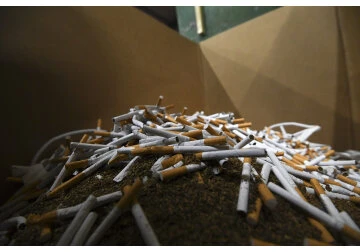
According to a study conducted by KPMG on behalf of Philip Morris International (PMI), for the first time since 2014, the share of cigarettes coming from the black market (counterfeit and contraband) exceeded 10% of total cigarette consumption in the EU. Consequently, consumption of illegal cigarettes reached 41.8 billion last year, resulting in tax losses estimated at 16.7 billion euros. Western European countries have been hit the hardest, particularly France, Belgium, and the Netherlands, where a significant increase in this figure was observed.
The study also shows that in 2025, cigarette consumption on the black market rose by more than 7% compared to the previous year. Counterfeit cigarettes had the greatest impact on this trend, with their share in EU member states steadily increasing. Their volume reached 18.3 billion cigarettes, accounting for 44% of total illicit consumption in 2025. This volume increased by more than 20% compared to the previous year, demonstrating the ability of organized crime groups to rapidly adapt their production and distribution models to circumvent detection and control mechanisms.
At the same time, the illicit market is undergoing significant structural changes. An increasing number of counterfeit cigarettes are being produced within the European Union, gradually replacing traditional smuggling routes from East to West. As a result, supply chains are becoming faster, more fragmented, and more difficult to monitor, while illicit activities are increasingly adapting to consumer markets. Western European countries, particularly France, Belgium, and the Netherlands, are increasingly emerging as hubs for the illicit trade in tobacco products and nicotine.
“The numbers speak for themselves: counterfeit products have become the main driving force behind the illegal cigarette market in the European Union, supported by criminal networks set up to distribute counterfeit goods to high-value markets. This phenomenon harms the European economy and fuels other types of illegal activity,” said Christos Harpantidis, Group Chief Corporate Affairs Officer at Philip Morris International. “This situation also highlights vulnerabilities in regulation, law enforcement, and legal procedures that allow illicit trade to expand at a time when many countries are facing economic and security pressures. Addressing these gaps requires coordinated action: strengthened law enforcement, public-private partnerships, and balanced, evidence-based, and practical regulation,” added Christos Harpantidis.
According to a KPMG study, France remains the largest market for illicit cigarette consumption in Europe, accounting for 41.4% of total consumption, which is equivalent to 20.5 billion cigarettes. Counterfeit products account for about 9.7 billion units, or approximately 19% of total consumption. Furthermore, France is projected to see the sharpest increase in illicit cigarette consumption in Europe by 2025. In Belgium, illicit products accounted for nearly 25% of total consumption, or more than 2 billion cigarettes. In the Netherlands, the share of the illicit market exceeded 22%, reaching 2.1 billion cigarettes, thus returning to the level recorded in 2006. Within the European Union, six member states currently have a share of illicit consumption exceeding 20%, underscoring the scale of this phenomenon.
Outside the EU, the United Kingdom remains the second-largest market for illicit cigarettes included in the study. In that country, the volume of illicit cigarettes exceeded 7 billion, of which 3.5 billion are counterfeit.
“European experience shows that there is no single measure capable of solving the problem, and success depends on striking a balance,” says Massimo Andolina, president of Philip Morris International’s European region. “Countries that avoid extreme measures and combine effective law enforcement with stable, predictable, and evidence-based tax and regulatory policies are able to reduce the level of illicit trade. Markets with an excessive tax burden, such as France and the Netherlands, where trends continue to worsen, should take these findings into account and act as quickly as possible,” he added.
For the first time, the study also assessed the market for oral nicotine products in select European countries. The results show that in markets where nicotine pouches are banned or strictly regulated, these products are nonetheless widely available. A substantial portion of these products comes from illegal sources, including counterfeit production or imports from regulated markets. This indicates that, despite existing restrictions, consumers continue to have high access to these products.
The highest rates of access to banned products with significant consumer potential were recorded in the Netherlands, Germany, and Belgium.
At the same time, the situation in Europe is developing unevenly. Some countries have managed to consistently reduce the volume of illicit trade through balanced policies combining predictable taxation, proportionate regulation, and consistent law enforcement. Greece, where the illicit market accounts for 14.1% of total consumption (1.9 billion cigarettes), recorded one of the most significant annual declines—a decrease of 3.4 percentage points. This trend reflects a significant shift compared to previous years, when the illicit trade rate consistently remained above 20%.
Ukraine, with an illicit market share of 15.9% and a volume of 5.1 billion cigarettes, reported a reduction in the illicit market of nearly 1 billion cigarettes compared to the previous year. This result is all the more remarkable given the challenging security and operational environment in the country.
Across the 38 European countries included in the study, total consumption of illicit cigarettes reached 55.3 billion in 2025. The resulting losses to government budgets are estimated at 22.4 billion euros.