


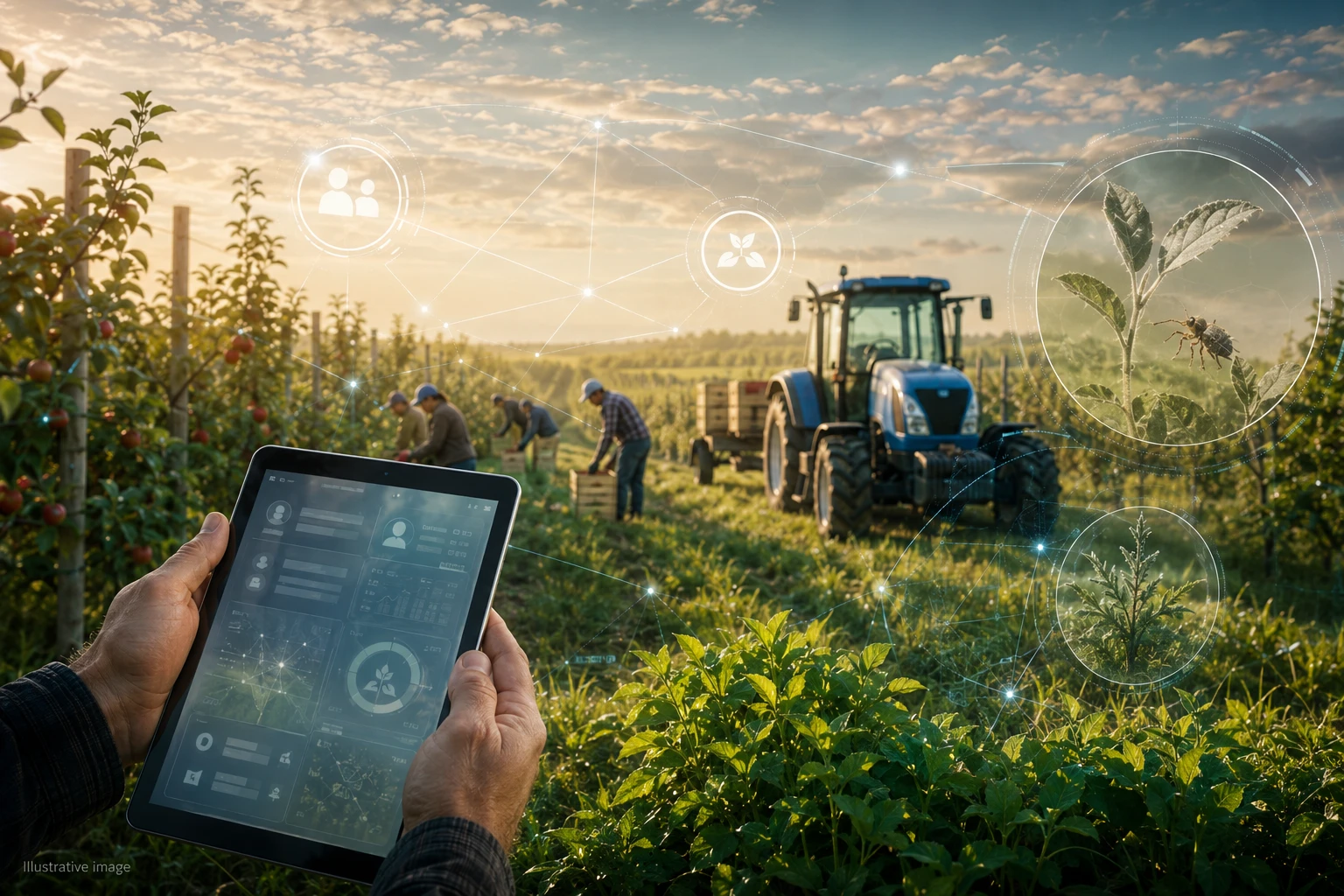
Moldovan agriculture is entering a period in which it is becoming increasingly difficult to operate “as before.” The government is transitioning seasonal labor to a digital tracking system, introducing new regulations to monitor plants and animals that could harm ecosystems, and gradually expanding the scope of responsibility for the agricultural sector. For an industry where so much depends on the weather, the season, people, and quick on-the-spot decisions, this is a significant change.
Two recent news stories clearly illustrate this transition. Fruit growers have proposed refining the e-Zilier platform to better reflect the realities of the agricultural season. Meanwhile, parliament passed a bill in its first reading that prohibits the import, cultivation, sale, and distribution of invasive alien plant and animal species.
Formally, these are different issues. The first concerns seasonal workers and digital vouchers. The second concerns environmental risks, biodiversity, and the control of species that pose a threat to local ecosystems. But for the agricultural sector, the underlying message is the same: agriculture is increasingly becoming part of a system of record-keeping, traceability, and accountability.
The e-Zilier platform was launched on June 1, 2026, and was intended to simplify the tracking of seasonal workers by replacing paper logs with digital tools. This is a critical issue for agriculture: during peak season, farmers need to quickly register workers, often for short periods—sometimes just a few days or even a single day. But this is precisely where digitization collides with reality.
Fruit growers point out that the system needs more flexible features: the ability to save and reuse digital vouchers, group them by day, delete canceled entries, and operate despite unreliable internet connections in rural areas. In addition, many seasonal workers arrive without identification, some people are wary of official registration due to its potential impact on social benefits, and certain procedures—such as occupational safety training and confirmation of wage payments—still have to be completed on paper because workers lack electronic signatures.
This highlights the main risk of any digital reform: if the tool does not align with real-world processes, it does not reduce bureaucracy but merely transfers it to an electronic format. For a large enterprise, this may be a matter of administration. For a farmer during harvest season, it’s a matter of time, labor, and losses.
The Ministry of Labor has already stated that the proposals will be reviewed, and the platform’s functionality is planned to be optimized to reduce the burden on employers while maintaining compliance with legal requirements. This is an important point: formalizing seasonal labor is necessary, but it must be practical. Otherwise, part of the market will once again shift into the informal sector.
The second issue—invasive alien species—may seem less “economic” in nature, but it has a direct cost for agriculture. The bill provides for the creation of a National Monitoring and Information System for early detection and rapid response, as well as two lists of invasive species: one will be based on the EU list, and the other will be adapted to Moldova’s natural environment.
Species included on these lists may not be imported, cultivated, grown, sold, transported, or released into the wild. Exceptions are permitted only for scientific research, in isolated areas, and with authorization from the Environmental Protection Agency. Violations of these regulations are subject to fines ranging from 2,500 to 5,000 lei for individuals and from 5,000 to 10,000 lei for legal entities.
For the agricultural sector, this is not just an abstract environmental policy. It is estimated that annual agricultural losses in Moldova due to invasive species amount to 5–10% for grain crops, 15% for field crops, and up to 25% for perennial crops. Among the invasive species already present in the country are ragweed, the American maple, ailanthus, certain fish species, the Colorado potato beetle, the common rat, mites, and various insect species.
And here, the logic is the same as in the case of e-Zilier: the government is trying not just to react to the problem, but to create an early-warning system. In the case of seasonal workers, this means keeping track of who is working and under what conditions. In the case of invasive species—to understand which plants and animals may pose a threat to agriculture, ecosystems, and public health.
For Moldova, this is part of a broader transition toward European regulations for managing the agricultural sector. But success will depend not on how well the documents are drafted, but on whether the new tools can function under real-world conditions: in rural areas, during peak seasons, amid labor shortages, with unreliable internet, and given farmers’ limited resources.
Agriculture truly needs record-keeping, traceability, and oversight. Without these, it is difficult to talk about competitiveness, market access, and protection against new risks. But these rules should help producers operate legally and sustainably, rather than becoming yet another layer of red tape. This is the main challenge: making the agricultural sector more manageable without disconnecting regulation from the land, the people, and the season. //July 12, 2026 – InfoMarket.