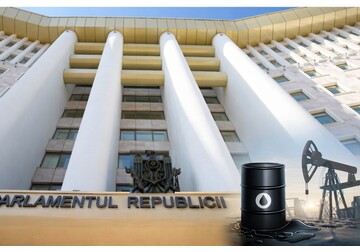
For the first time, Moldova will establish emergency stockpiles of petroleum products equal to either 90 days of average imports or 61 days of domestic consumption
This is stipulated in the draft Law on the Security of Petroleum Product Supply, which Parliament adopted in its first reading. Specifically, it stipulates that emergency stockpiles will be created and maintained at a level corresponding to at least the amount of petroleum products equal to the 90-day average daily net imports or 61 days of average daily domestic consumption of petroleum products during the previous calendar year, whichever is greater. The draft law regulates the mechanism for creating, maintaining, managing, and using reserve stockpiles of petroleum products. This ensures that consumers in Moldova will be able to obtain petroleum products even during crises or major market disruptions. According to the document, emergency stockpiles of petroleum products will be formed by both the Central Stockpiling Structure and petroleum product importers, with the responsibilities being divided equally between both parties. The stockpiling process will be gradual, until June 30, 2034, to avoid financial pressure on the state budget and the economic situation. The individual storage obligations of the Central Stockpiling Structure and each importer will be calculated and established by the Ministry of Energy based on individual data provided monthly by economic operators. The volume of mandatory stockpiles will be proportional to the volume of imported petroleum products in the previous calendar year. Gasoline and diesel fuel will comprise 75% of the total emergency stockpiles. Approximately 60% of the total stockpiles must be stored within Moldova, but some stockpiles may also be stored outside the country under bilateral agreements with host countries. The bill also provides for the possibility of creating intangible reserves through contracts stipulating the right, but not the obligation, to purchase petroleum products based on pre-established criteria. Emergency tangible reserves will be stored in authorized storage facilities, including customs warehouses and free zones. The National Agency for Energy Regulation will monitor compliance with storage obligations by economic entities, and the bill introduces sanctions for non-compliance. The activities of the Central Stockpile Storage Structure will be overseen by the Ministry of Energy. The draft law, developed by the Ministry of Energy, aims to harmonize national legislation with EU standards for the safety of petroleum product supplies. The document will be considered in parliament for a second reading. Once adopted, the law will enter into force on the date of its publication in the Monitorul Oficial. Subsequently, within eight months, the government will create or appoint the Central Stockpile Storage Structure. According to the Ministry of Energy, the project envisages the creation of a system in Moldova under which the state and importing companies will accumulate reserves of gasoline, diesel fuel, kerosene, fuel oil, and liquefied petroleum gas for use in emergency situations. This will reduce the country's vulnerability to external shocks and ensure the continuity of fuel supplies to the economy and the population. To finance the creation of a national system of emergency petroleum product reserves, the law provides for the establishment of a contribution for the formation and maintenance of emergency reserves. This contribution will cover the costs of purchasing fuel for the reserves, storing and rotating the reserves, and the financial costs associated with their management. During the transition period, the indicative contribution level is set at 0.48 lei per liter of gasoline, diesel fuel, or kerosene and per kilogram of fuel oil and liquefied petroleum gas. Thus, the system is based on a fair and proportionate principle, in which each market participant contributes to the security of petroleum product supplies based on the volumes entering the market and consumed. "Recent geopolitical events, including tensions in the Middle East, have once again demonstrated how fragile the stability of international energy markets and petroleum product supply chains can be. Moldova does not produce oil, has no refineries, and is entirely dependent on imports, so any external shock has consequences that are felt in people's lives. Under these conditions, security of supply ceases to be a technical or abstract concept, but directly impacts prices at gas stations, population mobility, and the functioning of the everyday economy," stated Energy Minister Dorin Jungietu. He added that the implementation of the emergency petroleum product stockpile system will be phased over eight years, allowing the storage infrastructure and market to gradually adapt. The full level of strategic reserves must be reached by July 1, 2034. At least half of the emergency petroleum product stockpiles must be stored within Moldova. The remaining reserves may be stored in other countries under bilateral agreements or in other forms permitted by law. The draft law also provides for a mechanism for continuous monitoring of the reserves. The Ministry of Energy will maintain a national registry of emergency stockpiles, and the National Agency for Energy Regulation will monitor compliance with storage obligations by economic operators. In crisis situations, decisions to use the reserves will be made within the framework of the national crisis management mechanism, allowing the state to intervene promptly and in an organized manner and avoid major supply disruptions.// 28.05.2026 — InfoMarket.