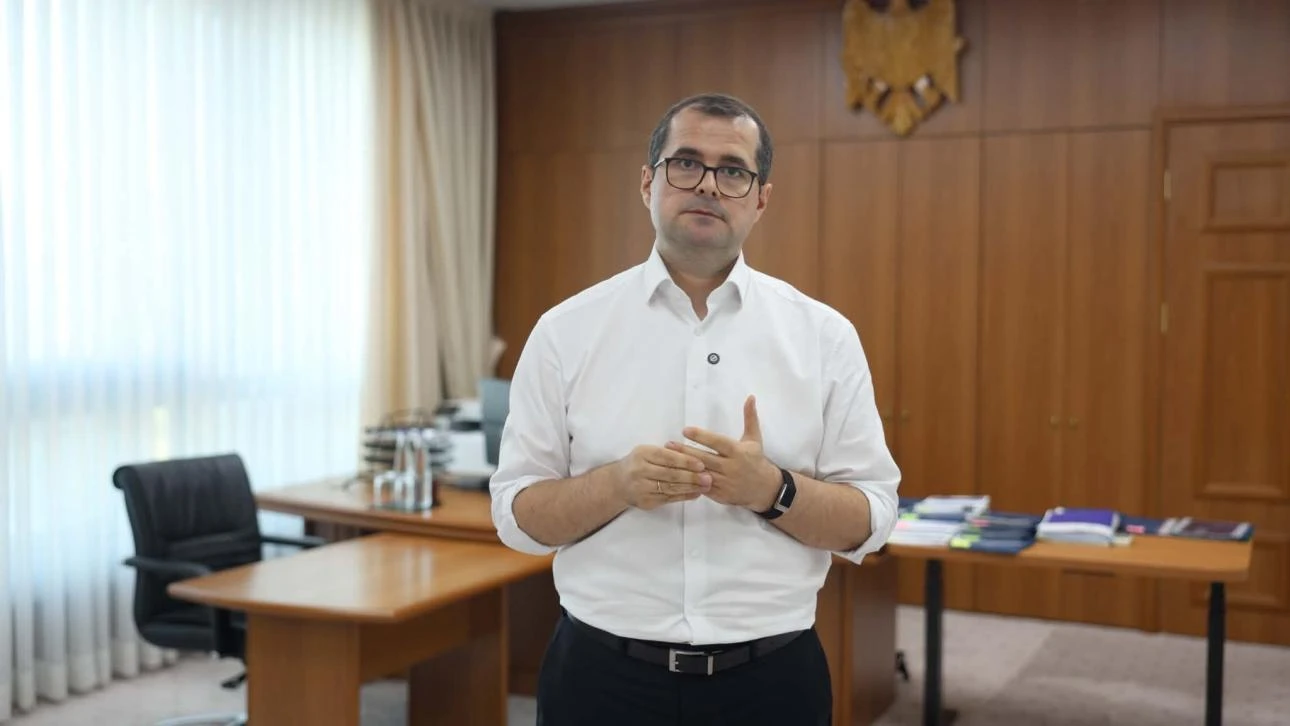
The Prime Minister recalled that on July 22, at his first cabinet meeting as Prime Minister, he instructed the Ministry of Economic Development and Digitalization to submit, by September 9, specific proposals in two areas: reducing unnecessary rules and procedures and changing the government's approach to conducting inspections in the private sector. Vasile Tofan noted that the deregulation packages are in the final stages of approval by the Ministry of Justice and the National Anti-Corruption Center and will be submitted for approval in the near future. The Prime Minister explained that an analysis of these areas revealed two problems: a large number of requirements and permits that need to be simplified, as well as a punitive and disproportionate approach to inspections, which are often duplicated and distributed among several agencies and under different regulatory regimes. In this regard, Vasile Tofan stated that amendments are proposed to nearly 100 regulatory acts, which are being analyzed as part of two packages: one provides for amendments to or the repeal of government resolutions, while the other concerns changes to legislation. About 80 permits are being reviewed for possible repeal or conversion into notifications or voluntary compliance documents. As the prime minister noted, outside the list of permits established by law, 172 permitting procedures have been identified that must either be justified and included in the list or converted into notification procedures. Currently, there are 19 regulatory agencies, 36 bodies authorized to adjudicate administrative offenses, and 5 investigative bodies that can intervene in economic activity. More than 300 articles on administrative offenses and more than 80 articles of the Criminal Code may pertain to economic activity. In the area of tax enforcement, scheduled audits currently account for approximately 4% of the total annual number of audits. This results in a lack of predictability and the risk of prosecution. Regarding the proposed deregulation measures, Vasile Tofan noted that they are aimed at eliminating repetitive procedures and redundant documents and permits. For example, for small-scale agro-industrial and energy investments outside populated areas, a simplified urban planning procedure is proposed without waiving technical, environmental, or heritage protection requirements. For instance, for the construction of basic agricultural facilities—such as a cold storage facility, hangar, warehouse, etc.— — outside a populated area that does not have an approved master urban development plan—obtaining an urban planning certificate for design involves at least 26 sequential administrative steps with a total minimum duration of 7–12 months, and if an environmental impact assessment is also required, 10–15 months. At the same time, veterinary and sanitary permits and food safety registration certificates must be reissued simply because a lease agreement is being renewed. It is proposed to make these permits and certificates valid indefinitely, provided that the business activities and relevant conditions have not changed. In addition, staffing schedules will no longer be mandatory. A company will be able to use them if necessary, without imposing this internal formality on all employers. Another problem arises when the law allows a business to begin operations based on a notification, but in practice the business is required to wait for the issuance of a certificate that merely confirms the fact that the notification was submitted. This approach turns a simplified procedure into a disguised permit. It is planned that occupational safety documents and training can be processed electronically, including online training with an electronic signature. Today, a significant portion of the documentation is still kept on paper with handwritten signatures. Small businesses with a low risk of fire will not be required to follow the same procedures as companies engaged in high-risk activities. In the construction sector, investors will no longer have to independently collect opinions and approvals from other agencies. For example, an opinion from the heritage protection authority—when required—must be obtained through coordination among government agencies. In the case of a detailed urban development plan, responsibility remains with the local government, and the investor will not have to visit various agencies. In addition, permits for a building and its utility networks can be obtained through a single procedure. Prior to detailed design, the investor may, if desired, request a preliminary review of the urban planning concept. If an authority fails to review an application for an urban planning certificate or a building permit within the established timeframe, or if it denies the application without clear justification, it is proposed to create an administrative mechanism to resolve the situation before the investor is forced to go to court. In addition, wine-making registries may be maintained directly within the existing information system, without the mandatory use of a paper format consisting of numbered, bound, and signed pages. Another example concerns medical laboratories. If a laboratory is accredited by a body recognized within the European accreditation system, there is no basis for requiring it to re-confirm compliance with the same standards. Another example is the yellow license plates for vehicles engaged in passenger transportation. These plates entail additional procedures and costs for carriers without improving passenger safety or replacing licensing, technical inspections, or oversight of transportation services. It is proposed to abolish this requirement and switch to standard license plates. In addition, forms related to cash registers and control equipment will be simplified. Fields that are irrelevant in all situations will no longer need to be formally filled out just to ensure the document is accepted. When granting certain tourism subsidies, a classification certificate will not be required in cases where the law does not actually provide for the classification of the relevant facility. As the Prime Minister emphasized, these examples illustrate the logic behind the entire package. According to Vasile Tofan, the second set of changes concerns how the government verifies compliance with regulations. Thus, a company with a low risk level and a good track record should not be subject to the same level of scrutiny as a business with a high risk level or a history of repeated violations. The Prime Minister explained that from July 22, when the website controale@gov.md went live, through September 6, 213 complaints were received from business owners. Of these, 63 directly concerned regulatory barriers, bureaucratic procedures, or industry-specific fees, while 38 concerned government inspections. Nearly 74% of the complaints related to inspections involved two agencies: the State Tax Service and the National Agency for Food Safety (ANSA). Among the most frequently cited problems are unannounced or repeated tax audits, assessments, and penalties deemed disproportionate; excessive requirements for small producers; obstacles in obtaining environmental, sanitary, and construction permits; duplicative reporting, as well as unnecessary requests for documents or data. As the prime minister noted, these complaints do not automatically mean that the government agency made a mistake or that the company is in the right; however, this data clearly shows where the most problems arise. According to him, unannounced inspections remain necessary when there is a real risk, signs of fraud, or a danger to people. Vasile Tofan announced a series of proposals in this regard. Specifically, it is proposed to conduct more scheduled inspections based on risk assessments. In the area of tax enforcement, a clear annual plan, a publicly available risk classification methodology, and the integration of the plan into the State Register of Inspections are proposed. Additional audits and unannounced audits should be justified exceptions. Clearer limits on the duration and frequency of audits are also proposed. The number of visits and their duration should depend on the taxpayer's risk profile and the potential damage. It is proposed to introduce checklists for tax audits, as businesses need to know what the auditor is checking, what documents they may request, and how serious each noncompliance is. The plan is to request fewer documents during an audit. As the prime minister noted, violations that can be quickly remedied and that do not pose an immediate risk should, as a rule, be corrected before disproportionate penalties are automatically imposed. At the same time, vague provisions, duplicative regulations, and instances where the same act can result in significantly different penalties will be reviewed. At the same time, the State Register of Inspections should also serve as a tool for monitoring inspectors. Its functionality will be expanded to facilitate data exchange, identify duplicate inspections, and automatically detect certain procedural violations. According to the Prime Minister, the effectiveness of agencies should not be measured by the amounts collected as a result of inspections. Inspections should be aimed at prevention and ensuring compliance with regulations, rather than at punishment. Vasile Tofan noted that comparable metrics for government agencies will be published: scheduled and unannounced inspections, companies inspected, sanctions, suspensions of operations, appeals, and procedural compliance. He noted that complaints from businesses regarding unjustified inspections or interference should be tracked at the systemic level, rather than addressed only on a case-by-case basis. Serious cases can be analyzed and escalated to a higher level to address recurring practices. The head of government explained that the deregulation packages are in the final stages of review. Subsequently, measures pertaining to government resolutions will be submitted to the government for approval, while amendments to laws will be approved by the government and forwarded to parliament. During this process, some decisions may be revised or excluded. "This process does not end with today's package. We will continue to review regulations and permits, eliminate duplication, and digitize procedures wherever possible. I urge you to provide feedback and share other suggestions for simplification. Requirements that protect health, safety, the environment, and consumers will remain in place. But procedures that no longer serve a practical purpose must be eliminated," noted Vasile Tofan. //10.09.2026 – InfoMarket.
Vasile Tofan presented a concept for deregulation and streamlining inspections
Prime Minister Vasile Tofan presented a concept for deregulation and the simplification of inspections, which will be developed into draft laws and government resolutions