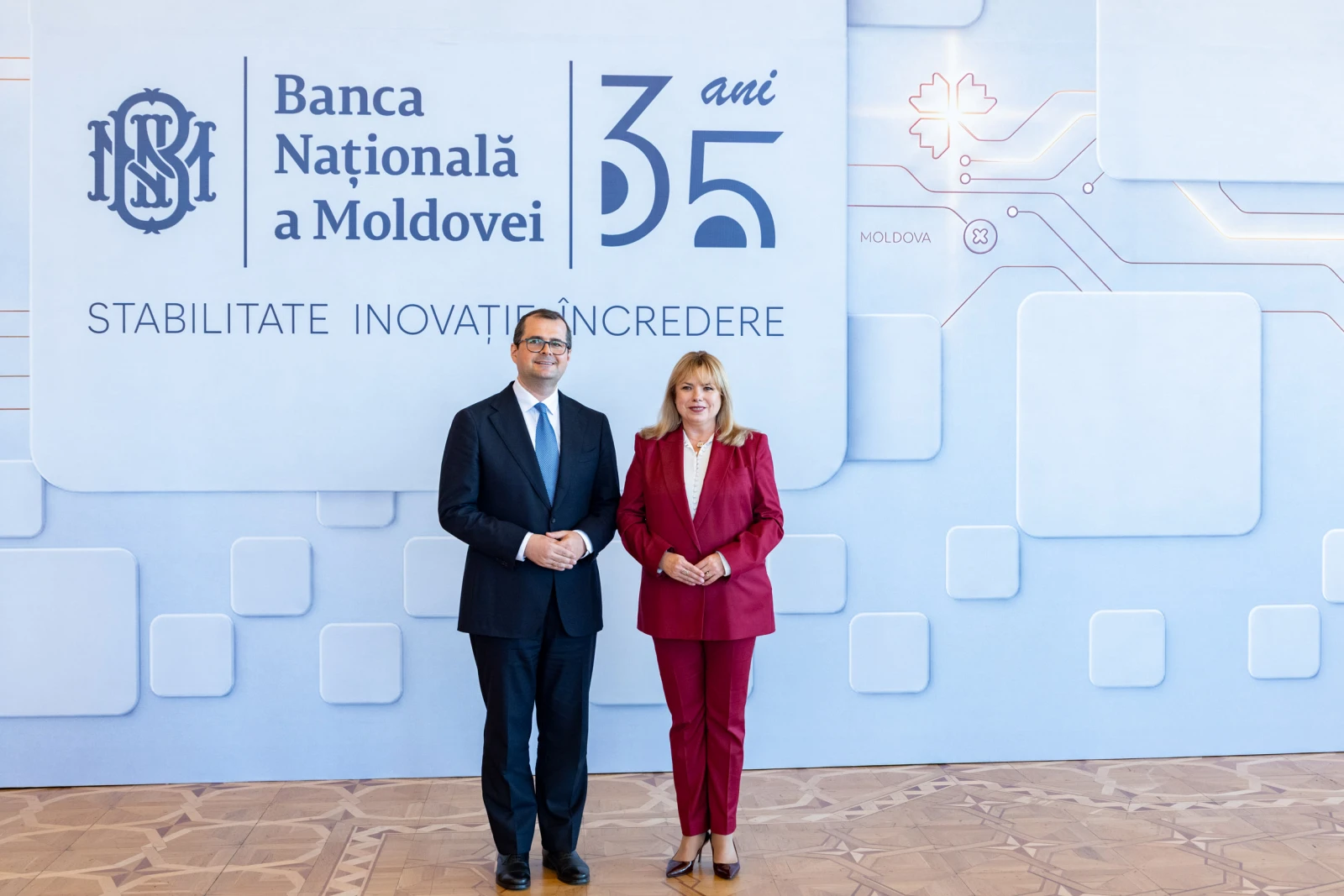
The prime minister made this statement while speaking at an anniversary event titled "The National Bank of Moldova: 35 Years of Stability, Innovation, and Trust." The head of government congratulated the National Bank's team and professionals in the financial and banking sector, noting the institution's important role in strengthening the financial system, ensuring monetary stability, and promoting Moldova's economic development. Vasile Tofan noted that in today's economy, few institutions are more important than a strong, professional, and independent central bank. In his words, the National Bank's independence is not a privilege but a responsibility. "It is the ability to make the right decisions, even when they are difficult, inconvenient, or unpopular. If confidence in the central bank is undermined, the entire economy will very quickly pay the price," the prime minister stated. The head of government emphasized that the National Bank's decisions have a direct impact on the economy, investments, and the well-being of citizens. A change in the BNM's interest rate can affect borrowing costs for hundreds of thousands of people, companies' investment decisions, exchange rates, household savings, prices, and family incomes. In this regard, the prime minister noted that the institution's independence must be underpinned by professionalism and responsibility in every decision it makes. "There is only one scenario in which I would want the BNM to relinquish part of its monetary sovereignty: Moldova's accession to the European Union and, once we are ready, the transition to the euro," said the prime minister. He also welcomed the presence of Romanian banks in Moldova's banking sector and emphasized the importance of the principle of reciprocity for Moldovan banks wishing to enter the Romanian market, so that trade and financial ties between the two countries can continue to strengthen. At the same time, Vasile Tofan thanked the leadership and the entire staff of the National Bank, as well as the institution's partners—including the National Bank of Romania and the Bank of France—for their contribution to the development of Moldova's financial, banking, and regulatory system. "Much of the central bank's work goes unnoticed, but its results should be felt in the form of trust, predictability, and—above all—price stability. As we mark this 35th anniversary, I wish for you to remain a strong, independent institution committed to high standards," the prime minister concluded. The National Bank of Moldova was founded on June 4, 1991. In November 1993, Moldova introduced its national currency—the Moldovan leu—which marked an important milestone in the development of the country's monetary system. The primary objective of the National Bank of Moldova is to ensure and maintain price stability. The BNM develops and implements monetary and foreign exchange policies, manages the country's foreign exchange reserves, regulates the activities of financial institutions and the financial market infrastructure while supervising them, and serves as the sole issuer of the national currency. // 17.09.2026 — InfoMarket
Vasile Tofan: An Independent Central Bank Is the Cornerstone of a Modern Economy
"A strong, professional, and independent central bank is the cornerstone of a modern economy" — Vasile Tofan