


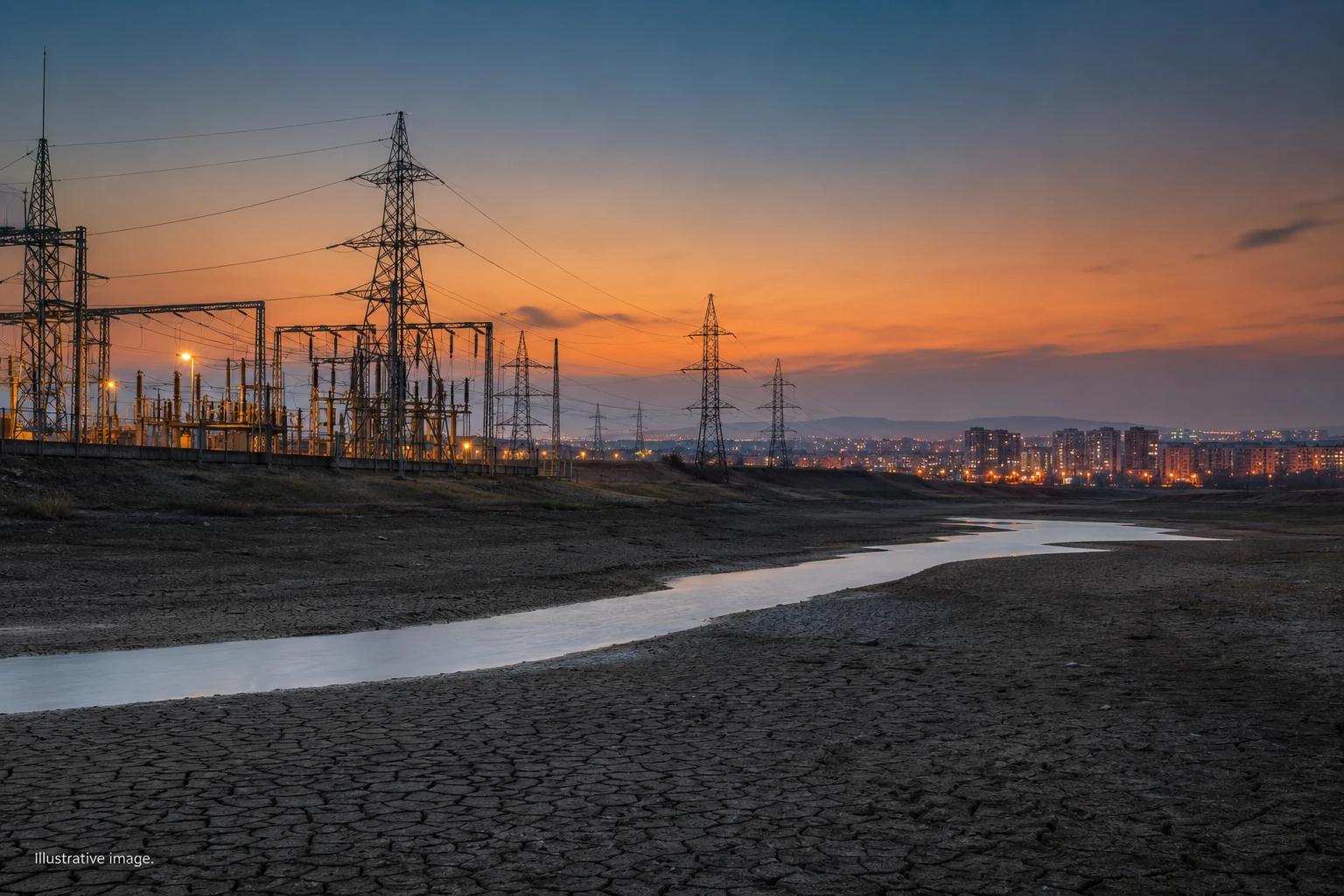
The commercial electricity shortage officially announced for the evening of August 4 became the most visible consequence of the heat wave and low water levels in the region for Moldova. From 9:00 p.m. to 10:00 p.m., the shortfall was estimated at approximately 74 MW/h, and in the following hour, at another 56 MW/h. Moldelectrica planned to activate emergency support, and consumers were warned of the possibility of temporary power outages.
However, the 130 MWh figure represents a projected shortfall, not an actual recorded one. This represents the total energy over two two-hour intervals, not a measure of the actual power shortage. Therefore, this figure cannot be used to determine how much emergency power was ultimately required or whether there were actual supply constraints.
The cause of the shortage lies outside the Moldovan power grid. The heat wave simultaneously increased electricity consumption for air conditioning and reduced the availability of power generation in the region. Low water levels in the Danube limited the operation of hydroelectric power plants and some nuclear power units that use river water in their cooling and steam condensation loops.
In Romania, the first power unit at the Cernavodă Nuclear Power Plant was shut down in a controlled manner on July 28 due to the unprecedentedly low water level of the Danube and remained safely shut down as of August 4. The second unit continued to operate at rated capacity after measures taken by the authorities helped raise the water level near the plant. However, the operator warned that if the water level continued to drop, the unit might still have to be shut down.
In Hungary, the situation was more severe. According to government data as of August 4, the output of the Paks Nuclear Power Plant had been reduced by 1,770 MW: the plant was generating about 230 MW instead of its usual 2,000 MW. At the same time, it would be inaccurate to say that all nuclear power plants in the region have been shut down. On July 31, Bulgaria's Kozloduy Nuclear Power Plant reported that both of its units were operating on schedule, despite the Danube's water levels being at their lowest in many years.
The shutdown of Unit 1 at Cernavodă was a preventive measure and was not the result of an accident. However, for the energy market, the reason for the reduction in capacity is of secondary importance: stable generation is being withdrawn from the system, supply is decreasing, and competition for available import volumes is intensifying.
This is particularly sensitive for Moldova due to its dependence on external supplies. A physical connection to the power grids of Romania and Ukraine does not in itself guarantee the availability of electricity when needed. What is needed is available generation capacity, accessible transmission capacity, and a seller willing to supply electricity at a reasonable price. Emergency assistance helps keep the system in balance, but it is usually more expensive than regular commercial purchases.
Moldovan authorities have suspended commercial electricity exports from 6:00 p.m. to 10:00 p.m., except for volumes necessary to fulfill public service obligations. Energocom has been tasked with seeking additional supply sources, while enterprises with energy-intensive production processes have been instructed to shift their peak consumption outside the 6:00 a.m.–9:00 a.m. and 6:00 p.m.–11:00 p.m. time frames.
At the same time, Moldova is facing its own water shortage. Two related but distinct factors are at play here: the shallowing of the Danube is limiting regional electricity generation, while low water levels in the Dniester River pose risks to the country's water supply, industry, and agriculture. Water withdrawal from the Dniester for irrigation is permitted from 9:00 p.m. to 6:00 a.m., and industrial enterprises not classified as essential sectors are required to reduce consumption by at least 20%.
The schedules for water and electricity conservation partially overlap. Irrigation is permitted starting at 9:00 p.m., whereas the evening peak in electricity consumption lasts until 11:00 p.m. If pumping equipment is turned on en masse at the start of the nighttime period, this could increase the load precisely when the system is short on power. The effectiveness of these measures will depend on coordinating the schedules of water users with those of the power grid.
Authorities see the development of energy storage systems as a medium-term solution. Currently, approximately 30 systems installed across the country have a combined capacity of about 150 MWh. By the end of the year, according to estimates by the Ministry of Energy, this capacity could more than quadruple thanks to private investments totaling approximately 150 million euros.
At the same time, the Ministry of Energy, the Ministry of Economic Development and Digitalization, and the Entrepreneurship Development Agency are preparing a mechanism for state guarantees on bank loans for battery installations. It is expected to be approved in early September. State aid, a deferral of VAT payments on imports, and the elimination of mandatory construction permits and zoning plans for such facilities are also being considered. The amount of the guarantees, the portion of the loan covered by the state, the limit per project, and the source of compensation for potential losses have not yet been specified.
It is not possible to directly compare the current 150 MWh of battery capacity with the projected deficit of 130 MWh. To make an assessment, it is also necessary to know the systems' capacity in MW, the duration of discharge, the charge level at the evening peak, and the ability to make the stored energy available to Moldelectrica. Batteries do not generate electricity: they allow for the storage of daytime surpluses—primarily from solar generation—and their use at a later time.
Moldova's vulnerability stems not only from its dependence on imports but also from a lack of domestic flexibility during peak hours. Energy storage systems can reduce the need for costly emergency support and smooth out short-term shortages. However, in the event of a prolonged reduction in nuclear and hydroelectric generation, reliable import contracts, new interconnector lines, controllable domestic capacity, and permanent mechanisms for regulating consumption will be required. Batteries alone cannot compensate for generation shortfalls in neighboring countries. // 05.08.2026 – InfoMarket.