


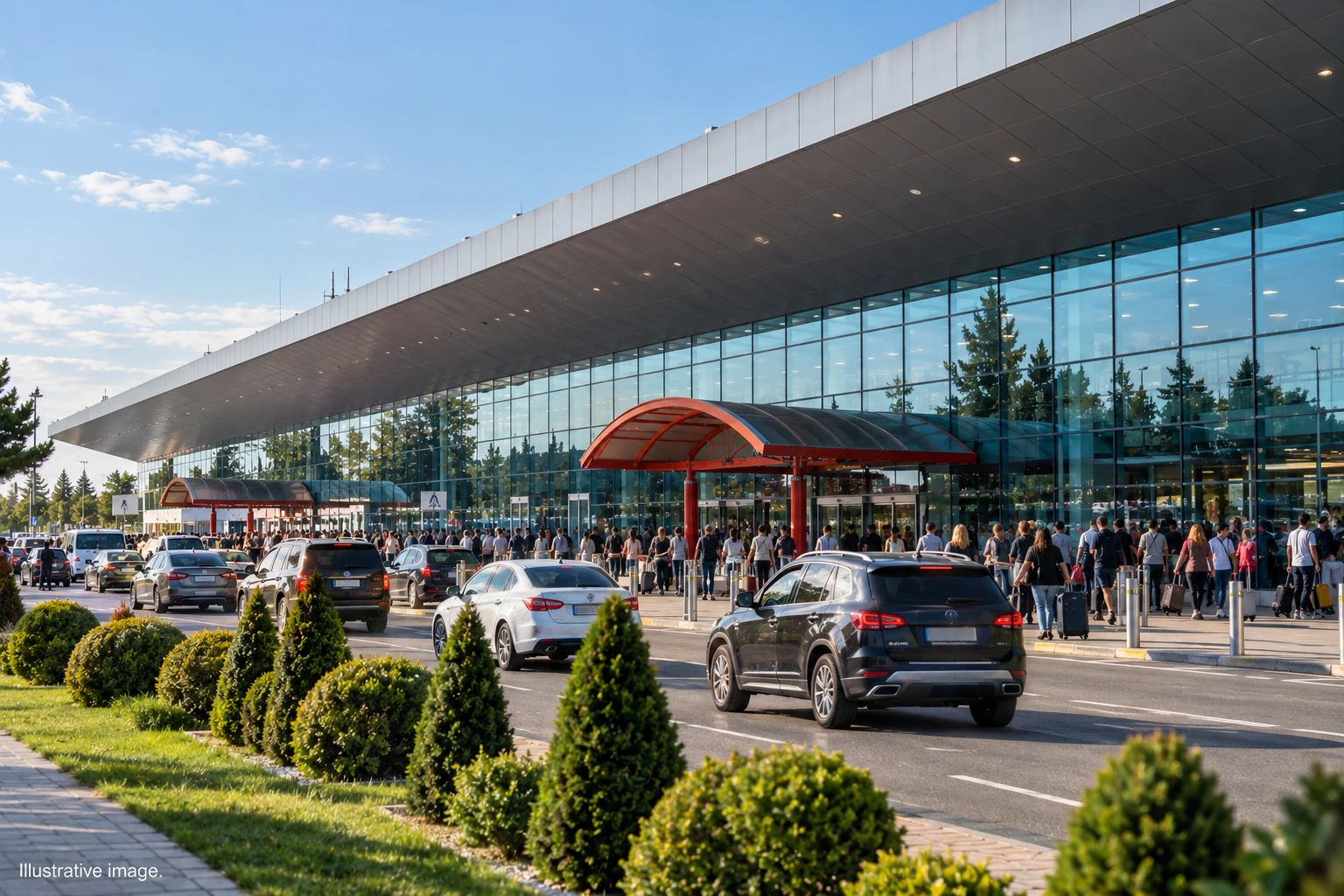
Chisinau Airport has not yet begun the planned renovation of its passenger terminal, yet the scope of its development is already having to be revised. Its passenger traffic is growing significantly faster than its infrastructure. In 2024, the airport handled 4.14 million passengers; in 2025, that number rose to 6.08 million—a 46.8% increase. More than 7 million passengers are expected in 2026.
In fact, the airport's operations have changed dramatically over the past two years, while the existing terminal has remained unchanged. This is particularly evident during peak hours, when a large number of flights are departing or arriving simultaneously. In September, the government acknowledged that the current infrastructure no longer meets the actual passenger flow and demanded that terminal expansion begin no later than October.
The problem, however, is that this project was initiated before the current surge in passenger traffic.
On May 7, 2026, the airport announced a tender for the renovation of the terminal building, including a partial redesign and expansion of the facilities. The estimated cost of the work is approximately 158 million lei, excluding VAT. The project aims to increase the floor space and capacity of the existing building without interrupting the airport's operations.
Moreover, this is not the first time the airport's development plans have had to be revised. Back in early 2024, the renovation of the old terminal was supposed to increase capacity from 800 to 1,100 passengers per hour. At the same time, authorities were considering the construction of a new terminal designed to handle more than 5 million passengers per year.
However, market growth turned out to be significantly faster. By 2025, the airport had already served 6.08 million passengers. As a result, the authorities abandoned the idea of building a new terminal and opted for a quicker solution—expanding the existing one by approximately 5,000 square meters, or 30%, increasing, in particular, the number of boarding gates from 7 to 13.
However, even these plans were formulated based on significantly lower passenger traffic. Government documents set the target for the airport's development by the end of 2028 at 5.2 million passengers per year and a throughput capacity of 1,700 passengers per hour. The airport exceeded the first of these targets as early as 2025—three years ahead of schedule. In 2026, passenger traffic is expected to exceed 7 million.
However, work has not yet begun. On August 10, two groups of bidders—the Standard Byte & Horus consortium and the Eurostil Construct & Moldconstruct Service consortium—challenged the tender results. On September 7, ANSC fully upheld both complaints and ordered the airport to take steps to correct the procedure. As a result, the procurement process had not yet been completed by mid-September.
This creates a paradoxical situation: the renovation, which was supposed to solve the problem of insufficient capacity, has not yet begun, yet the airport is already preparing documents for the next stage of development.
In February 2026, the airport announced a separate tender worth up to 20 million lei for the development of a new master plan for the airport. This is a significantly broader document than the project to renovate the current terminal. It is intended to define the long-term development of the site, transportation and airport infrastructure, aircraft traffic, and the airport's future needs. When explaining the procurement terms, the airport itself specifically emphasized that the terminal will be just one element of the new master plan.
But the main problem with the current renovation is that it addresses a space shortage that already exists today, whereas the new master plan must determine what kind of airport Moldova will need in five, ten, or twenty years. Until recently, this issue did not seem so urgent, but the pace of passenger traffic growth has completely changed the initial conditions.
In 2025, 6.08 million passengers passed through Chisinau, compared to 4.14 million the previous year. The increase amounted to nearly 2 million passengers in just one year. Moreover, 2025 was not a one-time spike: in the first half of 2026, passenger traffic continued to grow by approximately 21%. By comparison, the average growth rate for European airports in the same category—with annual traffic ranging from 1 million to 10 million passengers—was about 3.7%.
This means that expanding the existing terminal is necessary, but it is already difficult to view it as a permanent solution. If passenger traffic remains high, the additional space may once again prove insufficient relatively quickly.
In the meantime, the airport has had to resort to temporary solutions. In the summer, additional waiting areas were set up in front of the terminal, and in September, authorities required the airport to increase the number of seats in the waiting areas, install mobile food and beverage kiosks, and allocate additional resources to passenger screening during peak hours. These measures help reduce lines and congestion, but they do not fundamentally change the airport's physical capacity. In August, the airport itself acknowledged that the growth in traffic requires adapting the infrastructure to the new scale of passenger traffic.
Today, two distinct projects are under consideration. The first is to urgently expand the existing terminal and remove the most pressing constraints. Approximately 158 million lei has been allocated for this. The second is to determine what the airport's entire infrastructure should look like given the new market scale. To this end, a master plan costing up to 20 million lei is being developed.
However, this procurement process has also been delayed due to disputes over its results. On June 26, Urban Scope challenged the tender results, and on July 23, the ANSC fully upheld the complaint, annulled the airport's decision to award the contract, and ordered a re-evaluation of the bids. After the re-evaluation, the dispute arose again: on August 21, Urban Scope filed yet another complaint regarding the results of the same procedure. As of mid-September, it remains under review by the ANSC.
Chisinau found itself in a situation where infrastructure planning lagged behind market growth: while one expansion project was being prepared, passenger traffic grew so much that the next one was already needed. Therefore, the new master plan should be based not on the current 6–7 million passengers, but on a realistic long-term growth scenario. Otherwise, in a few years, the airport may find itself back at square one. // 17.09.2026 - InfoMarket.