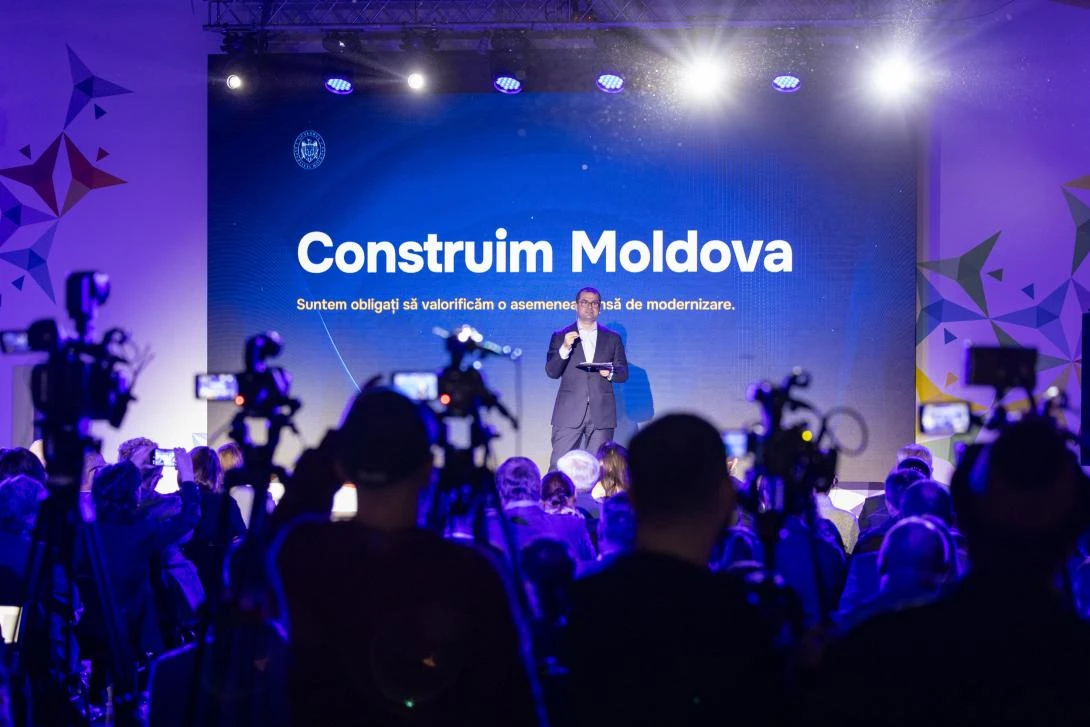
The projects focus on five priority areas—energy, infrastructure, agriculture, education, and healthcare—and are aimed at modernizing the country and improving citizens' living conditions. The investments will be financed under Moldova's Growth Plan through the mobilization of additional financial resources, including from international development partners. As part of the "Building Moldova" initiative, Prime Minister Vasile Tofan and members of the government outlined the main planned investments, expected outcomes, and implementation phases of the projects. In the energy sector, plans include thermal insulation for 1,400 residential buildings and 40 public buildings, the modernization of power grids, the construction of the Bălți–Dniesterisk power line, approximately 90 km long with a capacity of 500 MW, and the development of Chisinau's district heating system. In the infrastructure sector, plans include the construction of Moldova's first highway, the A8 Ungheni–Chisinau, with a length of approximately 125 km. Investment in the project is estimated at 1.2 billion euros. Plans also call for the expansion of Chisinau International Airport through the construction of a new terminal and runway, as well as the reconstruction of 132 km of national highways, including the R7 toward the Costesti customs checkpoint and the M3 between Chisinau — Cimislia — Comrat. Separate projects call for the construction of 697 km of main water supply lines and the provision of high-quality drinking water to 700,000 people. In agriculture, plans include the development of irrigation systems covering 6,900 hectares, the implementation of the Livada Moldovei II program, and the allocation of approximately 40 million euros to support small farmers. It is expected that approximately 300 million euros in investments will be attracted to implement about 750 projects in the fields of processing, packaging, storage, digitalization, and research. In the field of education, plans include the modernization of 20 model schools and 6 universities, the renovation of 24 academic buildings and 23 dormitories at vocational schools, as well as the construction of the HiTech Park technology campus in Stauceni, focused on information technology, microelectronics, bioengineering, and medical technology. In healthcare, plans include the modernization of 10 rural health centers, the development of telemedicine and the integration of medical information systems, the construction of a regional hospital in Bălți, and the creation of a center for the management of special waste. In the environmental protection sector, plans call for the creation of a system for the collection and recycling of special and hazardous waste at a cost of 58.3 million euros. The project is designed to handle more than 90,000 tons of waste, including batteries, chemicals, and end-of-life electrical and electronic equipment. Construction of the relevant infrastructure is scheduled to begin in 2028. According to the prime minister, the implementation of these strategic projects should accelerate the modernization of the country's infrastructure and economic development. He noted that Moldova has already received approximately 500 million euros in European support under the Growth Plan, to which a further tranche of 157 million euros has been added. Funding is provided contingent upon the implementation of the planned reforms. According to government data, every euro invested by the state from the Growth Plan attracts an additional approximately 7 euros in resources from international financial institutions for major infrastructure projects. The strategic investment projects presented are at various stages of preparation and implementation, and information on their progress will be published on the government platform Construim Moldova.// 29.10.2026 — InfoMarket.
The government presented 19 strategic investment projects
The government has presented 19 strategic investment projects that will be implemented in the coming years with EU support as part of Moldova's €1.9 billion Growth Plan