


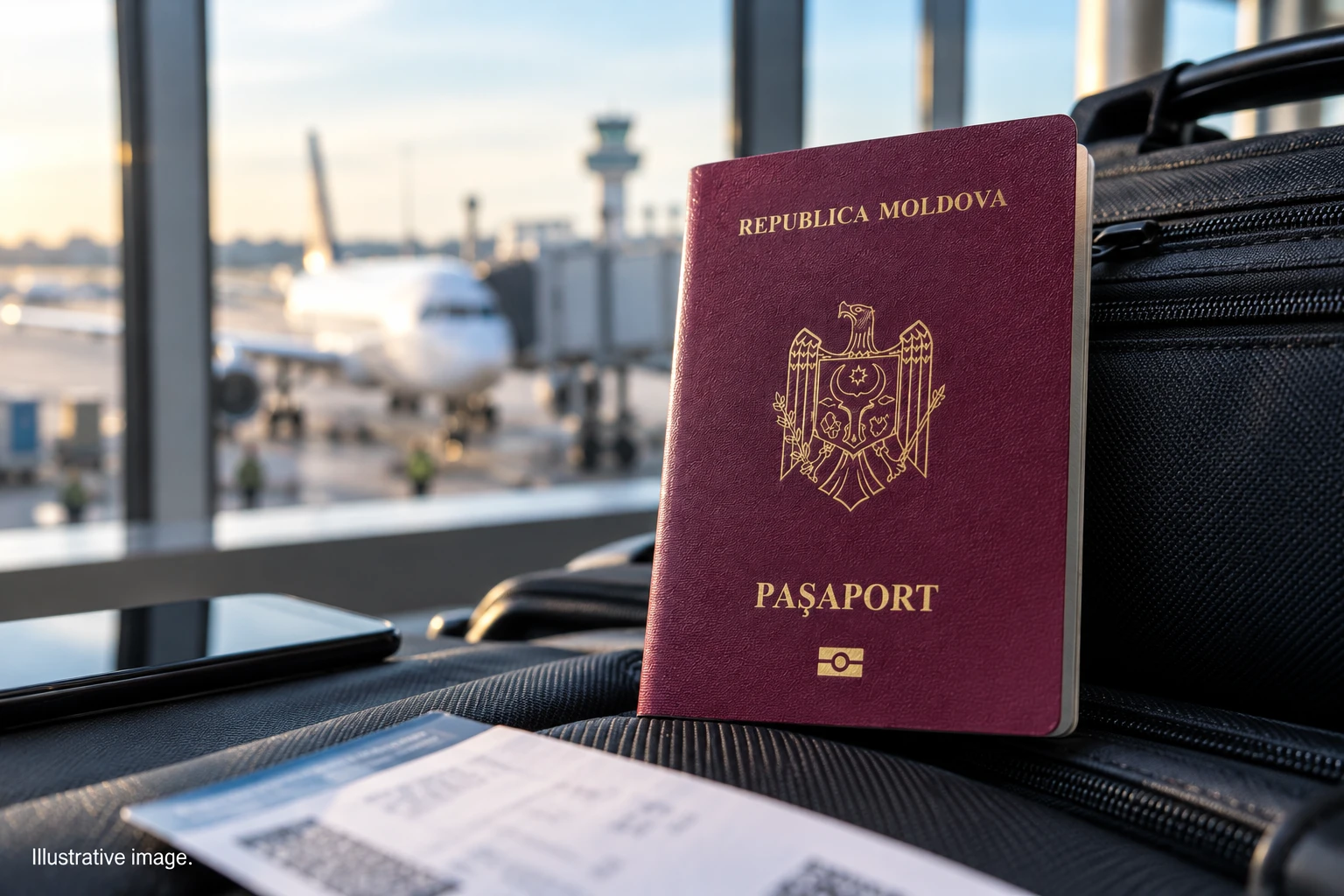
In 2026, the Moldovan passport ranks 79th out of 199 passports in the Passport Reports ranking—an international platform that evaluates passports based on the ease of travel abroad. In the early 2000s, Moldovan citizens could travel relatively freely, primarily throughout the former Soviet Union, while most of Europe remained visa-restricted. Today, the situation is fundamentally different: visa-free travel to Europe has expanded upon the opportunities that have been preserved with a significant portion of the post-Soviet countries.
According to Passport Reports, the mobility index for the Moldovan passport in 2026 is 122—that is, the number of countries and territories accessible without obtaining a traditional visa in advance. For Moldovan citizens, 74 destinations are completely visa-free; another 42 are accessible with a visa on arrival or other simplified procedures; and six require electronic authorization. For 76 destinations, a visa obtained in advance is still required.
This is just one of several rating systems: international passport indices use different methodologies and rank Moldova differently. Therefore, what is more indicative is not whether the country has moved up or down in the rankings, but how the actual geography of travel has changed over the past quarter-century.
After the collapse of the USSR, Moldova maintained visa-free travel with a significant portion of the former Soviet republics. One of the legal foundations was the 1992 Bishkek Agreement; later, many of these arrangements were formalized through separate bilateral treaties.
In the west, the opposite process took place. Until July 1, 2001, Moldovan citizens could enter Romania even with just an ID card. After that, a passport became mandatory. Following Romania's accession to the European Union on January 1, 2007, Moldovan citizens were also required to obtain a visa.
Visas also remained mandatory for most other EU countries. Starting in 2008, the procedure for obtaining visas was simplified, but a fundamental change occurred on April 28, 2014, when holders of Moldovan biometric passports gained the right to make short-term trips to the Schengen Area without visas.
For the Moldovan passport, this was a major leap forward. It wasn't just another country that opened up, but practically an entire region—and without having to give up most of the destinations that were previously accessible.
The scale of the changes after 2014 is best illustrated not by statistics, but by actual travel. According to data from the Moldovan Ministry of Foreign Affairs, from April 28, 2014, to April 20, 2026, more than 2.7 million Moldovan citizens took advantage of the visa-free regime, making nearly 21 million trips to Schengen Area countries.
There is, however, another factor that the Moldovan passport ranking does not take into account at all. A significant portion of the country's citizens also hold Romanian citizenship and, accordingly, an EU passport.
According to data from Romanian authorities provided in 2025 in response to a parliamentary inquiry, between 1991 and 2002, approximately 85,500 people from Moldova obtained Romanian citizenship through a simplified procedure, and between 2002 and 2024, another 773,400 applications were approved. Thus, between 1991 and 2024, there were approximately 859,000 cases of citizens and natives of the Republic of Moldova acquiring or regaining Romanian citizenship. Another 150,600 applications were pending review by Romania's National Directorate for Citizenship (ANC) in mid-2025.
This figure cannot be directly equated with the number of current residents of Moldova holding dual citizenship: some of those who obtained citizenship live abroad, the statistics cover a long period, and the status of individual people may have changed. But the scale of the phenomenon is significant. For hundreds of thousands of Moldovan citizens, European mobility is no longer determined by the visa-free status of the Moldovan passport, but by their rights as EU citizens.
The difference is significant. In the same Passport Reports system, the Romanian passport ranks 18th in the world in 2026 with a mobility score of 171, compared to the Moldovan passport's 79th place and a score of 122. But legal status is more important than the ranking: Romanian citizenship grants the right not only to travel to other EU countries without a visa, but also to move freely, reside, and work there in accordance with European regulations.
In the East, the changes have been less noticeable for travelers. The legal framework has gradually changed, but the ability to travel to most countries has remained. Russia, Turkmenistan, Kazakhstan, and Uzbekistan withdrew from the Bishkek Agreement at various times; however, the visa-free regime continued to operate on other legal grounds. When Moldova itself decided to denounce the Bishkek Agreement in 2025, the authorities also stated that travel arrangements with most CIS countries would not change significantly thanks to existing bilateral agreements.
However, European integration is gradually introducing a new factor into this framework. Convergence with the EU entails, among other things, the gradual alignment of Moldova's visa policy with that of the EU. This does not in itself mean the introduction of visas for citizens of Russia or Belarus: no such decisions have been made yet. But as Moldova moves toward membership, the differences between its visa regimes and those of the EU will become the subject of negotiations and legislative adjustments.
At the same time, the formal absence of visa requirements no longer always guarantees the same ease of travel as before. In 2026, the Moldovan Ministry of Foreign Affairs reported stricter checks on Moldovan citizens crossing the borders of Russia and Belarus. Russia has also introduced additional procedures for some foreigners entering under the visa-free regime. Legally, the regime remains in place, but travel conditions may become more complicated.
Therefore, the possibility of visas being required for travel to Russia or Belarus in the future cannot be completely ruled out. The future course of events will depend both on the further alignment of Moldova's visa policy with EU rules and on the decisions of these countries themselves.
Against this backdrop, changes in Moldova's ranking in the passport index appear less significant. According to Passport Reports, Moldova's mobility index stood at 123 in 2022 and 2023, rose to 125 in 2024, then fell to 124 in 2025 and 122 in 2026. The country's ranking fluctuated from 78th in 2022 to 75th in 2024 and 72nd in 2025, after which Moldova dropped to 79th place.
However, moving up or down a few positions does not indicate a comparable change in citizens' actual opportunities. For passport holders, it is far more important to know which destinations remain accessible without obtaining a visa in advance.
The main restrictions today lie outside Europe. A visa is still required for travel to the United States, Canada, the United Kingdom, Japan, China, and a number of other major countries. The elimination of visa requirements with any of these countries would expand the opportunities offered by a Moldovan passport. But replicating the effect seen in 2014 is much more difficult: Moldova does not have another region comparable to the European Union that it could open up almost simultaneously.
The next qualitative leap is possible beyond the scope of conventional visa policy. If Moldova joins the European Union, the difference between Moldovan and Romanian passports in terms of rights within the EU will largely disappear: Moldovan citizens will gain the rights of EU citizens to move freely, reside, and work in other EU member states.
Over the past quarter-century, the Moldovan passport has undergone a far more significant transformation than its changing position in the rankings suggests. The European visa-free regime has expanded the scope of travel, and the widespread acquisition of Romanian citizenship has granted hundreds of thousands of Moldovan citizens an even broader set of rights. Since 2014, a Moldovan passport has allowed visa-free travel from the Atlantic to the Pacific—albeit under different visa-free regimes—which is significant in and of itself.
But will Moldova be able to maintain this full range of travel options as it progresses toward EU membership? By the time of accession, the country must bring its visa policy into line with European standards. Today, Chișinău maintains visa-free travel with a number of former Soviet states, whose citizens require a visa to enter the EU. Therefore, the current arrangement—which has allowed the Moldovan passport to simultaneously retain access to the East and open the door to the West—may change in the future. // 15.09.2026 – InfoMarket.