From Cars to Cans: How the Iran War Is Affecting World’s Aluminum Supply
Aluminum is a ubiquitous metal that’s favored by manufacturers for its abundance and low cost. But the industry is built on a complex and sometimes fragile supply chain.
The Iran war is exposing some of those vulnerabilities. The closure of Strait of Hormuz and direct attacks on smelters have caused major production losses in a region that’s a crucial supplier to manufacturers the world over.
The resulting supply shock threatens to be one of the biggest in the market’s history. Its effects are already rippling across the global economy as aluminum — a lightweight, malleable metal — is used in everything from consumer electronics and food packaging to construction, aerospace and automotive manufacturing.
What’s driving the recent moves in aluminum prices?
Since the start of the Iran war, aluminum prices have been highly volatile. They initially surged to their highest levels since 2022, before easing on concerns about the broader economic fallout.
Prices then jumped again at the end of March after Iranian drone and missile strikes targeted two aluminum production sites in the United Arab Emirates and Bahrain. Iran’s Islamic Revolutionary Guard Corps. said the facilities were suppliers to the US military and described the attacks as retaliation for US-Israeli strikes on Iranian infrastructure. The UAE site — one of the region’s largest smelters — was forced to halt operations, and said it could take a year to restart operations. Aluminum futures on the London Metal Exchange continued to surge through April as traders factored in the growing likelihood of a global supply squeeze.
Although a ceasefire deal was struck between Iran and the US on April 8, the Strait of Hormuz remained largely shut as of April 17 and many traders and analysts still saw aluminum prices surpassing the all-time highs above $4,000 a ton that were reached in 2022 when the Ukraine war sparked a similarly profound supply shock.
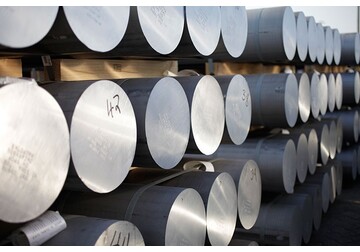
Concerns over shortages are also showing up in physical markets. Premiums paid by buyers to secure aluminum have surged, with surcharges for aluminum billet — an alloyed form used in everything from building components to aircraft — jumping by more than 90% in Europe in the six weeks since the US and Israel attacked Iran, according to pricing agency Fastmarkets Ltd.
Spot prices for aluminum have also risen above futures — a condition known as backwardation that signals demand is outstripping supply. Analysts at JPMorgan Chase & Co have warned that deep production losses are now inevitable, and say this year the market will face its biggest supply deficit in more than 25 years.
How important is the Middle East for aluminum supply chains?
Gulf Arab nations have spent decades leveraging cheap energy to build a competitive aluminum industry, part of a broader move beyond oil and gas exports into manufacturing. Aluminum smelting, which requires vast amounts of electricity, has been central to that strategy.
Countries including the United Arab Emirates, Qatar, Saudi Arabia and Oman are now significant centers for aluminum smelting, and the Middle East overall accounts for about 9% of global production. The two facilities targeted in recent strikes alone have combined capacity of about 3.2 million tons a year, while Gulf Cooperation Council countries as a whole account for more than 6 million tons. Total global production last year was about 74 million tons, with China accounting for 60% of output, according to trade association International Aluminium.
The region plays an outsized role in global markets because most of its output is exported, particularly to Europe and North America. About a quarter of the European Union’s aluminum imports come from the Gulf region. At the same time, these smelters rely heavily on imported raw materials such as bauxite and alumina, leaving them exposed to disruptions in shipping routes.
How has the war affected the aluminum industry?
Even before the direct attacks on facilities, the closure of the Strait of Hormuz had begun to choke off supplies of key inputs. Aluminum production depends on alumina, a white, crystalline powder refined from bauxite ore and imported into the region from countries such as Australia and Guinea.
The closure of the strait has already forced some smelters to curtail operations. Qatar’s Qatalum said on March 12 it would reduce production by about 40%, while Aluminium Bahrain said it was shutting down about a fifth of its capacity on March 15. Industry executives have warned that if the strait remains closed, further production cuts will be unavoidable — potentially pushing prices above the 2022 record.
Its conductivity also makes it an important material in the power industry, particularly in overhead transmission lines. Demand is increasingly driven by growth sectors such as electric vehicles, renewable energy and data centers, where aluminum plays a key role in improving efficiency. This has helped offset softness in other markets, such as construction and infrastructure in China, which has slowed in recent years.
What is the outlook for consumers?
As aluminum is the most widely used metal after steel, a sustained rise in prices would add to the cost pressures manufacturers are already facing due to higher energy prices.
More concerning for the global economy is the risk that deeper supply disruptions could leave some industrial consumers short of specialized aluminum products, forcing production curtailments or temporary factory shutdowns.
The effects are already being felt. Premiums for aluminum deliveries in key markets such as Japan have climbed to their highest levels in more than a decade, while supply is tightening most sharply in higher-cost alloys used in construction, aviation and transport. Several Japanese and South Korean auto-parts manufacturers have been in negotiations with a Russian aluminum producer to try to source primary foundry alloy needed for parts such as wheels, engine blocks and cylinder heads.
Middle Eastern smelters have been a key supplier of these materials, particularly to Europe, but also to the US. As disruptions mount, concerns are also growing about the availability of high-purity aluminum, which is used by the military. Bahrain’s Alba has already said it is reducing production of value-added products — which are used in an array of industries including aerospace and defense — in favor of commodity-grade aluminum, to give it more flexibility in a period of disruption.
bloomberg.com