IMF Slashes Growth Outlook for Gulf Oil States on Iran War Shock
The International Monetary Fund cut growth forecasts for countries across the Middle East due to disruptions stemming from the Iran war and warned that a prolonged conflict could put further pressure on the region’s economies.
Exporters relying on the strategic Strait of Hormuz, where vessel traffic remains a fraction of its pre-war levels, will see larger contractions than those with access to more diverse trade routes, the IMF said in its latest economic projections on Thursday.
The economy of Qatar, one of the world’s largest exporters of liquefied natural gas, is projected to shrink by 8.6% this year, a downward revision of almost 15 percentage points from the Washington-based lender’s October forecasts. Gross domestic product will contract by 6.8% in Iraq and 6.1% in Iran during the same period, the IMF said.
Saudi Arabia and the United Arab Emirates, the two largest economies in the Persian Gulf, are both forecast to grow by 3.1% — downward revisions of 0.9 percentage points and 1.9 percentage points, respectively, from the previous projection.
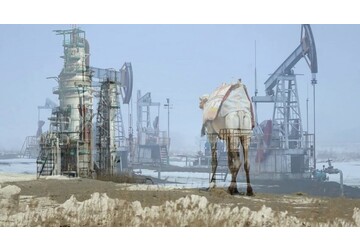
“The closure of the Strait of Hormuz, the disruption of oil and natural gas production, and the severe impact on air traffic to and through the Gulf have all had immediate economic consequences,” the lender said.
IMF Middle East and Central Asia Director Jihad Azour said “the scarring effect” of the war could get worse should the conflict last much longer.
The fund this week cut its global economic growth forecast to 3.1% in the most optimistic scenario, in which the conflict is relatively short-lived and oil prices average $82 a barrel. In the most severe scenario, in which energy infrastructure suffers far more damage, global growth would fall to less than 2%.
The IMF does not have “specific probability” in terms of which scenario is more likely to materialize, Azour said in an interview with Bloomberg on Wednesday. “The reference scenario is the scenario that we have based our projections on, but given the uncertainty around the shock we had to develop another scenario,” he added.
The war, which began with the joint US-Israeli bombing of Iran on Feb. 28, has already left thousands dead. Iran’s retaliatory attacks targeted Gulf Arab states and resulted in damage to key energy sites, including Qatar’s Ras Laffan LNG plant.
The longer-term impact of the war still remains unclear and much depends on whether the ceasefire clinched last week between the US and Iran holds and stability is restored, the IMF said.
“Although the damage to hydrocarbon production and exports is the primary factor, the large downward revisions also reflect lower nonhydrocarbon economic activity, as manufacturing and services (for example, tourism and logistics) are also hurt,” the lender said.
“The war in the Middle East is a severe shock with strong impact on the region but also with ramifications and reverberations across the world,” Azour said. “Countries in the region are not affected in the same way. This is what reflects the asymmetry of the shock.”
bloomberg.com