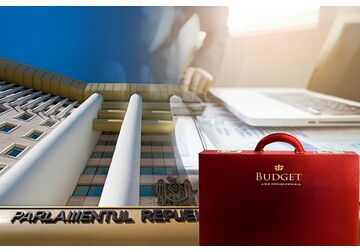
The Moldovan Parliament adopted the draft 2026 State Budget Law in its second reading, with a deficit of 20.9 billion lei (5.5% of GDP)
During the second reading, the key budget parameters approved in the first reading remained unchanged, but some redistribution of funds in the expenditure section was approved. Specifically, state budget revenues next year are expected to amount to 79 billion 674 million lei (+3 billion 877.2 million lei, or 5.1%, compared to the revised 2025 figures), expenditures to 100 billion 574 million lei (+6 billion 556.2 million lei, or 7%), and the deficit to 20 billion 900 million lei (+2 billion 689 million lei, or 14.8%). The 2026 state budget, provisionally titled the "Responsible Investment Budget," focuses on investment, economic growth, and improving citizens' living standards. The document aims to strengthen economic resilience, develop infrastructure, stimulate private sector competitiveness, and promote strategic investments in priority economic sectors. The minimum wage in the public sector will also be increased from 5,500 to 6,300 lei. Public sector employees whose monthly salary, calculated for a position with regular working hours, is less than 6,300 lei will receive compensation payments to cover the difference. The 2026 budget was prepared taking into account a forecast for GDP growth next year of 2.4% to 377 billion lei, average annual inflation of 4.3%, and an average monthly salary of 17,400 lei, which is more than 11% higher than in 2025. In 2026, state budget revenues are expected to increase by 5.1% compared to the current year, exceeding 79.67 billion lei. The largest share of next year's projected revenues—91.4%—will come from taxes and fees. According to the Ministry of Finance, the increase in revenues is due to moderate economic growth, favorable external dynamics, and progress in structural reforms. Expenditures will increase by 7% compared to those planned for 2025, exceeding 100.57 billion lei. It is expected that 93% of the expenditures envisaged in next year's budget will be covered from general state budget resources. Of this amount, over 5.7 billion lei will be allocated to projects financed from external sources. The 2026 state budget envisages an increase in capital investments to over 3 billion lei—the largest amount of capital investment in recent years. These funds are intended for 85 projects in infrastructure and roads, crèches, catering, and kindergarten renovations. 5.6 billion lei from the EU Growth Plan is also allocated for investment projects, infrastructure, and reforms. The largest share of capital investment expenditures—over 47%—is accounted for by the economic sector. It's about 1.44 billion lei, with 81.8% directed to road rehabilitation projects financed from external sources. Another 245 million lei of the total amount intended for capital investments are directed to water supply and sanitation projects. The document also stipulates that appropriations for general public services account for 16% of total state budget expenditures (16.1 billion lei). 74% of this amount is intended for development programs and other sectoral activities - implementation of information technologies; support for the diaspora; financial support for administrative-territorial units, etc. Appropriations in the amount of 14.85 billion lei are envisaged for services in the economic sector, which is 25.8% more than the adjusted appropriations for 2025. Accordingly, 1.06 billion lei are directed to activities to support small and medium-sized enterprises; 561.8 million lei - to the sector of electricity generation and storage; 465.2 million lei - to the National Fund for Agriculture and Rural Environment Development; 284 million lei - to the National Fund for Regional and Local Development, etc. About 9.8% of the state budget expenditures (9.89 billion lei) are intended for healthcare. The funds are intended for the development of an integrated regional network, the implementation of electronic medical records, a system for monitoring and tracking medicines, expanding access to innovative drugs, etc. Also, 21.94 billion lei are intended for education, including 238 million lei for free meals for gymnasium students, 35 million lei for increasing scholarships for schoolchildren and students, and 41 million lei for the renovation of kindergartens. 22.47 billion lei will be allocated for social protection. During the second reading, the bill was supplemented with amendments from MPs. 81 amendments providing for additional expenditures were registered. At the proposal of MP Radu Marian, an additional 20 million lei were allocated for the Bridge Export program. MP Liliana Nicolaescu-Onofrei proposed allocating 3.5 million lei for the renovation of one floor of the dormitory of the Academy of Music, Theater, and Fine Arts. MP Maxim Potârnice proposed allocating 12 million lei for the development of a feasibility study for the Arena Națională National Stadium project. An amendment by MP Vladimir Odnostalco was also adopted, increasing the allocation for transport cost compensation for persons with disabilities by 15 million lei. An amendment by MP Olga Ursu was also adopted, allocating 5 million lei for the reconstruction of the Triumphal Arch in the capital. Furthermore, amendments by MPs Valentina Meșină and Eugen Sinchevici concerning the allocation of funds for youth centers across the country were supported, as was an amendment registered by Vlad Bătrâncea, allocating 3 million lei for equipping forestry enterprises with drone systems for the sustainable management of the country's forest resources. The state budget deficit for 2026 is estimated to be 20.9 billion lei. Its main sources of funding will be both domestic and external.// 29.12.2025 — InfoMarket